Chris Chivers (Thinks)

  • Home
  • Blog-Thinking Aloud
  • Contact
  • Contents
  • PDFs
  • Sing and strum

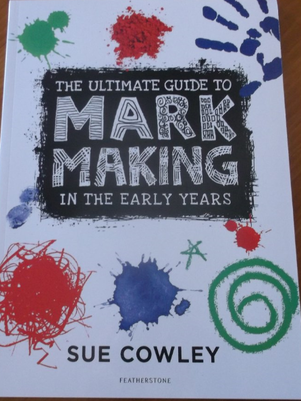
Review; The Ultimate Guide to Mark Making

11/6/2019

0 Comments

 
Picture

This new book, by Sue Cowley, is a very timely addition to my library. As a Governor of a Primary school, this will provide a huge boost to discussion on mark making with our EYFS children. The book provides a clear structure, with eight chapters starting with the idea of mark making as a form of communication through to letters, words and sentences. In between, the chapters develop different aspects of the mark making process, supported by a wealth of ideas on resourcing and organisation.

Sue makes the very important link between developing dexterity through handling objects, real life objects that demonstrate mass and volume, requiring different handling techniques. The development of finer motor skills is supported by simple activities like tearing paper.

Idea; this could be newspaper, which can then be used for papier mache, or tissue paper, to be incorporated into a collage; sea or sky from torn blue strips. Torn newsprint can be printed to make rocks, the whole incorporated into a wall display. Providing an additional purpose encourages involvement.


Using a variety of objects to make marks, Sue encourages mark making on different surfaces, but then adapting to use natural materials, such as feathers or sticks to manipulate paint. Zips, buttons, laces, threading, all add to developing dexterity.

​There are very useful ideas boxes throughout the book that focus on different aspects.


Gross motor skills and hand-eye coordination can be supported by throwing and catching balls or bean bags with a partner, passing balls between legs or over the head to a partner, or in a row. I’d add keeping a balloon in the air, using light muslin hankies to throw into the air and catch.

Idea; maybe playing a game that our French exchange partners called “tomate”; standing in a circle with legs apart, the object is to stop a ball passing through your legs. Both hands can be used. If the ball passes through, one hand goes behind the back, then two hands, then out…

Different materials are used to provide varied sensory stimulus, wet and dry sand, clay and plasticine or playdough, clear water to move or soapy water to explore the difference. Gardening and getting hands mucky to a purpose.
The book then goes on to develop more formal mark making, using different markers to explore the underlying shapes that eventually will form the basis of letter formation; verticals, horizontals, diagonals, circles, pushing, pulling, pressing. Working anticlockwise accentuates letter formation.

Idea; how about “magic colour shapes”, overwriting an initial shape in a variety of colours? This can be developed as “magic colour letters”, as names or specific words.

Idea; lines in tree rings. Draw a shape that represents the first year of growth of a tree. Repeat with a second line, trying to follow the first. Continue for perhaps ten years of rings. These shapes could be drawn from real life by cutting an onion in half, or maybe a cabbage as a real challenge?

The important message from Sue’s book is to make children confident in having a go; trial and improvement are the basis of all learning.

The book will provide a firm structure for a school to audit its culture, or for any trainee working with EYFS, probably year one, any activity ideas firmly embedded in process. It will definitely be shared with the school where I am a Governor and add to our articulation of expectations.

 
0 Comments

Do system Changes Militate Against School Development?

3/4/2019

0 Comments

 
Picture
As a school Governor, I am involved in staff appointments. We are currently looking for an Assistant Head Teacher for Teaching and Learning; Curriculum Development, our previous, very good AHT having been promoted in another school. What such an activity does is to create opportunities for broad and deep discussions about the details of teaching and learning, particularly in the context of the school and its point of development, both before and during the interview process. It was during one interview that this thought was generated.

I have touched on this idea before in a blog entitled “Tribal memory”, where staff loss can be debilitating.
Picture

Teaching and Learning and curriculum development have been the bread and butter of my whole career. You decide on a range of “stuff” that you consider children need to know at particular points in their lives, then decide the best approach to making sure that it “sticks”. Knowledge is broad and the accompanying pedagogies are equally broad.

Schools therefore have had to make strategic decisions. Some of these are likely to be general, in that the “knowledge” in different curriculum areas has been relatively consistent throughout my career, in Primary this can be broadly summarised as variations on Maths, English (R,W,S&L), Topic (H,G,Sc lead, Art, DT interpretation), Music, PE, RE, MFL.

In school and curriculum development terms, the key can be the availability of colleagues with appropriate background to be able to, at least, map out curricular development statements, if necessary, drawing on broader collegiate expertise within and outside the school. This may be particularly acute in smaller schools.

One interview raised the question of personal ambition as a potential drag on development. It is conceivable that, after a period of leading development in one subject area, an experienced teacher might be asked to then oversee an area that had received less attention, in so doing relinquishing responsibility to another. Equally, another teacher might be brought into a school and will wish to “make their mark”, with an eye to their own future promotion prospects. In either case, there will be a hiatus, as stock is taken and proposals made for “improvement”. This could be seen as “change”, a regularly used word in education.

Whereas improvement implies a strategy, unless a comprehensive strategy is articulated, change can become distracting; wholesale change can mean abandoning what went before. As a result, nothing gets fully understood or embedded.

This can be as a result of Government decisions. I'd quite like Government to hold back from initiatives, allow teachers to take stock, to be able to plan securely, in order to put in place structures that can stand the test of time, by allowing consideration of improving parts rather than wholesale alterations every few years. 

​I would still contend that much of the 2014 changes wrought on education were change for change’s sake. After five years, the impact has led to poor implementation in SEND and Ofsted altering their 2019 approach to look at the broader curriculum. Strategy is complex, a bit like a Gaia principle of “wheels within wheels”. Knee-jerk alteration in one area has a knock on into another, often causing unintended, or unforeseen consequences.

School managers need to plan development with care, mapping clearly how different elements work together, seeking to avoid duplication of or wasted teacher effort.

Distraction destroys continuity. Continuity and progression were by-words of my school career; progressively building from one phase of education to the next, within an overall aspiration for all children.

To illustrate this, I now draw on the “Learning and Teaching” policy that was my school’s articulation of purpose. It was set as a central plank that supported developmental colleague dialogue, enabling discussion of detail without distorting the whole, or the proposed learning journeys through a child’s life at the school.

While no statement is perfect, it gave clarity to teachers appointed to the school. Communication is key to development, from overall strategy to the detail of a specific area. If teachers are informed, they can support the strategic direction.

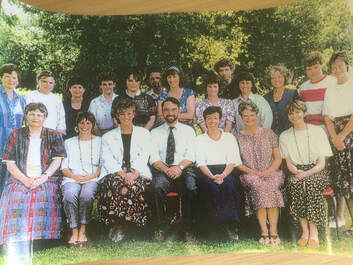
The "class of 1993"; stability supported development, embedding qualities that survived change.
Picture
Learning and Teaching Policy (first articulated 1993, developed to 2005)
A Statement of School Vision

Everyone involved with the educational process at X School is a partner in progress
This, in terms of children, is encompassed in the motto Thinking, Working, Playing Together.
Educationally making guided progress, through individual and group effort.

Our Aim
A typical child leaving X School will have these attributes
Confidence in themselves, as people and learners.
Awareness of the world around them, locally and wider, showing sensitivity, an enquiring approach, and a developing sense of awareness of themselves as spiritual beings.
Capable of working in many different ways, with different grouping of others, and be able to sustain effort when required.
Solve problems with different, but developing, levels of independence.
Think creatively and reflectively when appropriately challenged, organising their needs, and being able to talk clearly to anyone with an interest in their activities.
Accept guidance to achieve the best they can, with a clear understanding of their strengths and areas for further improvement.

A policy for learning, achieving the vision
Children, their thinking and learning, are our core purpose, within the context of a broad, balanced and relevantly challenging curriculum. They are to become active producers of learning, rather than passive consumers of teaching.
Children will start as information gatherers, capable of clear description.
Children will progressively become problem solvers, applying a range of relevant skills, able to articulate clearly in speech and then writing, the detail of their learning, and to have a developing repertoire of presentational skills through which they can show their ideas.
Careful consideration of information, and logical thinking, together with the ability to explain their thoughts, using 2-D or 3-D models, will lead to secure links in learning.
Learning processes will be clearly articulated to children, who should be able to explain what they are doing, and why.
The processes through which the children will be challenged will be known to teachers, parents, support staff or any other assisting adult.
The potential for learning across and between different abilities needs to be maintained, to ensure that children derive learning from as many sources as possible.
The taught curriculum will be well taught, with teachers working to improve their personal skills and practice across the curriculum.
ICT in all its forms will be a central tool of development.
The school and each of its constituent parts, will see itself as part of a wider learning community, deriving information and good practice from sources that complement our own developing practice.

Putting the vision into practice
Teachers at X School plan to ensure that the vision and aims are put into practice, employing methodologies outlined in the policy for learning, through an approach summarized as Analyse, Plan, Do, Review, Record, Report.

Analyse… Teachers will receive information from a range of sources about the prior attainment of each child. This will provide a framework upon which to base decisions about working arrangements, suitable objectives for learning and tasks to achieve these.
​
Plan… Teachers plan over different timescales, annual, based upon allocated topic specifications. It is for individual teachers to use these specs creatively to provide a dynamic approach to learning.

Picture

​Contributing to school level Planning Detail;
see blog on “Planning”

Whole of National Curriculum interpreted through School-based Topic Specifications for each topic within each subject.
Literacy and numeracy frameworks.

Planning at different levels (teachers)
Content
Learning needs
Space, timescales and resources

Do… Tasks given to children will be creative, challenging and engaging, leading to anticipated progress.
Task design. Tasks will have a definite purpose in progressing an aspect of a child’s progress, known to the child and any assisting adult.
Activity presentation. All activity will be clearly presented and understood by children before being active.
Independence levels, skill, knowledge and attitude will all be considered when devising the task parameters, as the different learning attributes of individuals and groups should be encompassed in the task challenges.

Children as learners
Understanding task… Children will have a clear grasp of what they are being challenged to achieve, be able to discuss and articulate purposes when asked.
Task behaviours… Children will be expected to demonstrate appropriate approaches to tasks, developing persistence to achieve.
Team working… Children will be challenged to operate as collaborative, independent learners on tasks specifically created to allow for qualities of cooperation to be developed.
Oral skill…Children will develop appropriate descriptive, analytical, exploratory languages to communicate clearly to a peer or interested adult.
Recording skill, written, pictorial, mathematical…Within any learning experience there will be opportunities for children to use different forms of recording to help them to remember sequences of events within an activity.
Evaluation… Children learn about learning by doing, by reflecting on the process and activity, and evaluating changes to approaches for future reference.
Review… Children will develop as primary evaluators of their drafts. Peer reviews will be developed over time, with the teacher giving informative feedback to help with the next phase of development.
By being given tasks that they will need to discuss, decide on action, carry out, review, re-evaluate and repeat, they will develop an insight into the ways in which adults work and solve problems.

Outcomes..Review
Teacher as reviewer and quality controller…Any piece of work from a child is the current draft capable of being reviewed and improved. Ongoing oral feedback should support the child within the learning process. Marking should provide opportunities for advice, and an overview of quality.
Feedback to children…should enable each child to review their own needs in learning for subsequent pieces of activity.
Room for improvement… advice on areas for development.
Objective and subjective…Correcting spelling or an aspect of grammar may be clearly objective, whereas a commentary starting “I liked…..” would be subjective.

Moderation…At intervals it is clearly good practice to share views on achievement. Moderation allows a consensus view about a discrete piece of produced work.

Record… Teachers will keep records which assist them in progressing learning for individual children.

Report… At half year and year end, teachers will write reports to inform parents about achievements and room for improvement.
​
Review, Recording and Reporting, especially individual needs
To colleagues
To parents
Significant others
Picture
0 Comments

Planning For Students

26/2/2019

0 Comments


I am just back from a day of visiting students on their final teaching experience and have spent the day considering the idea whether trainees should plan their own lessons, from a few elements that arose.

I would have to say that this has exercised my thinking at different points in the past thirteen years as a link tutor, for universities, Teaching School Alliances and a SCITT.

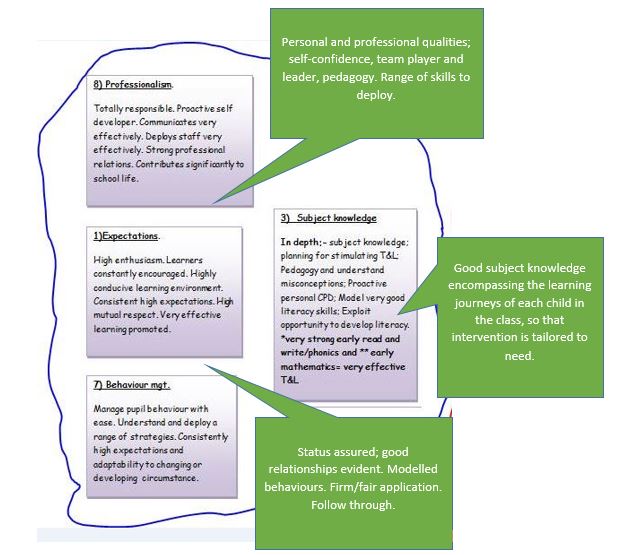
This thinking has been premised on a relatively straightforward notion; how does one get better at thinking about being a teacher? Teaching is a multifaceted set of demands, beyond the personal attributes of professionalism (TS8), behaviour management (TS7), having expectations (TS10) and subject knowledge (TS3).
​

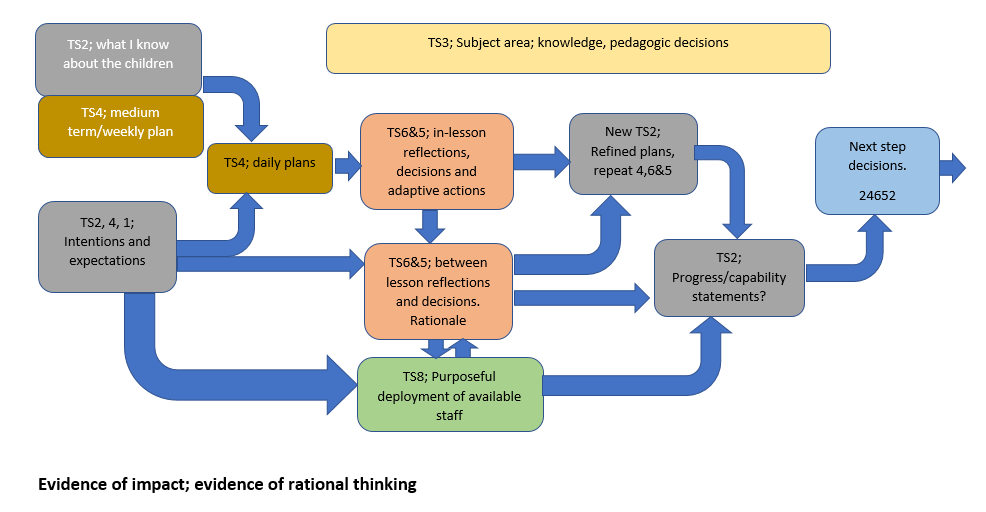
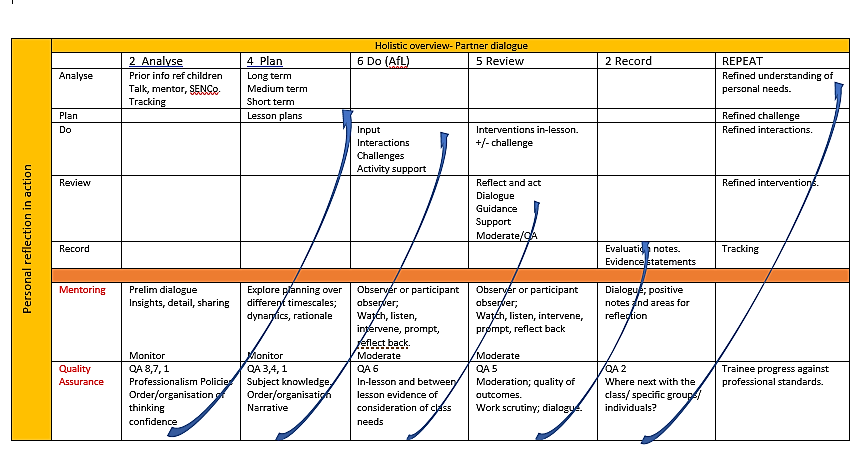
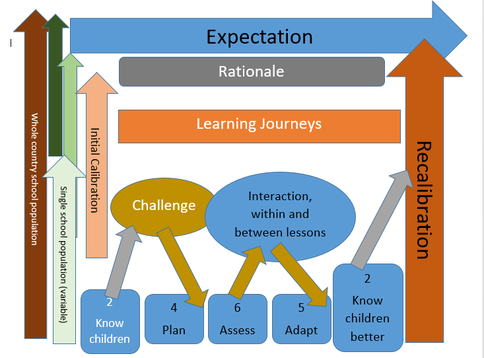
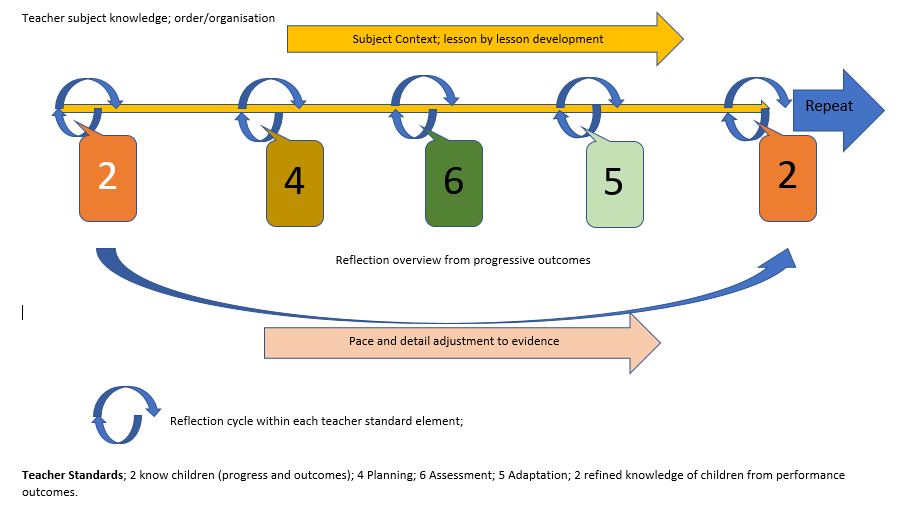
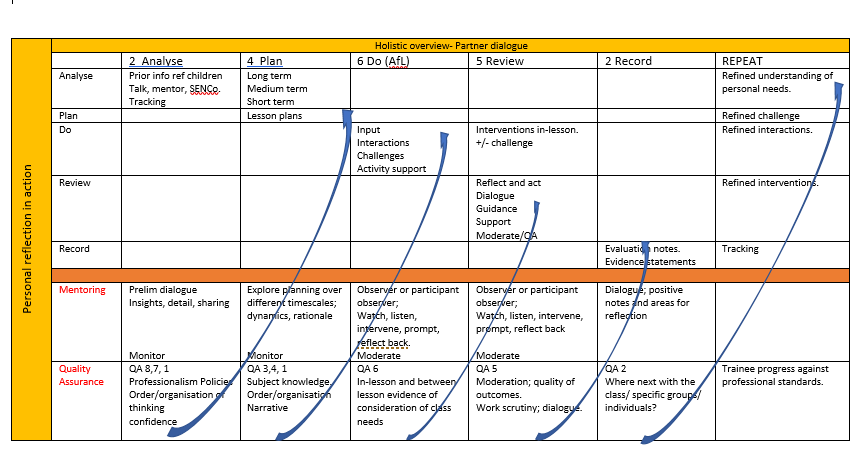
It’s very hard to describe a dynamic event in a 2D diagram, but a while ago, I sought to describe the idea of impact, to help trainees explore the thinking elements of teaching in a way that would fit with their day to day experiences and came up with this…
​
Picture
Trainees often find themselves in a 2 or more form entry school. On occasion, these schools allocate specialist responsibilities to each other to write the plans for the year group, which suits a settled team, especially where the plans are reviewed in the light of previous experiences. However..

·         Plans are a distillation of broader thinking.
·         An experienced teacher should have the capacity to interpret the narrower plan into a more holistic whole and add personal value to the plan.
·         An inexperienced teacher or trainee may take the plan as a whole and find themselves in difficulty if children start to demonstrate that they are insecure in learning.
​

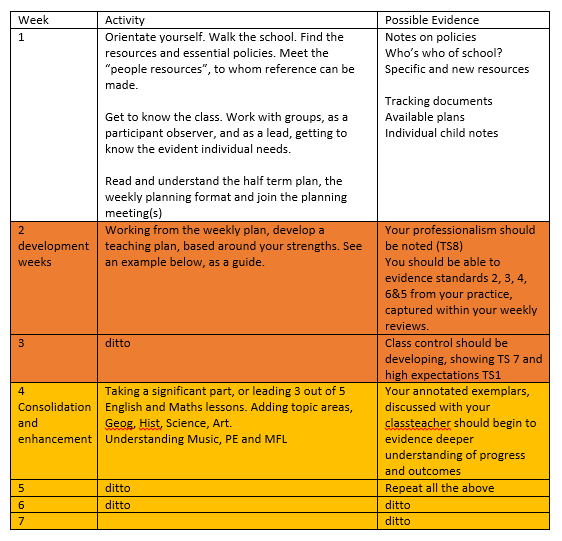
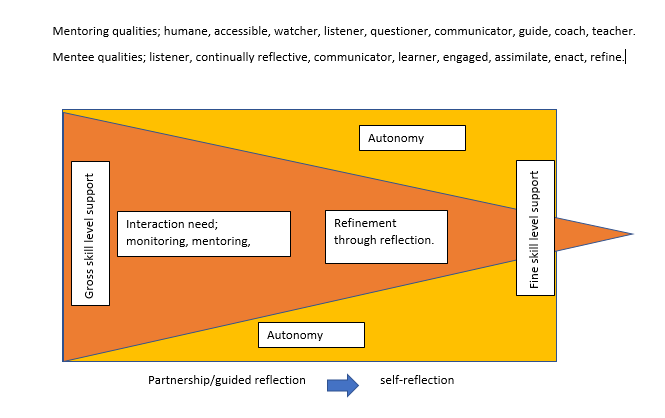
Trainees and NQTs are learners and need support, as per this diagram.
​
Picture

Trainee placements are in disparate schools, with variable approaches to planning and other school elements. The best that a training organisation can do is to provide generic advice on these, with the understanding that the trainee will encounter different realities in different schools.

They therefore need mentoring into planning in the school style and will still do so in their NQT year or even as a new appointee. The assumption that anyone is “ready-made” is misplaced.

Trainees, at the end points of their training may be offered the opportunity to plan a theme over a period of time, where they can explore all the different dimensions, but equally it is likely to be already decided. They still need to be taken through the process to fully understand the pre-determined lesson plans, in order to extract the essentials for their own lessons.

It shouldn’t be a magical mystery tour through someone else’s planning idiosyncrasies.

They also need to know the children to be able to calibrate their challenges and to be able to consider when children may not understand something.

Rather than argue that trainees should be following detailed school plans, I’d argue that both the trainee and the mentor gain a great deal from the reflective journey of mentoring and coaching, reviewing the school approaches.

Schools need to talk with trainees about their planning approach.

​It’s the bread and butter of their existence, but should be capable of review, even within the learning journey of a trainee. It should be based on easy to understand concepts.


Order and organisation (TS4) is fundamental to good teaching for progress. Disorganisation or lack of understanding of the nuances of the intended plan have more often been reasons for a trainee receiving negative feedback from an observation. Where they have receive the plan from a colleague, they do often feel aggrieved or let down. 

 Evidence of Impact? Rational thinking...
​
0 Comments

A Cautionary Tale; are they ready?

28/1/2019

0 Comments

 
Picture

After a lifetime of dedication to the cause of education,
I’m feeling much frustration at the machinations of an administration,
And the implementation of education policy based upon the fiction that all learners have a disposition
To arrive at the same fictional destination at the end of a phase of exertion;
By that token, many don’t arrive in Early Years “school ready” so have even further to travel!

For some the cause of celebration,
For others a feeling of desolation,
Being told they’ve missed the accumulation of marks,
In addition, subtraction, diction or story creation.
(The other subjects aren’t measured, so don’t count)

The prescription of specified method; by default the proscription of others,
Feels like the confiscation of tools which worked in the past, and still do,
Especially where the curriculum needs personalisation.
The thinking teacher’s invention or adaptation of an idea,
Helped the visualisation, by the learner, of complex concepts,
From which the child’s own imagination could indulge in acts of creation,
Exploration and experimentation, sometimes of invention,
Often through collaboration, supported by the intervention of an aspirational adult,
Determined to harness the combination of exertion and deliberation,
With a soupcon of consolidation, to arrive at a destination,
Worthy of celebration and appreciation.

The demonisation of a school of thought,
Seen as the antithesis of tradition,
Has allowed a faction to develop, determined to create a new fiction,
Tradition good, progression bad, in contravention of common sense.
Real education is a balanced, nuanced affair, an oscillation between the two extremes,
Teachers selecting the best tools for the job, just like any master craftsman,
Dedicated to the cultivation of a living tradition.
Education is the sharing of the accumulation of understanding across time and space.
The world in which, without direct explanation, they learn to walk, talk, look and explore.
Their natural disposition to be curious, enjoying exploration, experimentation, discussion,
Expanding vocabularies and concepts through vocalisation,
In environments where error is the cause of reflection, adaptation and active intervention,
To ensure correct interpretation.

It starts with parents and the home, continuing with a school’s help.

The teacher organisation of the available space and resources,
Coupled with their interpretation of records, their perceptions;
Anticipation of the disposition of each child,
To decide whether individualisation of challenge will be needed.

Good teaching is a complex action, where the reactions of the learners can help or hinder the flow.
Good learning requires exertion on the part of the learner, in the clear knowledge of the destination,
Or direction of travel, the co-creation of a visual map,
For a specified duration. 

Intervention may lead to the need for consolidation or reinterpretation, to avoid a period of disaffection or alienation, both unhelpful to learning.

Celebration of outcomes might include the admiration of peers,
An appreciation of effort, capability or talent.

Good learning is only a competition with oneself.
Self-awareness, self-belief, self-reliance,
Being responsible for oneself, for how others and the environment are treated.

Just getting better every day.
0 Comments

BrewEd early Years January 2019

20/1/2019

0 Comments

 
Picture

Thanks to the good offices of Simona McKenzie whose Twitter handle is @signoramac, there was a gathering at The Alexander Pope hotel in Twickenham to discuss Early Years issues. By no means an expert, I wanted to avail myself of the collective expertise and I wasn’t in any way disappointed.


There was Sue Cowley (@Sue_Cowley), Dr Lala Manners (@MattersActive), Ali McClure (@AliMcCureEP), Bethlyn Killey (@StarlightMcKenz) and June O’Sullivan (@JuneOSullivan). It was good to see Sue and Bethlyn again, after significant gaps between events, but equally interesting to hear the view of a broader group of speakers.

Sue Cowley gave a barnstorming opener for the day, as she put it, a bit of a rant, particularly about the general direction that it can appear that even early educational experiences are talked of in more formal terms, with testing and more structured “delivery” models being interpreted as “what’s wanted” from the “powers that be”. That this is external and top down can give the pronouncements greater weight, which in turn becomes interpreted into localised approaches, which, whether “liked” or “disliked” by the inspection regime, inevitably becomes the stuff of the local grapevine with other local providers changing to anticipate the needs of their next inspection, simply because no-one wants to be found wanting.

Topicality is the stuff of young lives, something that they have seen, heard or found and want to share with others. Equally, the adults will also want to bring in items of interest that will generate interest and inquiry. Sue spoke of “door handle planning”, in this context. Sue has a healthy scepticism of what is asked by others without the expertise in the age group.

Lala Manners is a professional who has links with Government decisions in the area of Physical Development (PD). With Sue, Lala shared the values of physicality in young lives, with specific mention of avoiding obesity at young(er) ages. In this regard she made reference to the need for EYFS professionals to be role models. One would think that getting children to be active would be one of the easiest things to organise, but the discussion moved to packaging of approaches, so that they required some form of preparatory training in order to deliver the programme.

While space can be an issue for some settings, there are many ways in which PD can be enhanced with limited equipment. Running and jumping are probably the easiest, dance can be supported by music and movement, as it was for many generations of children. General movement can be directed within a space, perhaps with floor markings helping instruction, or even masking tape, as a “balance beam”. Putting out scaffold boards, with bricks to enable them to be raised, can add to the balance challenges. Throwing stones or other natural objects (fir cones), balls, bean bags into a bucket. In many ways, it’s often limited by teacher imagination.

In my own mind, I linked physical development with literacy. I wonder how many teachers have considered that movement PE provides some of the oral base for many verbs and adverbs in describing movement that can be drawn into reading and writing?

Ali McClure worked with a wide range of ideas drawing from her career. She is a practising SENCo, as well as EY specialist and EP, so brought ideas about brain development through stimulus. While some colleagues might have argued with some interpretations of the internal workings of the brain, the idea of stimulus and vocalisation leading to some kind of mental schema organisation was central to Ali’s discourse. Using the term “Anchor of Attachment” made me think about the place of educational settings on the lives of children. For a number, the order and organisation of the setting may well be one of the few oases of calm in their lives; settled staffing, room organisation, resources and opportunities and understanding their place within the organisation can be stabilising factors.

Bethlyn Killey is well known to Twitter, as a strong questioner of SEND legislation and opportunity, or the lack, within the broader system. Bethlyn use the example of her son who had had nine settings by year seven. He’s now in a much better place, thankfully. The process of getting to this stage has been effectively analysed by Bethlyn, utilising the skills drawn from her work life. It is a salutary experience to listen to someone trapped in the complexities of EHCPs and the endless seeking of access to the relevant specialists, or advice, then to find school settings capable of addressing identified needs, but also to be aware of the potential for further diagnoses. In an education system that is gradually losing expertise, even staff in senior positions might not have had experiences that enable them to fully adapt their approach to the new needs. The system established in 2014 is complex, appears to offer a great deal for children with needs, yet often lacks the essential external expertise to support non-specialist staff. It is also budget constrained, as is regularly evidenced by contributors on Twitter.

When Bethlyn finished her talk, there was a collective gasp, as if we had all been holding our breath. It was more moving because it was her real-life experience.

June O’Sullivan was reticent to follow such an emotional experience, so we had a short break for refreshment or comfort.

June was another contributor who has the ear of Government. Her company runs a significant number of EY settings across London, including the House of Commons. Her brief was pedagogy and she took us on a journey that explored the philosophical background to pedagogies currently available. June is very down to earth, though and her approach is very child based; children doing, making, experiencing, exploring, discussing. She talked of dialogic reading as her philosophy, getting children into books. With over 100 languages across the settings, speaking is a key aspect; a mantra that I express as, something to think about, talk about, record (write?). In fact, the teaching and learning approach that she shared would have been seen in many successful mainstream primaries in SE Hants in the 80s-mid 00s. June’s organisation runs its own training for staff, calls each member of staff a teacher, so giving equality of status. It was always going to be the difficult “twilight” slot, but such was the knowledge base, delivered with humour and humanity, of June’s talk, that she held us over the planned finish time, yet the time passed very quickly.

As a first, Simona McKenzie can count BrewEdEY as a significant success. Thanks Simona.

All the speakers encouraged dialogue within their talks, so the significant collective expertise could be brought to the fore and available for everyone. Thanks to everyone for such a positive day; even on a Saturday… I was pleased that the Munster-Exeter rugby was still running on Channel 4+1 when I got home… even if it was a disappointment that Exeter lost…
​
Picture
0 Comments

Reflections on school Visits; Behaviour Systems

24/11/2018

0 Comments

 
Picture
Everyone needs someone to talk with?
 
In watching my Twitter feed over the past few days, it has been interesting to note the concerns raised in response to some colleagues coming together to express concern about the use of excessive isolation for some individual children. It made me go back to a number of school visits that I made with inclusive practice in mind. Perhaps it’s always better to look at realities rather than just to express an opinion. I am happy to accept that the schools concerned were wishing to demonstrate their inclusive credentials, so will have been a self-selecting group.
 
In no school, out of over fifty visits, did I encounter isolation facilities. The closest example would be a school that set up a restorative centre, in a small building at the centre of the school where children could either be sent or take themselves, should there be a need to do so. There was always at least one member of staff on duty, available to offer a listening ear. Other staff were available around these listeners, to provide greater help as needed. For some children, being able to articulate their feelings and needs was sufficient for them to see a way to resolve what they had perceived as a problem. For others, who needed signposting to wider help, resolution took longer, but identification, advocacy and coordination helpd to reduce the time between identification and help.
 
I am struck by the similarity of approach with the Samaritans, available to listen to people in need. This is also available in prisons, with prisoners acting as listeners to others. Articulation of a problem can sometimes put it into a practical frame with commensurate practical actions to be taken, in order to resolve the issue for oneself. Articulation also allows another to question further, to seek additional clarity.
 
In looking at this area, we have to accept that each school operates in a specific context, which includes the community, families, and available staffing, so each has to determine internal practices that address issues that arise. Current school funding may well be putting pressures on school ability to provide nuanced support to individuals. Sadly, this can lead to off-rolling as an alternative to supporting a child through their personal issues.
 
The route to exclusion should be well documented for most children, especially where issues are identified as persistent low level. For this, clear documentary evidence should be kept, for future reference as needed. I’ve appended a copy of an earlier blog that seeks to do this.
 
There are occasions, in any social situation, and we should recognise schools as always being a microcosm of their context, where the issue is immediate and dangerous, so requires immediate response to keep others safe.
 
In simple terms, every school decision should be capable of justification in the face of robust challenge, with evidentiary statements available for external review; in the first instance the school Governing Body, especially if faced with parent requests for review or complaint.
 
 
School 1
There is much evidence of creative and innovative practice. This is broadly shared within a staff seeking to develop its own capabilities. Within a challenging environment, staff often exceed what might reasonably be expected. This is fully recognised by parents and students, who expressed fulsomely their praise for the staff, individually and collectively.
 
Staff development is a strength of the school. Starting from being valued for the role being undertaken, staff accept challenge, which is not only met but often exceeded. Individual staff are enabled to take on responsibility, supported to succeed and enjoy personal growth as a result. This is a staff with considerable personal and collective expertise. They also present as happy, throughout the staff group.
 
Innovative practice is encouraged from all categories of staff.
 
There is much joined up thinking, with staff articulating their working relationships with others. This was particularly evidenced in conversations with the staff who are involved in Inclusion, where each found ways to describe how they work together for the good of children. This was endorsed through other conversations focused on curriculum entitlement, where children are supported to succeed. All conversations had a focus of building capacity, taking personal responsibility, good communication, demonstrating that each child in this school has an identifiable Team Around each Child, should they need that level of support, always looking to enhance opportunities.
 
Joined up thinking is also evident across other aspects of the school, with staff describing how roles interlink and sometimes overlap, to ensure coherence and consistency as well as a high level of adaptability to personalised needs. This was clearly described with regard to KS4 routes. The discussions about the timetable also showed flexible thinking. The timetable does not create curricular constraints.
 
The staff are enabled, supported and challenged to ensure that the best possible opportunities are created for children, that, where possible, barriers to progress are identified and remedied to minimise the impact of disruption. The whole staff are the eyes and ears of the systems. They are vigilant, proactive or reactive as necessary or possible, developing functional capacity in the child, the family, with support, or the school, where individual staff may be coached in specific skills.
 
Documentary evidence shows the interactive approach that is taken within the school to ensure that all vulnerable children are identified and supported through an internal Team Around the Child, as well as utilising appropriate external agencies for focussed work, both inside and out of school.
 
Inclusion Group descriptor
 
Multi agency meetings scheduled termly
Regular meetings with outside agencies re individuals, to help in overcoming barriers to learning i.e. Speech and Language Service, CAMHS, YPSS, YoT, Connexions, Social Services, EWO
Extended Services Core offer & Freetime Project
Extra-curricular uptake is high
Annual Reviews – SEND
Parents meeting with SENCO/ GLs / Inclusion Manager re bespoke programmes for students 
School nurse
 
School 2
The enriched curriculum is evident and the search for quality outcomes is a feature of a walk around the classroom areas, which benefit from a range of well put together displays. Children’s work in progress shows an attention to detail and care in finishing.
 
Words and phrases that come to mind when thinking of The F Education Centre include: -
 
Humanity, empathy, complex, personalisation, order and organisation, enriched curriculum, adaptable, creativity, stability, complementary, rigour, fun, expertise, valued, trust, communication, excellent information, distributive management, reflective, coherent, sensitive, independence, participatory, articulate, visionary, opportunities, clarity, team, expertise, problem solving, integrated, coherent, normality, humour, humility, spirituality.
 
These can be summed up as people matter and a personalised approach as the default position.
 
These are essential characteristics of the staff team, who work tirelessly to ensure that the pupils attending the Centre are given the best possible opportunity to succeed. There is a significant team ethic, trust and collegiate approach, which ensures that each team member is supported by the whole group.
 
School 3
The college policy can be summarised as a dynamic continuum. There is 1) rigorous analysis of evidence leading to 2) detailed planning, including the provision of appropriate resources and staffing. 3) Students are actively sharing in their learning journey, which is 4) tracked and reviewed at regular intervals with 5) accurate and detailed records being collated and disseminated, allowing the process to be cyclic and developmental.
This process has been evolutionary, with some avenues having been explored, adapted to need or rejected, if not useful to college development. As in all college development, mistakes were the catalyst for rigorous consideration.
          As a result, Inclusion is evident in every aspect of college life, ensuring that Every Child Matters and, as an extension, that every person associated with the college is also fully valued.
 
SEAL is an integral part of college life, ensuring that Emotional Literacy is embedded within the inclusion aspects of college life. This includes active engagement in restorative conversations.
TAs have many individual specialisms, enabling them to be a strength of the system, supporting pastoral and learning needs. Many have been developed to become significant members of staff, including through GTP routes into teaching roles. The college supports staff personal growth.
 

Picture
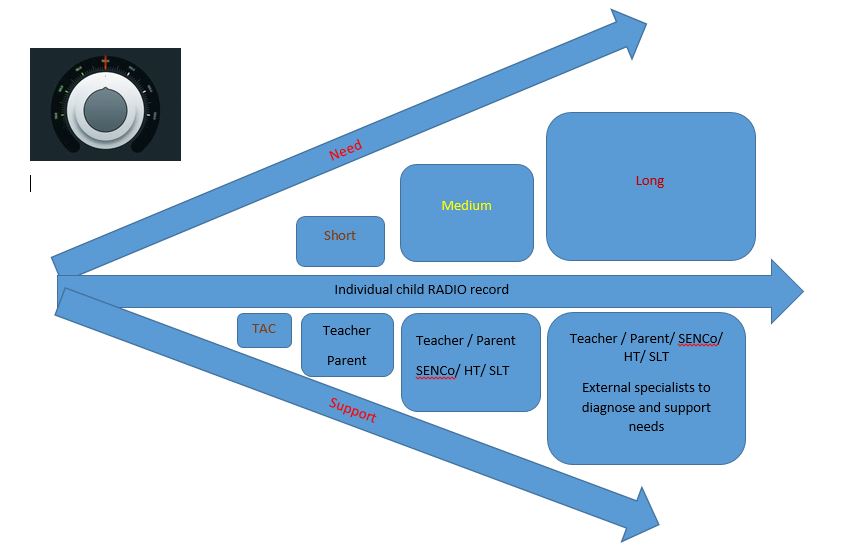
Seeking greater clarity by fine tuning actions through a

Record of Actions, Discussions or Decisions, Interventions and Outcomes

(RADIO, in case you missed it!).

Building an individual case study.

Essentially, SEND practice describes a sequence of events, which seek to refine the actions and focus of attention, to identify, quantify and qualify the exact nature of a problem. Once this has been established, remedial action can take place. The longer the gap, the greater the problem can become, as further complications can become built into the experience, not least of which is learner self-esteem, affected by adult and peer responses to the circumstance.

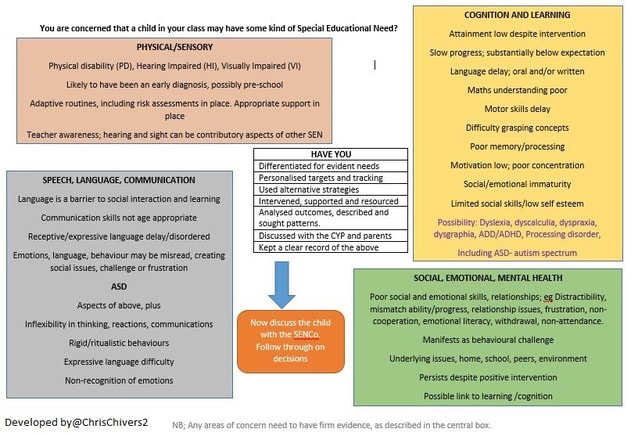
Every teacher is a teacher of individual needs, which often identify themselves as little concerns when a learner either exceeds or does not grasp what is being expected.

The SEND framework 2014 does state that poor teaching approaches will handicap decisions on a child’s special educational needs. SEND is not a substitute for poor teaching or poor teachers. High quality teaching and learning should identify, describe and track needs within a classroom. Work sampling, annotations and record keeping will all contribute to good decisions. Some may say that this is additional work. However, it could be argued that well planned, well focused activities, with good oral and written feedback, to identified needs, in itself constitutes a reasonably clear start point of a record. An annotated personal record, for discrete individuals, as describe below should also be kept.

Teachers receive their classes from someone else, even at the earliest stages, where a parent or nursery member of staff has already become aware of little foibles, or gaps in understanding, or an area where there appears to be extra talent.

The parent is the child’s first teacher; it is to be hoped that their relationship is such that they get to know their children really well, through interactions at home and in places of interest that generate speaking and listening skills. As a Governor of a school in Gosport, as well as my own education career, I know that this is not the case, with children arriving operating at two year old levels, of speech and socialisation.

The adult role, teacher and support staff, is to be vigilant in spotting the child reactions in different situations, noting areas of concern, but also of achievement, so that a balanced picture can be built. The profiles built up during the Early Years stage is a more refined document than may have formerly been available.

If concerns emerge, there are likely to be three phases;

1.    Short (wave) term, classroom based. The teacher and other adults become aware that an area of need exists. They develop a short-term plan to address the issue and agree a monitoring approach that allows them to spot and track the outcomes. Where feasible, discussions with the learner might deepen the adult understanding of the learning issues. Outcomes are checked carefully to deduce any patterns arising, which are then shared with parents and decisions reached about next steps.

2.    Medium (wave) term, involving internal specialist colleagues. Where an issue goes beyond the current capacity of the classteacher, the school internal specialist, the SENCo, should be involved to oversee the record, to discuss with the teacher and the parent possible ways forward and to agree a new plan of action in the classroom. This may involve using a discrete approach to the identified problem, with some specified time need. For example, a child with a specific reading issue might need some individualised time with an adult, whose role is to undertake a miscue analysis during each session to deduce with greater accuracy the nature of the problem. The SENCo may be involved in classroom observations, keeping records of on/off task behaviours, relationships, task application, with outcomes being photocopied and annotated to deepen the understanding of the problem, thereby refining the classroom action. Interventions strategies must be SMART targets. Too often in SEND situations, classteachers operate at too global a level, so that the refined needs of the individuals are missed, until they become more critical. There is a need for regular work sampling and annotations to describe the learning journey and issues still arising. The lack of such a record could handicap a child and the teacher, as it will be requested before specific help can be offered, especially if the school SLT has to allocate additional funding/adult support to address the issue.

3.    Long (wave) term, the school will involve a range of specialist experts, to support the diagnosis of the issue. Diagnosis depends on the quality of record keeping in the classroom and the school, if patterns are to be describe and the area for investigation is to be narrowed. As a result, a programme of action is likely to be agreed, timescales set and evidence needed identified. This is likely to be similar to the needs above, but within a refined remit.

Over time, a case study emerges, with a record of actions, discussion, decisions, interventions and outcomes. It may be, at this stage, that the collective wisdom is that there is a problem that is greater that the system capacity to identify and remediate the need. In the new SEND framework, schools will apply for consideration of an Education, Health and Care Plan (EHCP).

The evidence file is sent to a panel for consideration, along with other applications. Each case is judged on its merits and there is no guarantee that awarding an EHCP will be the outcome. Equally, an EHCP may not guarantee extra funding or alternative education placement. The EHCP, if awarded, is quite likely to be a tighter descriptor of the learner’s individual needs, the education response to be allocated by the establishment, the timescale and regularity of reviews.

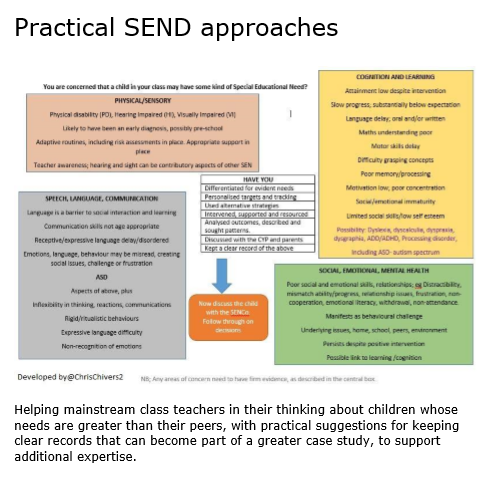
SEND issues cause teachers to become worried. I have suggested ways in which a teacher can expand their understanding of teaching and learning outcomes across the range of learners they are likely to encounter, in another post. Scroll down the page and click on download.


Picture
0 Comments

It's all about the People...

17/9/2018

0 Comments

 
Picture
Reflections on Pedagoo Hampshire 2018

The overriding impression from my day at Pedagoo Hampshire 2018 is that one is never too old to learn. Even after a lifetime in education, listening to another can either crystalize an idea or challenge one’s thinking.

The series of talks that I chose were focused around well-being. Five different people sharing personal insights into a singular topic. There was both similarity and sufficient difference in each to create those “nugget moments” that is to be hoped from a day of thinking.

The similarities were along the lines of people helping people, looking out for each other, spotting and engaging when there were evident signs of personal distress. There was an equal focus on preventative approaches, giving background support so that an individual and the context within which they operated could interact and respond according to need.

The similarities were overwhelmingly human. In a system where the “capital” is based on the humans that form the workforce, to identify work practices and demand is a significant element of organisation, requiring high quality communication, both globally, so everyone knows what’s going on, but also enabling high quality 1:1 discussions, where personal information can be shared confidentially.

Ilse Fullarton @kidshealthuk talked about The Children’s Health Project, aimed at providing essential background for PSHE and establishing healthy lifestyles in children, through a combination of basic knowledge and healthy practices; movement, food, habits and thought. All these elements combined in cross-curricular teaching in PE, science and PSHE. As someone who lives what she preaches, Ilse described her own journey to health.

Simon Warburton @Simon_Warburton is a member of SLT in a Secondary school in Cambridge. Simon gave a very honest and clear account of why he has developed such a passion for ensuring that CYP have support and guidance in well-being. Having had a period of stress, effectively debilitating and destabilising his personal and professional life, he took drastic steps to address his fitness and eating habits, losing a considerable amount of weight in the process. He also took stock of his professional life and stepped back from one role, to take on another that would allow restoration of an equilibrium.

In this role, he is charged with the healthy approach of his school, to adult colleagues and to the children, developing a wide range of opportunities for exercise, an education programme and high staff awareness towards each other and their charges.

Adrian Bethune @AdrianBethune asked a “simple” question; can you teach happiness? This happens to be the premise behind his new book, Wellbeing in the Primary Classroom (Bloomsbury).

Adrian explored the research base behind his premise, both psychological and physical, eg stress and anxiety, engagement and meaning. He explained that happiness can also mean experiencing and being aware of low points; self-awareness and quoted identical twin research, considering genetics, as well as life opportunities. The work of Dr Alejandro Adler was used to explain that a well-being curriculum increased academic outcomes as well as well-being, which led to my simplistic reflection, that happy children are more energised to engage with learning, so improving outcomes by being “in the moment”. Adrian used a statistic that emotional health at 16 can be determinant of future success and happiness and that the onset of depression in teenagers growing.

Exploring and comparing ideas of mind full or mindful led to the statement that mindful meant being in the here and now, aware of surroundings and what is happening, whereas mind full could mean overload.

Adrian focused on looking for positives, so had established the idea of WWW; three good things, to talk or write down. @PookyH Dr Pooky Knightsmith regularly uses this on Twitter, to share her three good things. Adrian had also rebranded anti-bullying week to become “It’s cool to be kind week”; emphasising positives rather than starting from potential negatives. Post-it boards recorded random acts of kindness, recorded by pupils and adults.

Mal Krishnasamy @MalCPD was my last session, looking at quick coaching techniques within her 40-minute session. There was a significant focus on active listening, with one participant describing to another something significant that they were passionate about and for the listener to draw a sketchnote of what they had heard, to retell it for accuracy. A second activity took us on a listening journey from the inner space to successively distant spaces, returning slowly to the inner. It was a form of meditation and a very pleasant way to end a busy day.

Mal, Adrian and Ilse gave a similar example of a very straight forward mindfulness practice, to focus on breathing, one thing. Pause time- 2 minutes; put a hand on your tummy, be aware of own breathing, from upper chest or diaphragm. One variation could be to put a soft toy on tummy and to watch the toy rise and fall. A second variation included timings, breathing in, holding and breathing out; 3,6,5 or similar, depending on the children. This activity raised physiological awareness. Adrian described how he used something similar as a teacher; self-awareness of in lesson stresses, utilising breathing exercise to establish calm.

My first session, in many ways, could be seen as the “wildcard” in the series, in that it was a trio of presenters, Max Bullough, Carolyn Hughan and Leah Crawford @think_talk_org presenting on their project Leadership through Narrative. As the session moved on, it became clear that it was “all about the people”; an active listener enabling another to present their story as clearly as possible so that they were in a position to interact appropriately and avoid issues that arise from assumptions. The joint discussion enabled an analysis and reflection before a clear description of future actions, decided by the interviewee.

This session was the “grown up” version of all the others and emphasised completely, along with @SueRoffey opening keynote, that education is totally “all about the people”, any of whom might need, at some stage, another person to care sufficiently to offer mentoring, coaching, or just a shoulder and a cup of tea; someone prepared to listen. Openness, honesty and trust underpinning relationships.
 
​
Picture
0 Comments

Bringing children into Their World

14/9/2018

0 Comments

 
Picture
They open their eyes, they sense the world, they look, they listen, they feel, they taste, they smell.
They see apparent chaos around them with a central feature, a parent’s face, their voice, their sustenance.
They respond, through crying, gradually having some muscle control and smiling, making responsive sounds.
It all takes time, but, somehow, while we can only engage with their externalising, their brains and bodies are developing in very sophisticated ways.
They start to interact with their world; their life journey of experiencing and making some sense of these experiences.
 
Each of us carries around the distillation of our passing experiences, formal, some sustained like years in education, or training programmes, many informal, some fleeting experiences, others based on life, our families in childhood, then our friendship groups and personal decisions about partners and life location.

Every one of these experiences impacts on us, some as they are pleasurable, others because they are traumatic. It can be easier to recall life’s highlights or low points than the more mundane aspects of our lives, as the significant events are our life “landmarks”; transitions almost. While our memories do alter over time and recreating earlier life can sometimes lead to embellishment, at any point in time, we are the sum of the parts.

Recently exploring my earlier life through looking at locality maps, it was clear to me that in geographical terms, the bulk of my life to the age of seven was restricted to a distance of around one mile from home, with occasional school holidays spent with more distant family. From the age of five, this was often independent and outside with friends; perhaps a luxury for today’s children.

My world expanded exponentially when we became £10 Poms, sailing to Australia via stops allowing visits to Pompeii, Athens, Aden, Columbo, Perth, Adelaide, Melbourne and Sydney, followed by the train journey to Brisbane. Five and a half weeks of watching out for dolphins, whales and flying fish. Playing deck quoits and other novel games. Watching the sellers with their fully laden, colourful canoes arrive beside the ship with their trinkets hoping for a sale, goods and money exchanged via ropes and baskets. Children and adults prepared to dive for coins thrown from the boat. It was interesting at the time, although my adult self can see it as demeaning. It was certainly “eye opening”. There was a very different world from the seemingly grey experiences that had preceded it.

Life has certainly happened since then. I have blogged about it, highs and lows, as I remember them. I won’t rehearse the features now, but it is worth reflecting that life memories are filtered through forgetting, as well as remembering.

On 13.09.18 I tweeted that I was reflecting on the following: -
We’re all constantly creating our internal models, developing them as new information appears. Challenging this creates internal tension; destabilising for some. Learning how to accommodate and adapt to circumstance has enabled ideas to progress; a life skill.

This followed a day when I worked with ITT trainees, followed by a session with their mentors. Within the room of some twenty nine trainees, there was clear evidence that some elements of their new experiences were causing internal tensions; the personal, getting to know their context and everyone and everything within it that might impact on their professional lives; the demands of studying and running a household, some with much reduced incomes; the detail of the academic information that they were receiving, some after a significant gap since their degree. Accommodation and adaptation take time, which, at this point in their existence is at a premium.

Children are learning to take in information, learning about learning, at the same time as having to accommodate to a multi-faceted world. There is a truism that young children are naturally inquisitive, prepared to try things out, familiarising themselves with novel experiences, through what we often call “play”, which they then describe as “fun”.

As an adult, I often engage in familiarisation activity; a new camera, smart phone or laptop requires familiarisation. For a while, I “play” with them to see what they can do, in my case, using prior knowledge that comes from earlier experiences with the same technology. I am sure that my camera, smart phone and laptop can do significantly more than my current uses, but, for now each serves the purposes for which I want them.

If I am listening to a speaker, as I will at an education conference, or in a university lecture from a colleague, I can be distracted by a single point that triggers a line of thinking; it resonates or challenges a previously held piece of understanding. This may lead to a bit of note making or doodling an idea trying not to forget the thought from “the moment”, which can happen with just trying to listen and hold onto everything that has been said. The single nugget can form the basis for further reflection, discussion or reading, leading to a change in my understanding.
​
Picture
In the same way, school lessons offer a similar scenario with new information being shared hour by hour. The difference could be that in school it is every hour, whereas an adult has the luxury of taking or making “time out to think”. Children in school don’t necessarily have the opportunity to reflect, unless it is built into the plans. It is to be hoped that every lesson offers something of quality to think about, to talk about and perhaps to make notes, or write about in order to remember.

In the early days of school learning, learning to order and organise thoughts is a key element, which is supported by teacher organisation and presentation of the different curriculum elements, ensuring that necessary links are made overt between aspects of learning, so that children are not left floundering with the bits of a jigsaw but no image within which to place the pieces. It is to be hoped, too, that learning in school might lead to extension in the home; appropriately set home activities can extend vocabulary or lead to further discovery. See talk homework.

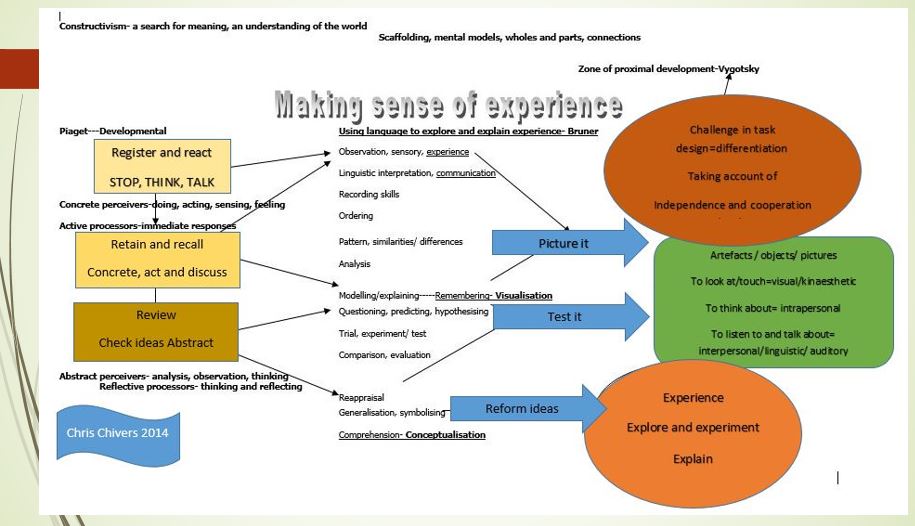
It is incumbent on the adult generation to offer life opportunities to children, in and out of school, that allow them to participate in the experience, to explore with whatever is their current capability, and to articulate their thinking, enabling an adult to engage further with questions or clarification. The act of learning can be “fun” to children. They need to learn that learning is not something that is done to them, but that they are active participants in constructing their own schemas.

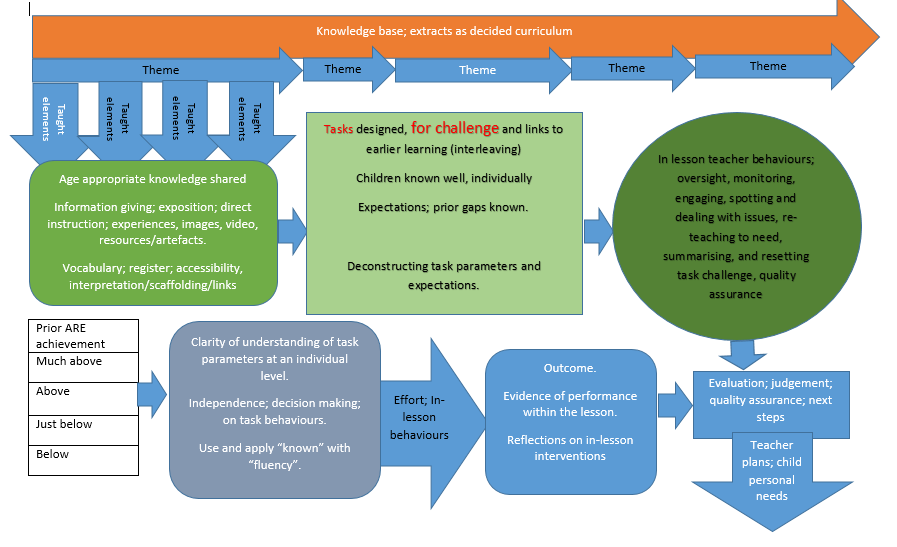
As a headteacher, I used this ideal as the basis for the school teaching and learning policy, which is on the blogsite. It was simplified into one diagram, as follows.  
​
Picture
​
At any point in time, we are the product of our experiences. If they are broad and supported by articulate adults prepared to unpick inconsistencies and add further value to the experience, the child can thrive, with the opposite also having an element of truth, although we may have to accept that children can succeed "despite their home/school experience".

If a child lives in a knowledge/language-rich environment they will experience and learn to use a wide range of conceptual words. The Bristol language studies of 1971 led by Gordon Wells showed the impact on less rich environments. It has implications for the language rich environment of schools, too, especially if the home contexts are known to be less rich.

Schools and parents, within their communities, are partners in bringing children into their world. Learning to work effectively together is essential.
0 Comments

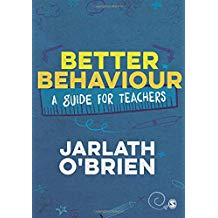
Better Behaviour; Jarlath O'Brien a Review

11/9/2018

0 Comments

 
Picture
When a book starts with a quote from Archbishop Desmond Tutu, who happens to have been one of my heroes, there’s a fair chance that whatever follows will be interesting.

That quote runs as follows, “There comes a point where we need to stop just pulling people out of the river. We need to go upstream and find why they are falling in.”

This is an incredibly simple, yet powerful message; find the source of the problem rather than always dealing with the outcomes.


Jarlath tells the stories of his early days in teaching, openly admitting to making mistakes, but thinking about them and learning from them. He reflects on much early advice that any bad behaviour was always the “choice” of the child, that there were “simple” ways to ensure good behaviour, such as seating plans, for the class to devise their own rules, don’t smile until Christmas.

The evolution of Jarlath’s thinking, through many described episodes of having to question why some children were causing problems, working patiently with his team when a Head Teacher, building professional in colleagues and personal capacity in children. He quotes the title of Paul Dix’ book; When the adults change, everything changes and Linda J Graham’s Queensland study that found that self-regulation has a great bearing on a child’s educational outcome; it’s the learning to self-regulate that can cause additional social problems.

His introduction ends with a short series of things that he has learned over his almost twenty years of experience: -

·         Some children regard schools as risky, unsafe places to be, where failure is inevitable and painful and must be avoided at all costs.
·         Lasting behaviour change takes time.
·         Learning needs to be an intrinsically rewarding experience.
·         Negative behaviour communicates an unmet need.
·         Behavioural difficulties can be regarded as demonstrations of skills gaps that are getting in the way of a child being successful.
·         Sometimes we choose actions, sanctions and punishments that only meet the neds of the adults. We do this in order to say that we dealt with a situation, but, in reality, the situation remains, at best unchanged. At worst, damaged.
·         Time invested in children is never wasted.

Getting to know the children for whom you are responsible as a class teacher is fundamental to making appropriate decisions at the right time. Early Years and Primary teachers get to know their children very well, very quickly, simply because within a week, they will have worked with their class for almost 25 hours. At most, a Secondary specialist might see a class for 5 hours, some will be an hour or less a week. This will inevitably create a different dynamic in relationships.

The social demands of school will put some children into an anxious state. For adults to be aware of this and to be able to offer support can be the difference between sinking or swimming. Recognising that “they” are not a homogenous group is a first step. “Spotting and dealing” is an important element of teacher awareness. Personally, I have used the term “behaviour whisperer”; getting to a child in time to offer advice and guidance to head off a developing issue. Too often we are just too late and have to deal with the outcomes before the child need.

Some children need help in articulating their feelings; having someone who will actually listen can be slightly threatening if it is a novel situation. Jarlath uses anecdotes to amplify situations that he had faced and his behaviour within and after the situation. Teasing out the reality can be time consuming, something that can be a luxury in a busy school and we have to be aware that behaviour issues cause teacher stress. For that reason, it is essential that whole school systems are very clear, communicated at every opportunity and followed through by every member of the school staff, office, caretaking and lunchtime staff included. Civilised social situations are a team effort.

Some children may need a form of mentoring; someone who is interested in and has time for them. Jarlath quotes Carl Rogers; Show children unconditional positive regard. Our personal manner can determine how some children will behave for us.

Jarlath’s book is an excellent review of the multiple factors that make up a complex school environment including rules and expectations, motivation and rewards, sanctions and punishments, restorative approaches, partnerships with parents, and a chapter on SEN and behaviour.

His last chapter is a reflective challenge to one’s own style, with a refocusing on behaviour as a social interaction, environmental factors in the school’s control including the behaviour policy, ability to adapt to the needs of children in certain situations. He also challenges potential misuse of behaviour policies, with a focus on SEN children and the impact of involving senior staff purely for punishment purposes.

Schools need to be purposeful places if children are to succeed. Internal systems should enable the highest level of success for each child. A “we’re all in this together” approach, including parents, shares the load and offers hope to some vulnerable children. And it’s worth having in mind that we all get things wrong some of the time; no-one is perfect.

Jarlath offers insights, but also, throughout each chapter, points for further reflection on a personal as well as an institutional level. This is a book that would benefit all schools, to be read in conjunction with Paul Dix.
​
Jarlath finishes with a quote from Dr Kevin Maxwell; Our job is to teach the children we have. Not the ones we would like to have. Not the ones we used to have. Those we have right now. All of them.

0 Comments

Education; Two Sides of the Coin

9/9/2018

0 Comments

 
Teaching and learning are two sides of the same coin; on one side, the teacher, the other is the learner. In one lesson the emphasis might be on the teacher to share essential information, in another it is for the learners to demonstrate current achievement. It’s a dynamic, fluid scenario.
​
Picture
Everything that is meant to happen in a classroom is determined by the teacher, as it always has been.

The teacher is the lead thinker in the classroom, responsible for the analyse-plan-do-review-record cycle as it affects each learner.

Looking at any records that are passed from school to school or internally, is an essential start point for thinking.

The teacher is the organiser of the space, resources and interpreter of the curriculum (knowledge), divided up into appropriate sized chunks to offer on the journey. This journey needs to consider the whole year of journeys, ensuring that all end up at the planned destination. It’s no good starting off in the hopes of getting through everything. Some slippage is inevitable; schools are very good places for creating detours. If it’s caused by bad planning, that’s the teacher responsibility, not the learners. It is imperative to note developing gaps, to seek opportunities to “bridge the gap” at an appropriate time. (See planning blog)

Their ability to weave a good narrative, to speak articulately, using and extending accessible vocabulary and in a register that enables the learners to be partners in the development of their own interpretation. Artefacts, images and modelling are essential aids in supporting learners in creating their own working images; dual coding.

The teacher is also the team leader, especially if there are other adults involved; they need to know what’s expected of them, working under the direction of the teacher.

It’s the teacher plan that determines how everything will run. The teacher is also the determinant of appropriate behaviours for learning in that space. They can appear, on occasion, to be judge, jury and executioner; it is a position of some responsibility.

The learners, at the outset, don’t know the journey, so they need to be shown an outline, an overview, so that all subsequent parts have a logical place, with checks at the beginning that they are equipped to make a start, followed by regular progress/retention checks on the way that they are “keeping up”, or that they are “getting it”.

There are different structural demands within different pieces of work; an example might be the difference between a letter and a report. Each has structural constituent elements that need to be demonstrated within an acceptable finished product. These could be considered as the “success criteria” for each activity; what the teacher is looking for as an outcome.

Using visualisers during a lesson, to show what you are seeking, by using child examples, is an excellent means of sharing emerging quality, especially if it is always supported by further developmental discussion; modelling improvement.

There is subject specific knowledge. If this has to be retained for future reference/use, it can be useful to create aides-memoire, memory joggers, that attach to the edge of books/pages, that can be flipped out to need, especially if spellings are challenging. They can become, over time, if learners are shown how to be ordered and organised, useful aids for revision; personal knowledge organisers.

Understanding whether a learner has mastered essential knowledge is often judged through oral or written responses. Where this demonstrates language needs these can also be highlighted on flip sheets; eg write answers in complete sentences.

Flip sheets offer continuity of expectation, clarity of focus and brings the learner into the centre of their learning. (See blog on exercise books as personal organisers)

Teachers can’t remember the learning needs of every child in every teaching group. This is exaggerated in Secondary, where 200 plus children might be seen in a week.

The closer that a learner need can be tracked over time, the more chance there is that individuals will make progress.

It shouldn’t be down to a flip of the coin.
​
Picture
So, to summarise
​
·         Plan long, medium and short with different emphases on what’s recorded and share with supporting adults. Organise the “knowledge journey” developmentally.
·         Order and organise space, resources and consider the available time.
·         Pitch and pace each lesson to known needs of the curriculum and the learners.
·         Set learning tasks that provide some challenge.
·         Share outcomes as learner models of expectation within and between lessons.
·         Evaluate throughout, ensuring continuity of expectation.
·         Checks en route, memory, use and application in challenge.
·         Simple personal record systems of developing vocabulary and presentation needs.
·         Books to become personal learning records.
·         Know your children as fully as possible, recognising that you can’t see exactly what they are thinking.
 
0 Comments

Teaching is a human(E) Act

28/7/2018

0 Comments

 
Picture

It’s the summer holidays 2018 and the EduTwittersphere is alight with two main topics; not as one might imagine, the future of the world order and whether we have food come March 2019. No, it is whether and why schools exclude (with some asking if it’s enough) and what appears to be a move by a Government minister to dictate further what is taught, and possibly how.

There is a regular mantra that is bandied about, that “anyone can teach”, and it has been in the back of my mind throughout, trying to differentiate between teaching and being a teacher. I would argue that knowledge is collegiate; the sharing of what one person knows enables others to enlarge their capacities. In teaching, there is both personal (knowledge) and professional (pedagogy) capacity.

Reflecting on a blog where I explored the teaching standards, entitled 24652, I separated out the personal aspects of “teaching” from the longer-term thinker about progressive development, making subtle changes to ongoing plans.

In different areas of interest, especially in nature conservation I have met a variety of people who can “teach”; stand in front of an audience (class) and speak about something that they know. This “expert” has a certain “something”, either in terms of their demeanour, their voice, their apparent knowledge or their manner of delivery. They can “hold” the audience, sometimes in rapt silence, especially if they can involve the audience with something to look at or hold or enabling interaction in some other way. Some of the best speakers, with children, bring artefacts to handle, or possibly even live animals, which they might be invited to hold.

These people have an important story to tell and can get it across. They help to pique an interest, to deepen involvement and to really engage children in the world of specific knowledge, much of which will be transient, but which, for some, might be the start of a life-long interest.

They are very useful in that regard, as they can offer an expertise that extends the audience experience, including the class teacher.

So, these people can teach, within their specific area of expertise, but, to my mind they are not yet teachers. There are much more nuanced decisions to be made that differentiate a “teach” from a teacher.

The “second level” of teacher thinking centres around the needs of the learners, rather than just the narrative being shared.

This is the 24652 dynamic. Know your children, plan effectively (over time), engage with their learning, tweak to needs, check if they understand; know them better, new baseline.

Teachers are judged on their children’s progress and outcomes (2). To know and understand he needs of children starts from a generalised understanding which is coloured-in through experience within classrooms, working with a wide range of children. This can also vary significantly between school contexts, where the demographic mix of the class and the community can create a very different dynamic. Even within a school, year groups differ, so even a teacher who may only have taught a narrow range of ages may not fully understand the needs of a different year group. I would argue that this may have an impact on thinking about SEN, particularly in the context of year-group based curricular expectations. A child who “doesn’t get it” might be a particular challenge to some, possibly less-experienced teachers.
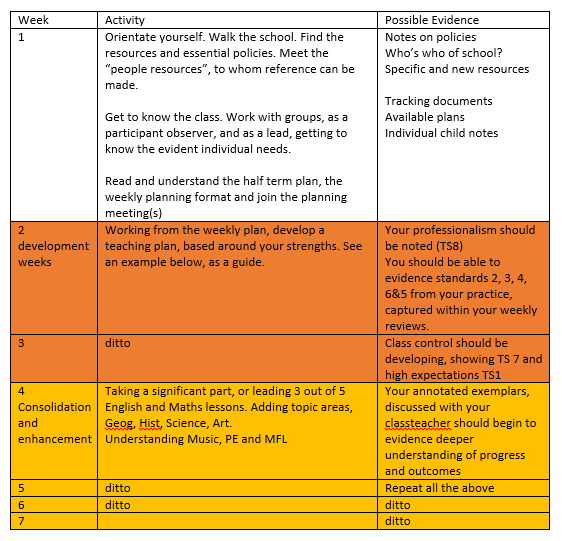
Equally, Secondary colleagues may not understand Primaries and vice versa, but this can also be an issue within a Primary school, if the Infants and Juniors are ideologically separate.

Being ordered and organised, being able to plan (4), over time is an important aspect of being a teacher, creating medium term plans, based on a good understanding of the starting needs, but also adapting these to the developing needs as they manifest themselves, as they will, while the children are working on challenge within their tasks.

To me, the most significant parts of the teaching standards are probably standards 6 and 5, which, although articulated as “Assessment (6) and “Adaptation (5)”, which can be effected between lessons at a generalised level, “did they “get it”, what do I do next?”, but which, if interpreted as the teacher “thinking on their feet, looking for prompt signs of learner discomfort” (6), leads to an engagement with any issues arising, coaching and support, or in more extreme cases, in-lesson adaptation to individual needs (5).

We are at the stage of a school year where teachers will, in a few weeks, be working with new classes.

While Primary teachers will get to know their children quite well, quite quickly, in relation to other classes they have had, Secondary colleagues may only see some classes a couple of times, so the individuals who haven’t made their current learning needs obvious may still be names, rather than people.

It is in the nature of interactions that the more frequent they are, the better you get to know the person(alities).

Some colleagues will move schools and be(come) aware of the nuanced differences between their new experience and their previous school(s). It can be a shock to be seen as an outstanding teacher in one context, only to find yourself challenged in another. The context can be a significant factor in perceived “success” as a teacher. ITE students can find the second practice more challenging if they have had the first in an “easier/nicer” school, especially if they are carrying the “high” grade potential with them.

Which leads on to the idea of the “Teachest”. These are the teachers who have taught for a while, have had experience across a wide age range, in different contexts, which enable them to cope with change, occasional difficult children (or colleagues), and who can, at the drop of a hat, magic up a very solid, or even a very good lesson, when covering for another colleague.

They have sought, filtered and adapted the best of their experiences to provide a nuanced “performance”, probably make teaching look easy, but also, at times, be unable to explain every aspect of their actions, because teaching is them, they are intuitive, but as a result of practicing their art/craft with embedded and ongoing reflection. They are and possibly always have been, reflective life-long learners, with a real excitement for their specific areas of interest, which they share, day in and day out.

In other words, they put all eight teacher standards into practice with ease, day in, day out.

It is this last descriptor to which I’d hope all teachers aspire. To develop to this phase, though, teachers need to pass through the other two, the “teach” and the teacher, with the teacher phase being the essential good stage, which is required of all teachers.

The “teachest” comes over time, but also the interrogation of experience as a self-development tool. The best “teachests” are also collegiate in their willingness to share and unpick their capabilities, to the benefit of less-experienced colleagues. These people are the bread and butter of continuous professional development, at no cost to any organisation. They teach teachers as well as children.
 
The skill of self-evaluation is the significant skill which can be shared with developing teachers. Focusing on the processes of development, rather than just passing on simple tips and hints, enables the developer to reflect on their own practice, so that tips and hints can be explored within a development dynamic.

A pack of tips and hints and bright ideas does not make a teacher. A set of pre-prepared worksheets doesn't make a curriculum. These things only work of they have clear purpose and the teacher is aware of potential issues, in order to intervene appropriately with children. I have seen more fail lessons arising from colleague generosity in sharing a plan, than from a teacher preparing their own.
​
A teacher thinks for themselves.


To some extent, teachers and “teachests” grow themselves, by regularly reflecting on new information and “sloughing off” aspects of the old, so that they can move forward with greater ease.

Sharing is caring; a simple mantra.

Collegiality is the hallmark of a successful staffroom. Shared expertise benefits everyone, ensuring that the children receive the best that a school can offer, which, in reality, is the best that any school can do.

Where it identifies the need for external support, this should be carefully considered, if it is to have a developmental collegiate impact.

Communication is key and this takes time. School leaders are responsible for how time is “demanded” for specific needs. Time should simply be allocated for quality talk between colleagues. That way, current reading can be shared, discussed and, where necessary, embedded in practice.

Love the ones you’re with. Make the best of the available talent. Support every adult associated with the school, including parents, partners in children’s progress.

Humane education, in professional hands, anyone?

Picture
0 Comments

On exclusion; a Closed File

27/5/2018

0 Comments

 
Picture

Emotive, often to an almost explosive degree, exclusion is a word that, unlike marmite, which can be a case of like or dislike, brings forth bile from different standpoints, aimed at people who may hold contrary positions. The extremes of any behaviour-related decisions are likely never to agree.

For what it’s worth, I think schools should have the option to exclude a child, for example to safeguard the others physically or mentally, from violence or bullying. But, I would expect there to be records of intervention or of general school approaches that ensure that civic expectations are articulated, carried through, or lived in daily life through the adult models.

Where, in a former existence, I visited schools to look at their inclusion approaches, those operating in very challenging environments had multiple layers of intervention, should that be necessary, enabling either staff or children to support self-regulation, or to seek to stabilise an individual when situations became untenable. At the extreme, and despite their best efforts, these schools held to the option of exclusion.

In an even earlier existence, as a headteacher for sixteen years, I excluded two children during that time.

I wrote about the school behaviour policy in an earlier blog, but, to simplify, as a Primary school, we had three principles, based on responsibility for self, behaviour towards others and towards our environment. These were enhanced by the adoption of the Hampshire Constabulary “Five Golden Rules”. The essence of these complementary approaches allowed stories from wide sources in assembles, exploration of narratives in class from class books, PSHE, or P4C. They also supported restorative discussions when children, inevitably, fell out.

One of the exclusions resulted in a “fair cop” approach by the parent, with relatively easy restoration.

The other resulted in a file that will stay in my loft for a further five years, even though I am technically retired. In many ways, it should have been another easy restoration, but one of the parents decided to appeal to the Governors, which resulted in a hearing, finding for my decision. That resulted in an appeal to the local area education officer, again finding in my favour, followed by a County investigation, by which time the child had moved school and been excluded, resulting in the head having a Governor review, which found in their favour… you know the rest.

In the meantime, my email inbox was full of regular missives with invective that I have rarely heard, even during a rugby and other sport earlier life, but which I printed on a “just in case” basis.

It was the call from the Department for Children, Families and Schools (DCFS), one of the incarnations of the current DoE, that became worrying, as they were then investigating a complaint against the County. A senior official would be visiting to investigate the original situation, to seek to understand the background and the dynamics of the situation. The multiple-page report found in favour of the County and all associated. We waited for any subsequent escalation of the appeals process, perhaps to some form of judicial review.

The several months that this process took were distracting, demoralising and destabilising for many people, throughout the County. Keeping one’s mind on the day job required significant focus. It often reminded me of the truism, that headship can be a very lonely job; there were things I couldn’t share, with anyone.

Exclusion is never to be taken lightly.

The ripples affect many people in many ways, and, in extreme cases, for many years. My thoughts go out to any head facing complex situations.
0 Comments

Mentoring Mentors

20/5/2018

0 Comments

 
​Everyone is capable of teaching another, especially in an area where one has an expertise that can be shared with the other. This could be a specific area such as carpentry or pottery, or a much broader entity that constitutes a professional qualification.

Mentoring, on the other hand, can be more challenging, as it may need to be built into a longer-term enterprise. Businesses of all kinds provide line management arrangements, where a senior oversees the work of several juniors. It is the working of this relationship that determines whether it is mentoring and developmental or judgemental and purely target driven.

Both approaches exist, but, I would want to argue that the mentoring, developmental approach, supported by clearly articulated goals, has the capacity to significantly enhance an organisation, where more simplistic judgements may diminish.

For a number of years, as a Linked Tutor for two universities and as tutor and quality assurance with a Teaching School, I have taken a number of roles in developing mentors, from initial familiarisation with the role, to overseeing mentor development throughout the training year.

As a relative outsider, I have an interesting role within any particular school; bringing some expertise to share, which will then be enacted through the lens of the mentoring teacher and colleagues, within the context of class specifics and school resources. Anyone who’s been in teaching for any length of time will know that there is a need to adapt to changing circumstances. This, in itself, can be challenging for a new entrant, who may well need to be supported in this regard, especially if they have come from environments where they have been “in control” of their in-tray.

As a personal preference, I would wish to see any school taking trainees, from any provider, considering themselves as mentoring (training) schools, and I have, on occasion, trained a whole staff, particularly where they are entering a training partnership for the first time. In this way, everyone becomes a part of a mentoring team, sharing responsibilities and responding appropriately to requests from trainees for advice or information. It also helps to create a self-help, collegiate environment; the mentor does not then have to be a member of management.

Where the classteacher is the mentor, able to offer informal as well as more formal development commentaries, I use the idea of the “parrot on the shoulder” as an aide memoire. In other words it’s ok for a mentor to advise a course of action during a lesson, to embed specific skills in timely fashion. A debrief after the event is much less effective, as it may rely on remembering specific points in the lesson.
Picture
Over the past few years, the role of the mentor has really come to the fore and, in keeping with this, I argued for greater formalisation of the mentor training being offered within the Teaching School and was asked to develop a series of meetings that would be held in school time, with different school hosts, to consider the dynamics of the training year and to pre-empt the needs for the following six to eight weeks.

We start at 1.30pm, to allow for time to eat as well as travel to the venue.

All mentors and trainees come together in July, before the training year, to have time to converse, to consider the initial paperwork needs and familiarise themselves with the course demands, including the mentor and teacher standards.
​

It is helpful if annual diaries are planned with overview aims, so that all parties are aware of course demands as well as school requirements.

Picture
In addition, as I make six visits to trainees during the year, one per half term, to undertake a joint observation with the mentor, to check progress and consider personal development needs. These dates are arranged and disseminated for the year, with detailed visits confirmed half a term ahead, to avoid too many changes. Mentor training meetings inform visits and vice versa.

The training overview covers:-
September (Focus Teacher Standards 87143). Creating a positive training context; order and organisation; revisit the Teacher Standards and paperwork (tracking development), especially trainee using reflective journal effectively. Weekly developmental dialogue.

November. Focus on Teacher Standards 265; knowing the children, positive, supportive interactions and reflecting on outcomes (light-touch moderation). Starting to think holistically over a known timescale; weekly/fortnightly expectations. Term end reflections and summation of specific children.
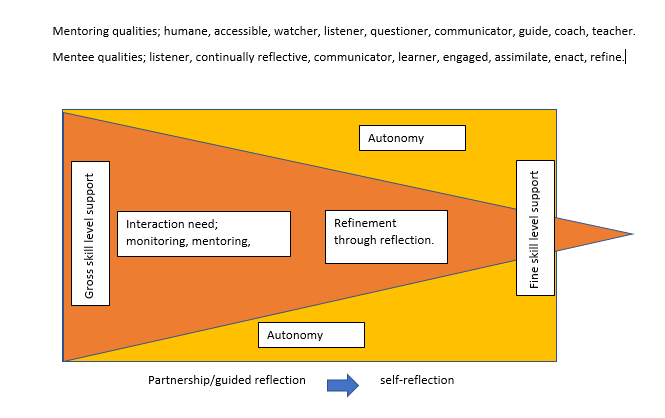
January. Second placement Repeating the sequence of the first two meetings, especially for new mentors (identify individual needs for follow-up visits) Moderation in different key stage, annotated examples and reflections. Lead to summative dialogue. NB. During the short experience, the substantive mentor visits the short practice school to undertake a joint observation as a form of moderation and mutual support.

February/March Return to substantive placement, rapidly to 80% teaching load. Mentor support to keep up with paperwork and to provide detailed coaching advice. Looking at the learning needs of specific individuals and teacher interactions to enhance learning opportunities.

May/June. Whole year reflections, preparation for final reports and judgements, evaluation of mentor roles and training, adjustments for following year.

Picture
Mentors value the opportunity to get together with other mentor colleagues, as much as the direct training, to compare notes and experiences. No-one is THE expert; everyone shares their expertise.

While there are formal elements of paperwork to be fulfilled, much of the experience hinges on the personal relationships that start in the July before the training year, between mentor and trainee and within the trainee group; the trainees seem to get together and organise a social media group as a support network.

Training to become a teacher is mostly down to supported self-development through guided reflection.

The day to day life of a teacher is a solitary, or small team existence, within their own classroom, so trainees have to become self-reliant, independent team leaders and members.

Within a well-planned structure, they have a chance.

Where trainees struggle, it is usually down to communication issues, of curriculum expectations/late planning details, in either direction. Schools can forget that they are hosting trainees right up until the end of the course, with the school providing much of the front-line practical training, whether HE or SD routes.

If I had to try to summarise the “steps to potential success, I’d propose:-
·         Work in and as a team to…
·         Plan effectively over different time scales, including timely meetings with support colleagues and appropriate in-house experts,
·         talk regularly, communicate clearly,
·         reflect and evaluate together; honestly,
·         consider both subject knowledge and pedagogy,
·         regularly discuss individual children using annotated outcomes as first-hand evidence,
·         develop an investigative approach to anomalies,
·         use feedback as support for reflection and enhancing personal approaches.

And always cognisant that it’s a human system, subject to human frailty.

​Teaching is a challenging role, from time to time it will get tough, with issues inside or outside school control. Developing teachers is a mixture of challenge and support, by a colleague with the skills to balance both to good effect.  


0 Comments

Absorbed

9/5/2018

0 Comments

 
Images from a visit to Barbara Hepworth's studio in St Ives
Picture
As an adult, it is possible, if time can be made, to become absorbed by an interesting activity, with significant amounts of time, thought and activity devoted to what to others might seem to be isolated tasks, but which demand your full attention.

Two of my friends have hobbies where they can almost seem to lose themselves in the process of creating the best possible photograph, or the best possible painting. In both cases, the absorption is in decision making, working their way through subtle changes, seeking clarity in image, or the best placing of the next colour stroke. Absorption could, of course imply obsession, but, in both people, their interest in the broader world is what provides the stimulus for their focused behaviours, from which they capture images that express an aspect of them.

In both cases the process is key, leading to several iterations of a possible outcome through a process of evaluation and editing; these might be separate pieces, or might be a reworking of the available image. Both are adding depth, through adding to, or removing layers from, the original.

Over the recent past, in education, process has been pushed into the background, yet, at heart, it equates to the models above, by effectively being a progressive layering of information and opportunity that evolves into a personal iteration at a particular age. If one was to see teachers as artisans, working with a very specific raw material, then every single child is a work in progress, capable of being helped to make alterations to what they know and how they use and apply their knowledge in novel contexts.
​
The common factor between the hobbyist photographer and painter and the artisan educator is that they control elements that are seemingly in their control as long as they have mastered techniques. The educator’s raw material, being multi-dimensional, may not always be totally in their control, especially in the early stages, resulting in variance in outcomes. It is, after all, a human system dealing in human frailties.

Picture
Teachers, if one takes Twitter as a minor barometer, is obsessed with getting it right, and, somehow, through the grail of the magic bullet, for each and every child.

A sculptor working with wood will evolve very different approaches to one who works with stone; similar skills, but different application.

The variation in children has always been broad, yet, quite often, every one is treated exactly the same and there is an argument, developed over the recent few years, to “teach to the top” and scaffold for those who need it. In quality artisan hands, this will work in exemplary fashion, but, in less experienced hands it is likely to produce clunky outcomes, as the inexperienced may lack the ability to spot when there’s a need to intervene and adjust to need. You only have to watch ITE trainees in their first attempts at teaching to see this writ large. I’d suggest that the early days NQT will be experiencing similar.

Teaching is absorbing; unpicking children’s thinking and actions can provide many hours of distraction. Focusing on their learning needs, providing appropriate challenge and resources can spill over into weekends and holidays, impacting on outside lives. No wonder that we worry about work-life balance!

My teaching career is littered with abandoned hobbies, sport, music, art, any one of which, at the time, provided a few hours of absorbed behaviour, leaving behind the work details, creating space. The cricket stopped after I “caught” a ball in my face, having slipped for a split second into wondering about a particular child at school; not a good idea when you are only four metres from the batsman! I played my bodhran for a variety of folk groups, including a barn dance band, until the developing demands of an upcoming Ofsted inspection kept taking practice nights away and I had to step out; once replaced, there’s no way back. Painting has occasionally made an appearance, usually in the middle of the summer holiday when there’s been enough time and a place to get materials out.

Equally, though, I wonder about children’s lives, whether in either their home life or their school experience, they learn to become absorbed, to be able to focus on and achieve one thing, at the expense of others, maybe, but doing something of quality that can become the start point for further development and which provides personal pride. Some attend groups outside school or may choose a continuous club provision in school. They may be “spotted” and shepherded into an extension club with more qualified coaches.

School timetables have moved more from blocked time to singular lessons, with a defined time slot, with any flexibilities sometimes compromised by internal organisation that precludes a teacher from offering an extra few minutes for a child to complete a task in class time. It also means that tasks are designed to fit the available time, so can result in reduced challenge.

If process is important, then time to think, to plan, to organise, to start, to continuously evaluate and edit (in-task) has to be available. The alternative is a diet of shrink-wrapped, ready-prepared, short-term experiences, which may or may not link.
I know that time is finite and that schools are challenged to put in place the maths and English curricula, but in reality other subjects “feed” the core, so should demand a place of value. Thinking, along with doing and talking, supports many facets of literacy. Having something of quality to think and talk about enhances English, and maths opportunities are everywhere.

When learners become absorbed in a task and can take some control over, and responsibility for, the outcome, they derive pride and pleasure from the production at any age, especially if they can also see the ways in which they can continue to improve. Teacher quality assurance, response and feedback, has also to be nuanced. It’s easy to put learners off taking part, because they begin to believe that they’re “not good enough”! Belief in one’s ability to continuously improve is a support for progress.
​

Process is essential. If we lose it, teachers will have to work twice as hard, to provide scaffolded experience as both process and outcome. They will have to provide both the process and model outcomes. Sometimes, in open activities, children can demonstrate that they have far greater insights than their teachers have previously thought. Task activities can be limiting.

Picture
0 Comments

Immediacy effect; Busyness

20/2/2018

0 Comments

 
Picture
.Do teachers really have “thinking time”?

When we consider a choice between two options or rewards, we tend to prefer the readily available one. In other words: the current and near future are incredibly powerful.

Busyness is the stuff of school life leading to rapid decisions, but good decisions may need a period of reflection.
With so many interactions taking place within every minute of every lesson, it is hardly surprising if those involved will, occasionally make what to others will seem an error of judgement that is instinctive. These instinctive responses are likely to demonstrate personal bias. We may not be aware of bias until an unguarded utterance demonstrates to another something of our internal monologue and they have the confidence to address this back to us.

Under normal classroom circumstances, in any classroom, it is less likely that the others, the children, will have the temerity to point out inconsistency in a teacher demeanour.
​
It is, however, possible outside the busyness of the classroom, to seek to create periods of calm that allow for some reflection. From the very beginning of my teaching career, we were encouraged to be reflective, especially after a day’s work, thinking about what had gone well and what needed further thought. Some of this thinking was aided by opportunities to discuss areas with colleagues, often over a cup of tea. It might have been a matter of pedagogy or simply curriculum knowledge, the what, why and how-to of teaching. This can appear to be a luxury, but such reflective time does allow consideration of more strategic aspects which can sometimes be put to one side in a busy classroom, reducing interactions to “call and response”.

Reflection, articulation, consideration, refinement, action, evaluation leading to a further round of reflection, eventually leads to refinement, in any learning situation, at any age.

It is always interesting to interact with a school as a headteacher, external assessor and now as a Governor, talking with staff who spend their days being busy, seeking to explore the strategic aspects. It can be quite enlightening to engage in what becomes a somewhat scaffolded conversation, allowing the staff members to think before responding, moving the everyday into dynamic structures and eventually towards impact evaluation. It can also be very frustrating if the staff member cannot move beyond the descriptive into reflective evaluation.

The majority of school staff will say that their thinking time is often well outside school and often during the holidays, when the distractions are less, especially if they go home from school into the busyness of family life. We always have to be aware that periods of life can feel as if they are little more than reactive. Again, a majority are likely to find that work and home life combine to eat up their time. It is often when an external or unexpected event happens, such as personal or family illness, that a real awareness of time limitations is highlighted.

Schools that are able to create or offer quality time to reflect, to organise themselves strategically, putting in place systems that are easily articulated, well communicated and easily understandable to everyone, are likely to be calmer environments that allow for reflective reactions.

Time-poor schools, always in a phase of reactive behaviour, are likely to encounter a greater proportion of needs for immediate response, some of which will be less than secure and may well create a secondary level of problem. An example might be a behaviour issue, dealt with too rapidly, that then causes the parent(s) to become involved. The secondary layer can, in some cases, become a new level of distraction.

Making time to think can come at a cost, but it eventually has a cost-benefit.

Having a clear strategic agenda for developmental discussions, providing ongoing target dates can be a focus, making better use of time. Awareness of a direction of travel can mean all moving towards a known goal. The alternative is everyone making things up as they go along, reacting in their own way, rather than operating within known boundaries.

As in any organisation, it is a case of pulling together, or possibly pulling apart.
​
Picture
0 Comments

Mentors 24652

17/1/2018

0 Comments

 
​Considering Post Graduate and School Direct short placements, planning for a successful experience.

Being such a short experience, the six/seven weeks will fly past very quickly, so, to maximise the potential for a successful practice I offer the following organisational insights from supervising previous experiences.

The first thing is to secure the personal professional standards as per this diagram.

Picture
This means being professional from the first contact with the new school to give the school confidence that the trainee is an appropriate person to be trusted with their children. There is an immediate need to find out about key policies, including safeguarding and behaviour management.

 From the beginning, getting to know the children from talking to them, generally and about the work in their books helps to establish appropriate expectations. This will be added to with discussion of tracking documents and knowing where the teacher would like the children to be by the end of the period. Find out the themes and topics being covered and those specific areas where you will take a lead role. A good mentor ensures that the trainee has received as much detailed information as possible that will help them in their early decision making.
Two key messages to any trainee; know the children as well as possible and know your stuff…
​
The trainee, guided by their mentor, needs to create a personal development plan for the weeks of the experience. They need to put into the plan any specific areas that they need to observe, or experience, within this key stage, whether structural like planning or behaviour management, discussions with specific staff, to address any gaps in, or to broaden your understanding of different areas. Plan in any assignments that have to be completed within this timescale, particularly if they depend on interactions with children or staff. Professional time should be used effectively and trainees need to remember that colleagues fit conversations around their other jobs.
​
The practical teacher standards will need to be developed within the experience. 

Picture
2; Progress and Outcomes or knowing the children, in class terms. The range of abilities, how they are organised for learning and tasking. Finding out about the school approach to assessment and feedback.

4; Planning. This will have school specific elements. Hopefully, trainees will be able to get the plans for the half term, from which weekly plans will be developed, by the trainee, so that daily and single lesson plans can fit into a weekly dynamic, allowing reflection, during the week, of the need to adapt and also to evaluate the progress made during the week.


Picture
6&5; While some assessment will be after each lesson, with the next lesson altered if there is an evident need, there is also a need to consider assessment within the lesson. Whereas a trainee may think that you have created the challenge within tasks appropriately, children will demonstrate, through a variety of means, that they do not understand something, or that they are finding the challenge too easy. It is important that this is spotted and dealt with fluently, so that children’s learning is not disjointed.

2; The loop is closed with evaluation of outcomes and greater understanding of the children, as a group, but also as individuals. The repetitive cycle enables a refining of understanding and of approaches.
​
Seeking to put this together into a coherent plan that allows for all these elements might be supported with the following model.


Picture

Going into their second experience, trainees will have already demonstrated a high degree of professionalism, as team players and future team leaders. They have been able to make good relationships with their class teachers and support staff, as well as with the children. They tend to be allocated to classrooms that are well ordered and organised, with good, positive behaviour management strategies enabling the teacher to teach and learning to occur.

The trainees themselves, by this stage, are generally well ordered and organised. They plan effectively and make sure that they have high quality resources available to enhance their lessons. The IWB is usually used to good effect and there is evidence of other technology being used to enhance learning, eg visualisers, cameras and iPads.

They all work hard to make sure that they have appropriate subject knowledge and appropriate resources for each lesson, either through discussion with colleague professionals or personal research. This can be discrete knowledge and would benefit from broader understanding of how the discrete fits into the holistic model of learning for the children, thus allowing some deeper interrogation of in-lesson outcomes.

The following diagram seeks to describe the dynamics being explored from visits during second experiences. The trainees are at a transition point, where they are moving from absorbing structural knowledge, linked with discrete subject knowledge, to being able to embed these as procedural and interactive understandings within an active classroom environment; ie timely decision making.


Picture


​In the second experience, standards 8 professionalism, 7 behaviour management, 1 expectations, 4 planning (order and organisation) and 3 subject knowledge, are generally secure, across all the trainees, as they are personal attributes that are enhanced with experience and application of personal capabilities.

There is some variation in standard 7, within classes where specific behaviour issues required individualised responses, which the class teachers acknowledged were significant.

Although teaching standards 2, 5 and 6 can therefore be argued as less secure, it is perhaps important to reflect why this is the case, as they appear across all types of trainee going in a second experience. It was interesting to discuss this issue with mentors during a training session and to ask them to consider where they would feel less secure if they were parachuted into a different school and key stage.

With standard 2 being progress and outcomes, the trainees are at a disadvantage in going into their second school, as they just don’t know the children in that class. Neither will they have a detailed understanding of children of that age group, so may not have mental “baselines” from which to extract appropriate learning expectations.

Standards 6&5; Learning to develop tasks for a new age range is challenging in itself, to match and challenge appropriately over time. In the absence of good subject knowledge that embeds an understanding of how the subject develops, lessons can become activities that may or may not lead to secure learning and, in addition, appropriate interventions may be missed. The ability to think on their feet and adjust a task demand to evident needs of the learners might be compromised. Assessment can be further undermined, as each school is seeking to develop their own internal systems in the absence of national descriptors. The meeting with mentors showed that there were seven systems within nine mentors, including four variations of the local County system.

The early meeting with the teacher mentors leading the second experience enabled discussion of issues that arose in earlier cohorts, seeking to pre-empt some of the issues that might simply be a constituent part of the second experience.

As a result, these areas were a focus for mentor-trainee discussion.

Trainees are charged with monitoring progress and interventions over their experience. They have to unpick the detail of learning from interactions and outcomes to understand ideas behind progress. Some of this is captured in personal case studies.

Trainee reflection time. With the inevitable pressures of routes such as School Direct, built in (collaborative peer) reflection/ weekly review time would seem a necessary element to consider, when reviewing the holistic experience. Time to sit, to think and to have professional development discussions needs to be built into all school experiences. The mentor role is key to this.

In Primary terms, the breadth of teaching standard 2, as progress and outcomes, covering year 1 to year 6, is one that would repay some developmental thought, to create exemplar material that demonstrates the development from EYFS (year 1) to year 6, within the current curriculum, especially in English and Maths. This reference material would support developing judgement. If it was extended with examples from other curriculum areas, this could raise appropriate expectations.

To exemplify TS2 further, regular moderation activities between the trainee and the class teacher could result in a personal reflective portfolio unpicking progress in different subjects, but also introduce the trainees to the need for regular evaluation to inform teaching practice.

In the main, trainees will be on track to achieve at a good or better level at the end of their training year. If they’re not, they will be subject to detailed concerns having been raised.
All trainees would benefit from focused reflection time looking at the 24652 dynamic, working to fine tune their approaches, developing personalisation to evident needs, including SEND. This is a clear action on the mentors during weekly review meetings.

When considering needs in returning to their substantive experience: -
Get to know the progress made by the children in their absence, then…
·         to develop (with support) their own medium term plans,
·         to unpick the detail of  learning from outline intention through their own actions,
·         understanding subject development over time,
·         creating challenging tasks appropriate to the children’s needs,
·         interacting with learning giving appropriate supportive feedback and guidance,
·         making rational decisions based on outcome,
·         interacting with anomalies
·         and evaluating outcomes.

​In other words, refining, or recalibrating themselves as whole class teachers, taking ever greater responsibility for progress, preparing to consider the needs of different classes in September.

Picture
0 Comments

2018; A Year For Dialogue (as CPD)?

31/12/2017

0 Comments

 
Picture
Thoughts on mentoring as organisations; stop talking at, start talking with...

What if every teacher could learn from, and be as good as, the best in the school, with an extension into the local area or wider organisation (LA or MAT)? Teachers are full of great ideas. Shared, they take on another life, can be adapted and developed, then returned with interest. 

One of my roles with a local Teaching Schools Alliance is working closely with mentors, including five formal sessions of training during the school year, supplemented, as needed, with personal support. In many ways this works extremely well.

The mentor is, in most cases, the class teacher, so the feedback loop is very tailored within each lesson, not reliant on a timed “drop in” for an observation. The role, in interpretation, can occasionally become a little formulaic, with judgements being more judgemental than developmental. In a training year, the latter has to be paramount. Judgements about capability have to be kept in mind, but, trainees are not the finished article, by any stretch of the imagination. Everyone has to start somewhere...

In reflecting on the first year of my own career, I am wondering if elements could be useful for institutional reflection.
In 1974, I left training college, armed with my “permit to teach”, having passed the three-year course of training. This let me start teaching in what was then called your probationary year. In the August of 1974, I received a letter from the Department of Education and Science welcoming me and informing me that qualified teacher status was contingent on my passing the probationary year.

That first year, I spent a term in a boy’s Secondary Modern school, mainly teaching science successfully, but with additional teaching responsibilities for the ROSLA children, the Raising of the School Leavers Age group that had to be in school for an extra year, but who were not taking any exams at the end of the year. There was no curriculum and no support from the head of science who had no ROSLA groups, so it was very much trial and error with very challenging classes. The deputy heads were rarely seen, a couple of times to check on the quality of my teaching, with an “ok” at the end, but they were no use in curriculum support. It was colleagues in the science department with whom the probationers spoke in the tech rooms who offered some help and guidance. The hours were long and stressful, which, combined with little support became destructive. Plus ca change…

In January 1975, I moved to a local Primary school. In those days, there was no-one designated as a mentor, taking a supposedly key role in guiding and monitoring your development. You were a team member and were expected to be a team player, working and talking together, sharing the available resources and ideas. Everyone had something to offer and, as a result, the rest of the year went relatively smoothly. The principle was that sharing what you knew helped everyone. It was simply a sharing culture.

It is very hard to think that that class of children are in their mid-50s. I’ve met a few who stayed locally and they have done well in life, so I can’t have caused any permanent damage!

In addition to staff collaboration, there was a local teachers’ centre, with a dedicated lead, who would organise courses run by local teachers with acknowledged expertise that they were willing to share. These courses, all twilight, ran for between three and six weeks, so genuine background reflections into processes behind subjects and an opportunity to try out ideas supported deeper insights into what children could produce, especially if there were opportunities to share outcomes from the week. Some of this happened at our regular TGIF meetings, informal probationer chats over a bottle of beer at the teachers’ centre. It was a good way to unload and start the weekend and some of that group are still friends, some 43 years later.

The driver to all this was ourselves, as self-developers. It was not required by external demand; certainly not the school head or deputy, simply a response to personal awareness of need to fill in inevitable gaps from initial training. I didn’t have a mentor, just colleagues who shared.

Today’s trainees and NQTs have a dedicated mentor. This is seen as a significant role and has been flagged up as a need within the most recent Government consultation on QTS. Colleagues who currently take on mentor roles are usually senior members of staff, often SLT, with a range of competing responsibilities, some of which will inevitably interfere with planned time for discussion, observation and the myriad other requirements of supporting a trainee. Universities and TSAs pay receiving schools from the received fees to host trainees, so there is a pot of money available to facilitate meetings etc.

Trainees are also expected to show that they are self-developers (teacher standard 8), taking a full part in school life, working within school expectations (TS1) and behaviour systems (TS7) contributing, as possible, to year or subject planning (TS4), supporting wider school life, becoming colleagues, rather than just a trainee.
​
Mentoring is a multi-faceted role; I blogged this as https://chrischiversthinks.weebly.com/blog-thinking-aloud/mentoring-modelling-moderating-and-monitoring
​
Picture
In many ways, modelling, monitoring and moderating can be done by a range of colleagues, according to their personal specialisms, with the accredited mentor providing a conduit to signpost the best advice. In this way, the whole organisation becomes the mentor “knowledge base”, from which to select the best provider.

Where schools regularly take trainees, it is a very good idea for the whole staff to receive briefings from the providers of their student teachers, so that they can work in concert to provide the best training base; each knowing that they have something to offer. This year’s NQT was last year’s trainee, so they can empathise with the workload; others can give of their specialist help. Every school has to reflect on the needs of “newbies”, both NQTs and those new to roles.

There appears to be a relatively young workforce currently in teaching. CPD for all is important, but is also an expensive element, with supply for release and course costs. How about a bit of self-help first? All of the following were, at some stage, a part of my career experience, especially within my headship.

·         What about seeing internal sharing as first stage CPD, with colleagues sharing their practice, process as well as outcomes, to provide progressive descriptions that might begin to underpin descriptions of learner progress?

·         What about staff meetings occasionally being simply sharing what’s happening in classrooms, through alternating the venue to visit each other’s rooms?
·         If colleagues are sharing, they will have organised and clarified their thinking, in order to present. In doing so, they may well have revisited sources to be able to quote accurately. This research may well have resulted in questions that might stimulate discussions that, in themselves, increase the general understanding.
·         How about occasional papers, think pieces, to stimulate thinking and further consideration ahead of staff meetings; moving discussion from reactive to developmental?  
·         Mentoring skills are the first steps in middle management; being able to harness the capacity across the organisation to best purpose.
·         Specialists, especially in foundation subjects, can share the underlying developments in subjects, with essential “staging points” against which to make judgements. Collecting and collating outcomes across a school can provide essential reference points for others; the art of celebrating what’s possible. This can become aspirational, but also guide the non-specialist to ask appropriate questions.
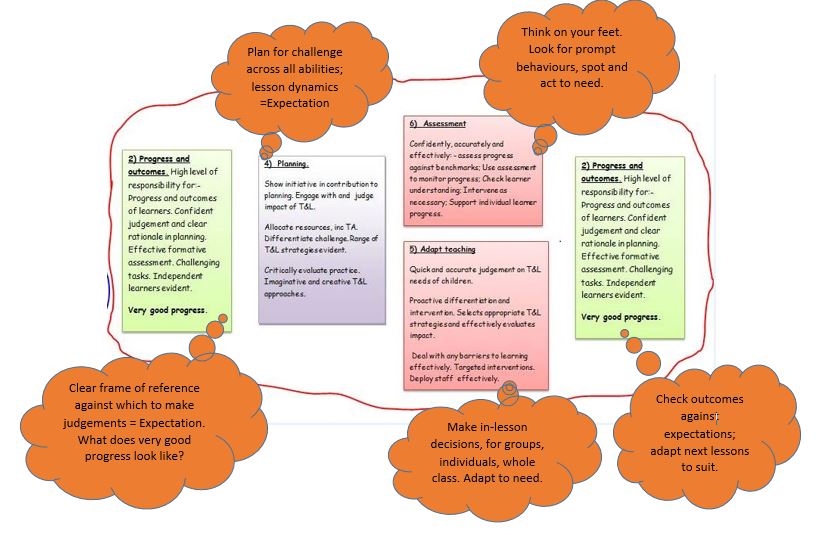
·         Engaging in discussion about outcomes and processes, with interpretation into descriptions of progress, are essential to every classroom decision, from overviews and broad decisions to refined interactions.
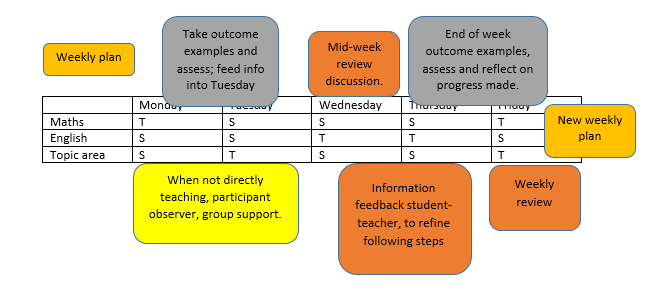
·         How about a book club, which could be expensive if supplying a copy to everyone, or a led book session, with one colleague each month sharing an education book that they have read? This could also develop with a fiction title or an author being shared. This latter idea could become a staffroom display, with colleague reviews encouraging others to have a read, and share with classes.
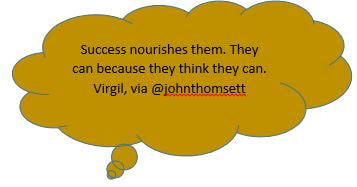
All the above can be classified as part of the general collegiate discussion. I would hazard that it is rarely considered as any form of CPD, which has become synonymous with “going on a course”. These events, often costly, may have limited impact if they remain the property of the attendee. “Cascading” is often a hit or miss affair, unless it is timetabled into other meeting times. Reporting back, with a summary appropriate to the school needs would seem to be a minimum requirement after a day out of school that’s cost perhaps £500 in total.

The essence of all education is communication. Collegiate, talking schools share good practice and ideas, to the advantage of the whole. Talk is relatively cheap CPD, unless you count the cost of a cuppa and a good biscuit or two.
​
Keep talking…

Picture
Picture
0 Comments

Mentoring and Coaching

17/11/2017

0 Comments

 
​See earlier post if interested.

The words coaching and mentoring seem to be regularly passing through my experience at the moment, partly as I am responsible for training mentors within a Teaching School Alliance and in my role as a university link tutor, but they also passed through a presentation by a colleague at Winchester University.

The role of a coach or mentor is focused on the person whom they are seeking to develop. The University example drew from sporting situations, where the guiding person is regularly seen as a coach.

Wondering what the difference is between a coach and a mentor, I came to the following conclusion; a coach is someone who supports development of discrete skills through exploration and improvement advice in each area, whereas a mentor, to me, signifies someone capable of nurturing a whole talent, always focused on the bigger goals, helping the trainee to maintain their own focus on agreed targets.

Being a coach and mentor is not unusual. Teacher mentors are, at one and the same time, coach and mentor, keeping the bigger picture in sight while exploring the details along the thinking journey. It is a positive, developmental eye kept on the process of becoming a teacher, as well as the outcomes.

Below is a diagram exploring the thinking process within teaching; based on the analyse, plan, do, review, record idea that I have explored in other posts. These statements link with the Teacher Standards as they currently exist; 2 Progress and outcomes (know your children), 4 Planning (order and organisation for lessons), 6 Assessment (thinking in and between lessons), 5 Adaptation (spotting needs and doing something about them). A return to 2 will be based on a more detailed understanding of the children, allowing subsequent information sharing and challenges to be more refined to needs and achievements.

The mentor role is to unpick the detail of each element within the whole, engaging in a reflective dialogue with the trainee, so that it can be put back together within the agreed lesson structure. I was introduced to the “whole-part-whole” approach by a PE inspector early in my career. While it can be overt in a PE lesson, it can also apply in any other learning situation.  

Picture
As a mentor, judging when to allow the trainee to operate “independently” is likely to be a key decision, based on many factors, but, more likely, an understanding derived from the dialogue that the trainee is confident and sufficiently organised to “have a go”. There may well be a need for the mentor to step in, quietly and unobtrusively, to prompt the trainee to take timely action. In many ways, this is more profitable than a reported conversation after the event. As mentor confidence in the trainee grows, greater autonomy is granted. There are similarities, in my mind, with parenting, allowing a child to make independent trips into town alone. As confidence in abilities grow, a more relaxed approach develops.
​

The mentor is then needed as a sounding board for discussion of the process and the outcomes, with the trainee, as much as the mentor, identifying the areas where further reflection is needed.
Picture
​But, and it’s a big but, the difficulties arise within the complexities that exist in several areas.

Consider again; 2 Progress and outcomes (know your children), 4 Planning (order and organisation for lessons), 6 Assessment (thinking in and between lessons), 5 Adaptation (spotting needs and doing something about them).
The first (2) encompasses the whole of child development for the age groups being taught, across a wide range of subject areas within the Primary Curriculum.

Subject knowledge, standard 3, as a teacher must include the pedagogy of how to teach the subject, across the age range, understanding the steps that children have to take to acquire proficiency, selecting of appropriate vocabulary to aid the narrative of the lesson and also having a good understanding of the available resources that are available in and outside the school.

Standard 4, planning, needs to consider planning over different timescales, long, medium and short term, to ensure coverage, use and application of the known in challenges. Planning structures can be a variable between schools, and imposed structures can become limiting factors for individuals. Plans should support the order and organisation of learning.

Standards 6 and 5 may well have to be the subject of much coaching, as they constitute the thinking teacher skills, inside and between lessons; reacting to evident needs and doing something about them, to affect the learning dynamics for individuals, groups or the whole class. Checkpoints and interventions (please don’t call them plenaries) to need are positive. Just stopping the class to show that you can is a waste of time.
​
And then we’re back to 2, a reflection on the lessons from the lesson, that will guide decisions for the next lesson, where adaptation may be required. It’s the get it, got it, good approach to assessment; get it, move on; not got it, review next lesson before moving on.
Picture
The essence of all good coaching and mentoring is communication, mutual understanding of the job in hand and how it will be tackled. Dialogue is, by far, the strongest approach, with the trainee and the mentor working out together the needs of the trainee and the best training path over the agreed timescale.

The plan is for the trainee to enact and the mentor to oversee and provide a developmental commentary, together with personalised areas for further development, which, in the case of teaching, can be areas to reflect on, to read about or signposting to discuss with a knowledgeable colleague.
​
The mentor role will always be to make the trainee as good as they can be. Limitations can be very personal, in understanding the complexities within each of the simple statements, such as planning and subject knowledge. It’s sometimes like having all the jigsaw pieces but not a clear picture of how they fit together. That’s a significant part of mentoring; holding onto the bigger picture. They are, after all, good at their craft.

​Shared experience is excellent CPD.


0 Comments

It's Good To Talk

29/10/2017

0 Comments

 
On social and emotional aspects; spot, stop, talk and care.
​
Picture
It was the best of times, it was the worst of times, it was the age of wisdom, it was the age of foolishness, it was the epoch of belief, it was the epoch of incredulity, it was the season of light, it was the season of darkness, it was the spring of hope, it was the winter of despair.

Charles Dickens; A Tale of Two Cities

I sometimes think that the above quote could apply to a great deal of human experience. At times, we are in a state of happiness, the next can be plunged into indescribable sadness. I have a bipolar friend who exists in such a state, an exceptionally clever man, capable of amazing strategic planning, creating several projects at the same time. This then becomes his difficulty, in keeping so many plates spinning, that, when they start to fall, he falls with them. He’s at the very sharp end of mental health issues, occasionally requiring hospitalisation and medical intervention.

This week, in the TES, Tom Rogers wrote about his own situation. It’s a very open and honest first-hand account of how mental illness creeps up and takes hold, destabilising the person and everything around them.

https://www.tes.com/news/school-news/breaking-views/we-owe-it-our-students-discuss-our-own-struggles-mental-health-one

From my own life, I would highlight two points of significant sadness, the first was when my mum walked out on us. As a child of twelve, this was devastating, even more so because it had been talked about for several weeks; it would happen on a specific day, when she had finished the summer season in a local hotel. Separation and divorce in the mid-1960s was messy, so the formal situations, meetings with magistrates who had to decide where we’d live, added to stress, rather than being supportive. It affected my sister far more than me. For some reason, my defence mechanism was to believe that mum had died, it was easier than feeling rejected. An unexpected meeting at my sister’s house, some ten years later, led to many tears in the car afterwards; more from opportunities lost. Fortunately, my first wife, Della, was with me and was my talking companion, creating an appropriate perspective.

After Della’s death, following twelve years of living with breast cancer was an equally devastating event, in some ways ameliorated by the time scale and being able to support her through the last couple of months. However, I did, for several weeks, take myself off into the woods, or other quiet spots, armed with a notebook, where I sat and “talked to myself”, as prose and poetry. I gradually talked myself back to a form of reality.

A kind friend, whom I eventually married, was my Samaritan and walked with me while I talked. Bereavement is an odd time for all concerned. Some people, for the right motives, manage to say the wrong things. It got easier.

 Is your school a listening school?

Feeling sad, to differing degrees, or just being out of sorts is a natural part of living. Getting things done can demand a bit of extra effort, which some seek to call grit and resilience. To me, that would depend on the nature of the challenge and whether the person seeking to accomplish it has a clear understanding of purpose, so that their efforts are focused. “Pulling yourself together” might just require a modicum of interactive therapeutic talk.

The problems can increase if there seems no end to the sadness or if there seem no options for your own efforts to get past obstacles. This can be made worse by having no-one to turn to or to talk with.

My personal Samaritan is also a Samaritan in her spare time, manning a local telephone, answering texts or emails or meeting with callers. This scheme offers a listening ear in different forms available throughout the day and well into the night.

A report in the Guardian, based on a Care Quality Commission report showing that there can be an 18-month wait for a referral to Child and Adolescent Mental Health Services (CAMHS) for those with potential mental health issues.

https://www.theguardian.com/society/2017/oct/20/children-waiting-up-to-18-months-for-mental-health-treatment-cqc

Long delays are leading to some children starting to self-harm or fall out of education, couples breaking up and parents having to stop working so they can look after their child, the charity Young Minds said. Statistics show that one in five children referred for treatment in England cannot be seen by overstretched child and adolescent mental health services, and some families end up seeking private care.

Or are you too busy?

A child in school can exhibit anxieties in a wide variety of ways; while some can talk and explain, seeking out their personal listening ear, others act out in some way, which inevitably causes a different level of school concern.

I want to encourage adults to be a STARR; stop, think, ask, respond and report. All adults in school are the eyes and ears of the organisation, any of whom should be able to interact with any child whom they suspect might be showing distress to some degree. In some schools there are specific staff with roles that involve taking the initial concern and seeking to understand the issues more fully. Their role is to allow the child to talk and develop their own story. This may need to be verified in some way, or, in extreme cases, might involve escalation to higher authority, or to external organisation such as Child Protection.

Developing the child narrative is an essential precursor to creating a case study to share with someone like an Educational Psychologist, if a developing concern, or with Child Protection if a sudden need. Collated via several sources, with evidence of antecedents, behaviours, consequences and decisions, the more evidence, the better.

While adults might begin to suspect a mental issue, teachers and school staff are not qualified to diagnose. Their role, in spotting and describing clearly the social and emotional elements in a child’s life could be the significant difference that leads to an appropriate intervention. Sometimes, it can be the spotting and chatting that offers insights and guidance, sufficient to provide the child with skills to support themselves. Sometimes, the spotting and chatting can open a can of worms that has to be addressed to safeguard the child. Despite some teachers thinking otherwise, spotting and caring have always been a part of the teacher role. Long may it remain so.

Although we might hope that parents are aware and the first line of support, for a number of children, their teacher can also be their Samaritan; don’t walk by…
​
It’s good to talk.
​
Picture
0 Comments

Groupwork; Talk your Thinking

11/10/2017

0 Comments

 
Picture
Much is talked about the perils and downfalls of group work, usually in terms of not being able to guarantee that every child is giving equal effort or learning the same as the others. I would suggest that, even in the quietest classroom, it is highly unlikely that every child will be learning equally which could be demonstrated by the range of marks should a test be administered to check what they knew.
Group working, for some becomes a ritualistic activity, where children are given “roles” to be enacted almost within a scenario. Where this falls down, in my experience, is that the child then has to think how a chair or reporter has to think then possibly act out of character. It is the equivalent of playing charades, something I seek to avoid at parties!
Having a problem to solve and talking together, making decisions about working methods, structuring a plan of action and then following through together, with permission to evaluate and adapt on the way, has always been my personal approach, across a range of Primary subjects.
Given a challenge, as equations or an investigation in maths, a collaborative story/play in English, a cooperative piece of art work, a science investigation or DT working model, each has given sufficient idea of an “end point” to provide the stimulus for activity. Self-determining groups also became self-moderating groups, ensuring that everyone contributed.
I have used this approach with every age between 4 and 16, with positive outcomes. Yes, some may contribute a little less than others, but peer pressure can be a very powerful driver.
The need to articulate thinking, so that every member of the group is fully aware of what is happening, is an important element. Good communication enables clarification, the bringing together of multiple viewpoints. Planning processes support action, with the ability to harness specific skills, enhancing the status of some who may have a chance to demonstrate often hidden abilities. Permission to evaluate and to reassess working methodologies, in-task, allows for an “oops” moment and a rethinking of ideas.
The independence that can be created through high quality, purposeful group activity enables a teacher to identify and focus on those who need support through different stages. It is important for the process to be evident, as reflection on the process, as well as the outcome enables children to improve stages and therefore subsequent efforts.
Ultimately, the essential components of independent group work are quality challenges to get their teeth into, a manageable group size, possibly 2/3 at 5-7, 3/4 at 7-16; although some topics may lend themselves to other sizes.
They need something that requires high quality talk that offers a clear purpose and has a definite end point, preferably with a broad audience, as a presentation or display.
Group work can embed much of the social curriculum; getting on together and seeing the other side of someone.
Group work is effectively a life skill.
0 Comments
<<Previous

    Chris Chivers

    Long career in education, classroom and leadership; always a learner.
    University tutor and education consultant; Teaching and Learning, Inclusion and parent partnership.
    Francophile, gardener, sometime bodhran player.

    Archives

    March 2021
    January 2021
    July 2020
    June 2020
    May 2020
    April 2020
    March 2020
    September 2019
    June 2019
    May 2019
    April 2019
    March 2019
    February 2019
    January 2019
    December 2018
    November 2018
    October 2018
    September 2018
    August 2018
    July 2018
    June 2018
    May 2018
    April 2018
    March 2018
    February 2018
    January 2018
    December 2017
    November 2017
    October 2017
    September 2017
    August 2017
    July 2017
    June 2017
    May 2017
    April 2017
    March 2017
    February 2017
    January 2017
    December 2016
    November 2016
    October 2016
    September 2016
    August 2016
    July 2016
    June 2016
    May 2016
    April 2016
    March 2016
    February 2016
    January 2016
    December 2015
    November 2015
    October 2015
    September 2015
    August 2015
    July 2015
    June 2015
    May 2015
    April 2015
    March 2015
    February 2015
    January 2015
    December 2014
    November 2014
    October 2014

    Categories

    All
    Assessment
    Behaviour
    Differentiation
    English
    Experience
    History
    Home Learning
    Inclusive Thinking
    Maths
    Parents
    Science
    SEND
    Sing And Strum
    Teaching And Learning

    RSS Feed

    Picture
    Click to set custom HTM L
Powered by Create your own unique website with customizable templates.