Curriculum 1971-2014; broad, balanced and relevant.
Curriculum 2018; knowledge rich (or learning rich)?
Put simply, classroom learning is children, context, engagement, guidance and adaptation, evaluation of outcomes. The whole captured within communication.
Remembering always the maxim that education( life) is a journey not a destination. (Ralph Waldo Emerson, an American essayist, poet, and leader of the Transcendentalist movement in the early nineteenth century.)
It’s strangely fascinating occasionally just to be a bystander to conversations on social media. There’s a current penchant for everything curriculum, as if it’s the next new thing that no-one has ever thought of before You can almost hear the sound of cash tills ringing with the book potential.
The recent Ofsted commentaries on curriculum are strangely reminiscent of earlier HMI statements, one series of which was dubbed the “raspberry ripple” books because of their covers. The September 2018 commentary suggested that there was a lack of curriculum development expertise. In some ways this is not surprising, as for twenty years curriculum and pedagogy has been engaged through ever tighter dictat, seemingly removing teacher and school discretion, whereas autonomy is the life-blood of a thinking organisation.
Forgive me for being old(er). I started as a classroom teacher in 1974 after three years at training college; my first Primary class will now be coming up to 55 years old. In that extended career, I never worked in a school without a curriculum in some form. Some were stronger than others. They might have been based on a scheme for maths and English, with Topics (now called the foundation subjects) being the area that was apportioned to specific year groups. Once you knew the topics, there was the search for the available school resources, or perhaps an investigation in the locality to seek out appropriate places to visit or people with local interests. We were, to all intents and purposes, organising the knowledge, supplemented by the County Library Service and, from time to time, museums and costume services. It was relatively easy to put together a package of essential knowledge that would be shared, sometimes with teachers making some kind of information book that was derived from the various sources.
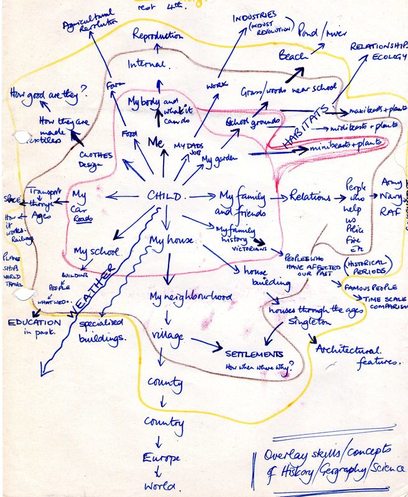
In looking through my notebooks from my career, I came across a diagrammatic version that was the top layer of an early curriculum map. It’s not detailed, but an overview that enabled themes to be allocated to year groups, then further developed through locality resources and resource boxes.
In many ways variations on this have been a feature of my career. Start at the top layer, then work ever deeper, providing greater detail at different points to support teacher thinking in their classroom. This last layer might include agreed details that have to be structured into the theme narrative and retained for future use.
Curriculum 2018; knowledge rich (or learning rich)?
Put simply, classroom learning is children, context, engagement, guidance and adaptation, evaluation of outcomes. The whole captured within communication.
Remembering always the maxim that education( life) is a journey not a destination. (Ralph Waldo Emerson, an American essayist, poet, and leader of the Transcendentalist movement in the early nineteenth century.)
It’s strangely fascinating occasionally just to be a bystander to conversations on social media. There’s a current penchant for everything curriculum, as if it’s the next new thing that no-one has ever thought of before You can almost hear the sound of cash tills ringing with the book potential.
The recent Ofsted commentaries on curriculum are strangely reminiscent of earlier HMI statements, one series of which was dubbed the “raspberry ripple” books because of their covers. The September 2018 commentary suggested that there was a lack of curriculum development expertise. In some ways this is not surprising, as for twenty years curriculum and pedagogy has been engaged through ever tighter dictat, seemingly removing teacher and school discretion, whereas autonomy is the life-blood of a thinking organisation.
Forgive me for being old(er). I started as a classroom teacher in 1974 after three years at training college; my first Primary class will now be coming up to 55 years old. In that extended career, I never worked in a school without a curriculum in some form. Some were stronger than others. They might have been based on a scheme for maths and English, with Topics (now called the foundation subjects) being the area that was apportioned to specific year groups. Once you knew the topics, there was the search for the available school resources, or perhaps an investigation in the locality to seek out appropriate places to visit or people with local interests. We were, to all intents and purposes, organising the knowledge, supplemented by the County Library Service and, from time to time, museums and costume services. It was relatively easy to put together a package of essential knowledge that would be shared, sometimes with teachers making some kind of information book that was derived from the various sources.
In looking through my notebooks from my career, I came across a diagrammatic version that was the top layer of an early curriculum map. It’s not detailed, but an overview that enabled themes to be allocated to year groups, then further developed through locality resources and resource boxes.
In many ways variations on this have been a feature of my career. Start at the top layer, then work ever deeper, providing greater detail at different points to support teacher thinking in their classroom. This last layer might include agreed details that have to be structured into the theme narrative and retained for future use.
These early thoughts were supplemented further with a very active inspection and advisory service and teachers centres that provided both courses and in-house support to school development.
From an earlier blog:
Curricula are usually written by experts, from the expert perspective, ensuring that information is delivered, whether or not it is appropriate for the learner’s current needs.
As teachers, unconstrained by predetermined curricular expectations, we were able to assume the mantle of experts, reflecting on what the four year olds brought with them in the way of life experiences which would be the start points for school based experiences and exploration.
So history started as My story, based on storyboards created with a series of photos, then developed into His or Her story, with reference to parents and grandparents. Local walks to look at houses of interest started a link between History and Geography, with sketch mapping, drawing in situ or photos being taken (development time, much easier now?). Parents and grandparents came to tell their own stories, recorded onto c45, 60 or 90 tapes to be replayed and reflected upon. For homework, children were asked to telephone grandparents to ask a series of questions. Timelines were created throughout, so historical perspectives were constantly being revisited, as knowledge was added. And we got back to the Victorians with photograph based family trees, together with the accompanying narrative.
Building materials became the stuff of science, complemented by Lego or other construction material, as well as clay models of houses, made out of very small bricks, fired in the kiln. Trials with garden clay compared to the bought variety. One child brought in a tile found in their garden, which we took to the local museum to be told it was Roman. Visiting the local church we discovered even more tiles, being used as wall bricks and on the way back a local aunt offered the chance to have a look inside a house originally dating to 1580. I know, risk assessments, CRB etc. The Tudor context allowed exploration of timber as a building material. One idea often led to another, with settlements, including the Anglo-Saxon beginnings of the village being explored, with the support of the local history society.
In reality, what is a curriculum? It is a series of related contexts within which learners will enhance their understanding of the world in which they live, allowing opportunities for language acquisition, broadening communication, real contexts for writing and other recording. The mathematics of measures and data creation supported the core learning at every age. So the basics were the backbone of topic work. The contexts provided the creative structures into which the relevant subjects could be fitted.
Asking questions and seeking answers were the basis for both library research and experiential science activity, which might be based on the notion of finding out interesting ideas to share with the rest. Every subject had value for what it brought to the child as thinking and learning opportunities. The art table was a permanent fixture within the classroom, with half a dozen children regularly interpreting information in picture form.
When the National Curriculum was brought in in 1987, I was a deputy in a First School. Our audit of the school curriculum against the NC showed a 95% correspondence, with a couple of tweaks to be effected.
This became a feature of revisions; small tweaks were needed to accommodate the update.
I came across my notes from 1987, when I had responsibility for science. I had grouped the sixteen attainment targets, yes 16, into three main areas; scientific processes, our environment, make it move/forces, and three supplementary areas; electricity/magnetism, sound and music and light. These might have been organised as larger, three-week projects, or perhaps a week of experiences.
It was not long before a reorganisation led to the sixteen ATs becoming four main areas; virtually the same content, but a reduction in areas for assessment, essentially materials, physical world, living world and scientific exploration.
When I became a HT in 1990, we worked hard on the curriculum, because, although the school had taken on elements of the NC, there were gaps which needed to be addressed.
The approach was refined over time and can ne read about in a blog on planning. There is a clear focus on layering.
In addition, as a school, we also looked at quality versus quantity in writing.
It was clear that children were being asked to undertake a considerable amount of writing, but that, for the most part, any writing in subjects other than English were of poorer quality.
We moved from this to identify the main writing approach for the week, which would be developed through different stages; modelled, organised and drafted, with occasional redrafting for display quality, for an audience.
The two-page approach to writing that we developed is shared as writing process, tweak your books which morphed through all writing in one exercise book, to using the exercise book as a personal organiser. This highlighted that writing is writing in every subject. It allowed for each week, or fortnight to be devoted to a particular project, perhaps a report from a practical experience, to letter writing, or imaginary story. As a head, I encouraged teachers to consider the use of time available for quality writing. This could be an hour by hour for essential teaching and modelling, note making or early organisation activities. It might be a morning to enable a range of drafting and evaluation/critique activities. Timetable flexibility allows quality to emerge, rather than unfinished work. Over time, the time frames reduced to emphasise fluency.
Topic areas, essentially the foundation subjects, were organised in different layers, as articulated in the planning blog. Topics lasted as long as was needed, but all allocated topics had to be shared. Topic themes were resourced by subject coordinators, with a topic specification and a collation of the resources available within the school. Book resources were sourced through the County Library Service.
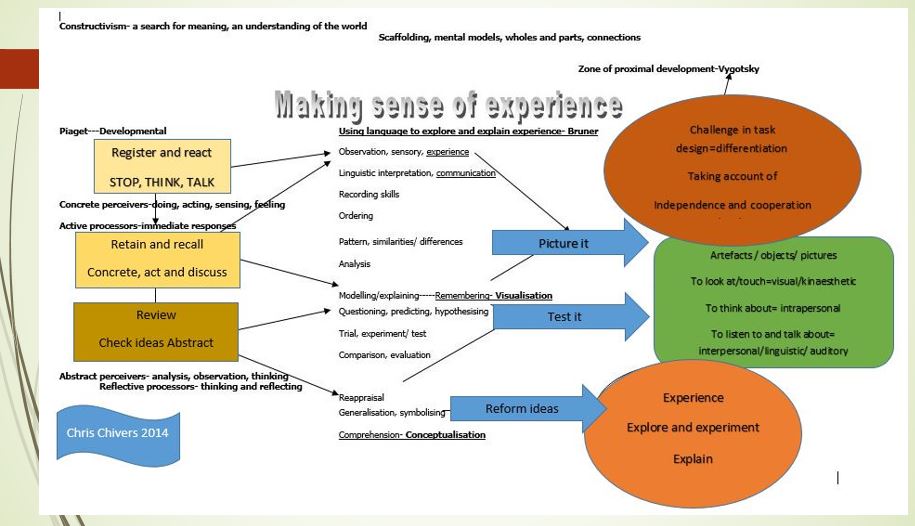
Within these areas, we reflected on the commonality of learning themes and came up with the “Making Sense of Experience” model; a means of looking at deepening experience, at any age. The “Experience, explore, explain” mantra was central to the thinking; simple enough to remember, but embedding many different elements.
In 2014, the current NC was enacted. Having listened to Tim Oates, when we shared a panel, telling the assembled staff that the 2014 version was created to be easier to test, I started to worry. With it being maths and English heavy with testing in these areas, the next few years have shown that the wider curriculum has diminished, in some cases significantly. However, there is a strong argument for the curriculum retaining its breadth and depth.
So why are we where we are?
My simple answer would be estate-wide small thinking, more from the point of view of ever closer attention on the minutiae of teaching and learning, especially by some individuals who have made national and international names, and a lot of money from publishing, by a focus on small bits. The words that we use, such as differentiation, assessment, planning, writing, reading, phonics along with others, have been packaged and repackaged into formulae, then interpreted into book form, to be sold into the education spending market, which itself has grown significantly over the past 25 years.
A couple of the latest high-profile areas are “growth mindset” and research. Each has the potential to become formulaic, distracting and ultimately to be devalued. The former, to me is what teaching and learning are all about, otherwise what’s the point and the latter, as an investigative mind-set, is what I’d want from all teachers, seeking to refine their practice.
The issue with buying a scheme for doing the thinking for you is that you can stop thinking about the whole and how things fit together, and that’s what I’d say some have done. These schemes can dictate timetables, as children are packaged up into appropriate sized groups to undertake the specified activities, often led by the less well-informed members of staff, so that, although “coverage” might be assured, the depth of understanding might be suspect for many. These groups are, by default, mini sets or streams, so can become self-limiting systems. Time is also lost, as children move between areas of the school to be part of their small groups.
There has been successive reorganisation of priorities, with literacy and numeracy taking over from English and Maths, with a subsequent downgrade of other subjects, all of which provide the background information against which English and Maths operate in the real world. There is talk of the knowledge curriculum, but the knowledge areas of the curriculum, in some places and for some children are under some threat.
The small thinking arises out of a sound-bite need for politicians, to show that they are doing something to improve the situation. The Literacy Hour was not the be-all and end-all of the Literacy Strategy, yet it became the simplistic message given on the radio and TV every morning. For the past four years, we have heard phonics equals reading as the mantra.
The problem with both messages is that it can distort practice to the point where other aspects of each subject, which are equally or more vital, are diminished, so teachers and children lose sight of the bigger messages.
Levels became the bête noire of the system because they became distorted into data points, rather than remaining as the progress descriptors that they were in the beginning. From misuse, they lost their purpose and became distorting, as they became high stakes in showing progress. The number and the data point lost the accompanying words, but, at least in some of the foundation subjects, the words could still be a useful starting point for reflection on progression.
Like all things, I’d argue that a focus on detail is essential, but that at every stage any change in one aspect needs to be reflected upon across the whole learning system, otherwise it can be distorting.
It’s a little bit like an exercise regime where concentration on one part of the body can create a distorting effect.
It's got to start with the whole, consider the parts and then put the whole back together.
And when it comes down to simplicities, the whole relies on effective communication in all forms, pitched to the audience, using words that they can understand, sharing images to supplement the words and to enhance the capacity to make links with earlier experiences.
It takes an aware teacher to be able to do that with facility. Teachers need subject and pedagogic knowledge. Thinking teachers sharing a thoughtful curriculum and supporting each other with their own knowledge and sharing successful pedagogy can significantly alter the curricular diet for every child.
My simple answer would be estate-wide small thinking, more from the point of view of ever closer attention on the minutiae of teaching and learning, especially by some individuals who have made national and international names, and a lot of money from publishing, by a focus on small bits. The words that we use, such as differentiation, assessment, planning, writing, reading, phonics along with others, have been packaged and repackaged into formulae, then interpreted into book form, to be sold into the education spending market, which itself has grown significantly over the past 25 years.
A couple of the latest high-profile areas are “growth mindset” and research. Each has the potential to become formulaic, distracting and ultimately to be devalued. The former, to me is what teaching and learning are all about, otherwise what’s the point and the latter, as an investigative mind-set, is what I’d want from all teachers, seeking to refine their practice.
The issue with buying a scheme for doing the thinking for you is that you can stop thinking about the whole and how things fit together, and that’s what I’d say some have done. These schemes can dictate timetables, as children are packaged up into appropriate sized groups to undertake the specified activities, often led by the less well-informed members of staff, so that, although “coverage” might be assured, the depth of understanding might be suspect for many. These groups are, by default, mini sets or streams, so can become self-limiting systems. Time is also lost, as children move between areas of the school to be part of their small groups.
There has been successive reorganisation of priorities, with literacy and numeracy taking over from English and Maths, with a subsequent downgrade of other subjects, all of which provide the background information against which English and Maths operate in the real world. There is talk of the knowledge curriculum, but the knowledge areas of the curriculum, in some places and for some children are under some threat.
The small thinking arises out of a sound-bite need for politicians, to show that they are doing something to improve the situation. The Literacy Hour was not the be-all and end-all of the Literacy Strategy, yet it became the simplistic message given on the radio and TV every morning. For the past four years, we have heard phonics equals reading as the mantra.
The problem with both messages is that it can distort practice to the point where other aspects of each subject, which are equally or more vital, are diminished, so teachers and children lose sight of the bigger messages.
Levels became the bête noire of the system because they became distorted into data points, rather than remaining as the progress descriptors that they were in the beginning. From misuse, they lost their purpose and became distorting, as they became high stakes in showing progress. The number and the data point lost the accompanying words, but, at least in some of the foundation subjects, the words could still be a useful starting point for reflection on progression.
Like all things, I’d argue that a focus on detail is essential, but that at every stage any change in one aspect needs to be reflected upon across the whole learning system, otherwise it can be distorting.
It’s a little bit like an exercise regime where concentration on one part of the body can create a distorting effect.
It's got to start with the whole, consider the parts and then put the whole back together.
And when it comes down to simplicities, the whole relies on effective communication in all forms, pitched to the audience, using words that they can understand, sharing images to supplement the words and to enhance the capacity to make links with earlier experiences.
It takes an aware teacher to be able to do that with facility. Teachers need subject and pedagogic knowledge. Thinking teachers sharing a thoughtful curriculum and supporting each other with their own knowledge and sharing successful pedagogy can significantly alter the curricular diet for every child.
 RSS Feed