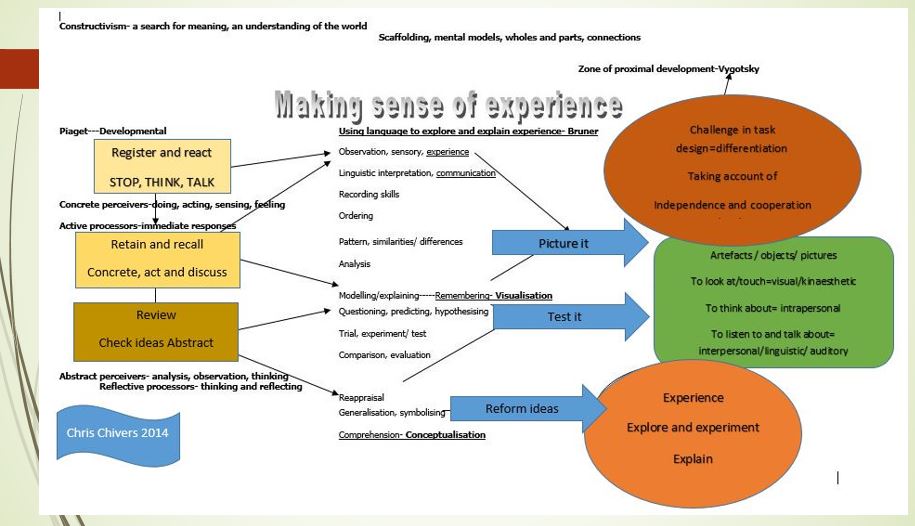
Chris Chivers (Thinks)

  • Home
  • Blog-Thinking Aloud
  • Contact
  • Contents
  • PDFs
  • Sing and strum

Teaching and Doctoring

28/6/2015

0 Comments

 
Picture
Listening to the radio on a Saturday morning is, to me, a treat, especially when driving. On Saturday Live was a short interview with Samer Nashef, a consultant cardiologist from Papworth Hospital, who sets the crossword for the Guardian. It wasn’t that which caught my ear though, it was his honest account of how he determined to became a doctor in the first place, after hospitalisation for pneumonia as a child, then how he became a surgeon.

Spending time as a junior during ward rounds, Samer described how he would regularly encounter consultant surgeons approaching a sick patient, who was ignored while the surgeon expounded his diagnosis based, not on the real symptoms as expressed by the patient, but according to the latest paper that he (usually male) had read on the subject. Samer became concerned, as his own discussions with patients often showed that they had no clue as to what was happening to them. He developed approaches that were based on the dialogue with the patient. In 1995, he led a group which developed the EuroSCORE system –a safety and monitoring tool which predicts the outcomes of heart surgery by analysing the risk factors presented by individual patients. He’s also written a book called The Naked Surgeon, written to demystify surgery. Surgery, to him, is a people activity, not a paper one.

This was the point which I caught and reflected on, as the teaching profession is seemingly bombarded with prescriptions from all sides, not least from “Doctors” Gibb and Morgan. There is an almost daily diet of what’s “right for all children”, which often means doing exactly the same for longer, if the children don’t “get it” the first time. It almost seems irrelevant that a child might have specific needs which require an adaptation to practice, more is better. Doctors prescribe drugs to a patient, on the basis of the patient descriptor of symptoms. It makes both the patient and the doctor happy that they have done something. On occasion the drugs have side effects, at which point it can be the case that another drug is prescribed to counter the side effects. This approach, with a doctor seeking to mollify an anxious relative, led to a sudden collapse, which, on exploration, was caused by the cocktail of drugs.

Diagnosis and prescription need to be nuanced. Much effort is currently being put into personalising drugs to combat cancer.

In the same way, the diagnosis and prescription of educational need also needs to be nuanced, with the practitioner able to select from the available remedies the appropriate one for the need. This nuance requires teachers with the ability to explore inconsistencies in symptoms in a way that supports their diagnosis and to have available a range of remedies that can be put in place in timely fashion.

Doctors and surgeons don’t regularly see well people, only those with symptoms of ill health. In the same way, the majority of learners, given a healthy diet, careful nurturing and positive reinforcement, don’t cause the teacher too many problems.

We need doctors and teachers to be attentive listeners and watchers, to pick up the signs of poor health and development, not just to be able to quote the latest research paper.

Talk with children, they are the experts on themselves, at least as far as trying to explain their symptoms.

0 Comments

Behaviour management - restraint

23/6/2015

0 Comments

 
Picture
Restraint is an interesting word when applied in a behaviour management context, as it has two meanings.

There is self-restraint.

I used to find that, when confronted with a difficult child or parent, I would naturally calm and quieten, which was disconcerting for the other, but also enabled me to think and talk clearly. It enabled early calm in discussion, allowed the child or parent to have their say and brought about a more satisfactory outcome.

My discussions with children were always premised on the principle that they would tell me “their truth”, that I would accept that this was how they saw the situation, but that I would carefully check their story, in case there were other views. They were then confronted with alternate views and my decision.

And then there’s restraint…

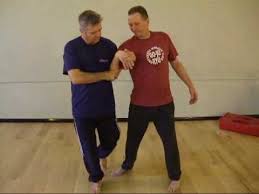
I’d been a teacher and headteacher for 32 years, when my first wife died and I took on a part time SENCo role to be better able to look after my teenage son.

This occasioned the need to undergo “Team Teach” training, more commonly known as restraint training, as the school had taken in a child, J, with a history of physicality in the Infants. He spent time in our Nurture group and seemed to be making progress. The restraint training was a just in case measure, or so we thought at the time.

The worst that happened initially was that he went off site and having seen him in the distance, I followed him until he eventually got to his home, where I was able to have a useful chat with his mother.

It was a somewhat disconcerting aspect of the time after the Team Teach training, that those who were trained were then on edge, as we were “on call”, ready to move at a moment’s notice and then the lad decided to pick up a chair and throw it at a window. Having evacuated the others, the three trained people were duly called for and spent time trying to talk him down. Eventually I managed to get close enough to hold him appropriately, while still talking and managed to remove him to a place of safety. Suffice to say that he was excluded at that point.

In thinking about restraint, though, it brought to mind B, a solid infant, arrived fresh from London with his family, we discovered later, as a result of a “moonlight flit”, to find themselves in a less built up area. No records accompanied the arrival, then, but, with some very detailed investigative work a bit later, we discovered more of the details, which every teacher might second-guess.


B didn’t like working, or at least putting pencil to paper, but he was a mine of information about every subject you cared to discuss. He got excited by oral learning, but then closed up when paper was put in front of him. Marks were careless and meaningless. These were perhaps significant dyslexia related warning signs, but they could, at times, be accompanied by another side, a stubborn withdrawal into himself, which was almost self-hypnotic, as he also uttered a low moan. At first this was merely disconcerting, but, after a few episodes, this became physical, with others in danger of being hit.

My instinctive reaction was to envelope him to make sure that he could not lash out, all the while talking to him positively and making sure that the rest of the class were functioning as well as possible. Being in an open plan school helped as a colleague could help to keep an eye on both classes. It took time, but, adopting the role of “whisperer”, feeding positive alternatives and considerable encouragement, B began to settle, to read in the first instance, then to start the painful process of tackling writing which was a couple of years behind his peers, who were quite amazing, taking him under their wing, making sure that he had friends and encouraging him in their own way. It took the best part of the year, but B settled and started to make progress, which in turn he found encouraging, so started to take his own steps, in a positive frame of mind.

Every teacher will have such stories. However well prepared you are for eventualities, there is always the potential for the episodic outburst, sometimes from unexpected places. I most schools these are rare, but, when they occur can cause a great deal of hurt, physically and mentally.

As a HT, if any event of this nature occurred, there was always a form of debrief, time out or time to calm for the staff concerned, whatever they needed. Keeping calm is challenging for a teacher in a conflict situation. The adrenaline runs and it takes willpower not to respond in kind.

Simple advice; know your children well, read the signs, spot and deal, keep calm, be firm, be positive.

Picture
0 Comments

Behaviour management and "Upward Delegation"

22/6/2015

0 Comments

 
Picture
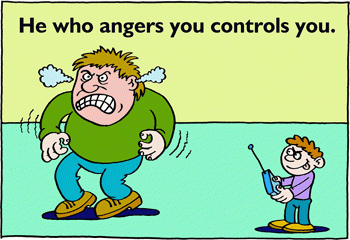
Behaviour management starts when you have to step into a situation.

Insecurity leads to insecure decision making.

I came upon the phenomenon which I dubbed at the time “upward delegation” when, as a headteacher, one of my staff began sending children to me to effectively be told off, usually for a very minor issue. When I discussed this with the teacher concerned, it seemed as if he had decided that to deal with the issue at the point of need would disrupt the lesson. The teacher did admit that the behaviour in his class did seem to be getting worse. He was losing status with the children as a significant adult, capable of dealing with them and what is now deemed to be “low level disruption”.

This was the equivalent of “Wait ‘til your father gets home”, where the authority of one parent is seen as greater than the other, so is deferred to, at a cost. The role of the “teller off in chief” is not then an easy one, in that, if the adult seeing the issue has somehow misread a situation, as sometimes happens, the “teller off” may have to take a more lenient line in resolution, so annoying the teacher. At this point, the senior leaders are deemed by teachers not to be supportive, starting a spiral of decline in staff relations. Equally, the reactive behaviours become compromised and perhaps less effective over time, as this can be manipulated to advantage, or develop insecurities in the whole system.

Children do get “under the skin” and can become teacher targets. “Keep an eye on x” advice can mean that x cannot breathe without being seen doing something untoward. In x’s eyes things are “never fair”, often then leading to escalation of negative behaviour, essentially because they might as well, if they were going to be blamed anyway. The teacher who can admit that x has got under their skin may need colleague support, to talk through and come up with alternative strategies. It can also be the case that a move to another teacher might be the best option.

D was a bit “naughty”. He was eventually diagnosed with ADHD, after an extensive and exhaustive period of time where a case study was built from collecting episodic records demonstrating his various behaviours, at home, as well as school, including finding that both the father and grandfather had displayed similar issues, which, in their day was put down to being “practical jokers”, dismantling toilet doors, locks and other mechanical items, as examples. An incident on one day was blamed on D, by a lunchtime supervisor and a child. On the day in question, D was not in school. The response was that it was something that D would do.

The point at which “upward delegation” became a thing in my consciousness was a day to go back to the behaviour management policy with the teacher concerned and then the staff more broadly. We focused on the principles on which this was premised; responsibility for self, behaviour towards others and the environment. This was explored through the lens of choice and consequences, which brought the classroom behaviours into greater clarity for the teacher, with consequential decisions on his behalf. There was an exploration of the impact of teacher behaviours on the children, as individuals and as a collective. There had to be a system of restitution in the classroom, as deferential distance had diminished the impact and the teacher standing. The teacher had to be clearly “in charge”.

I also instituted the notion of the “paid nag”, which I used with the children in that class and then wider, to reinforce in their minds relationships, choices and consequence. This was based on the idea that I was the highest paid nag in the school, and I paid the teachers to nag in my place if I was not near. I put to the children that, if we let them get away with low level disturbance, their parents would nag me and the teachers and we didn’t want that, so we’d do our job. Their job was to “work in work time and play at playtime”, then it was fair to everyone and no-one would get nagged.

This simple set of mantras were heard less over time, only to be brought out on special days.  

0 Comments

Behaviour management and ITE

19/6/2015

0 Comments

 
This was going to be a short post trying to distil the “wisdom” of years into a few succinct phrases. As I began to think about the topic, new aspects popped up, demonstrating different facets of the whole. As the focus of the current discussion seems to centre on ITE behaviour management training, I have the perspective of a headteacher of 16 years of a 32 year, in-school career, as well as an ITE tutor for the past 9, supporting students in schools.

Having been party to the teaching input in two local universities for both undergraduates and postgraduates, I am aware that both groups receive guidance on behaviour management, at least in an overview form, which is then refined within the approach of their practice schools. No university can equip every student with a full toolkit of skills to be able to manage every eventuality. The initial training needs to be supported and developed with experienced practitioner mentors.

Over the years of ITE tutoring, where behaviour management has caused an issue during teaching practice, this has often been as a result of misunderstanding and misapplication of communal rules, or a personality clash with individuals in a class.

“Low level disruption” might be classified as teacher distraction from the intended purpose of the lesson. It is important that, should this occur, all aspects are, or have been considered, including teacher actions, which will have a bearing.

If I was seeking to provide a simplified set of mantras, I’d begin with an overview approach and seek to refine to the needs of a situation.

  • Catching them being good and acknowledging that is important, so that positive messages support good behaviours.

  • Have a clear rewards scheme in place, so that there is benefit in being good.

  • Decide whether rewards are to be intrinsic or extrinsic. Organise properly.

In the event of poor behaviour appearing;

  • TIC (Team including the Child; sorting things out within the lesson, or at the point of problem)

  • TAC (Team around the child; involvement of internal expertise to support and restore)

  • TOE (Team of Experts; in extremis, the need to involve counsellors, psychologists etc)

  • Within boundaries and a framework that fairly emphasised that choices could lead to consequences, with consistency across all practitioners.

  • This leads to a fair but firm approach.

  •  Possible to get things wrong, but need to admit and remediate.

  • Following up and following through as an essential element of good BM.

  • The ability to engage in restitution, or restorative justice approaches should be encouraged. There has to be a clear scheme for resolution.

All the above come into play when it is deemed that a child has stepped out of line in some way, always determined by an adult. Persistent behaviours should be subject to good record keeping, so that patterns can be determined and described, to be presented to experts if needed.

Like the laws of the land, the school rules have to be clear, so that the majority of children adhere to them, whether they know the exact nature or not.  

Community expectations

Schools are collectives, and, as such, will be subject to rules, in the same way as society has rules and laws used to hold individuals to account, where behaviours are determined to have transgressed certain boundaries. If these are agreed and communicated widely and regularly, their awareness is the baseline guide to expectations. Children and adults work within these rules; they don’t make them up as they go along. Some schools have long lists of articulated rules and sanctions, others don’t. It will depend on the philosophy (and the need) of the community. Of course, all rules can be subject to review, as the need of the community changes, but, in essence, they are likely to have the same outlines.

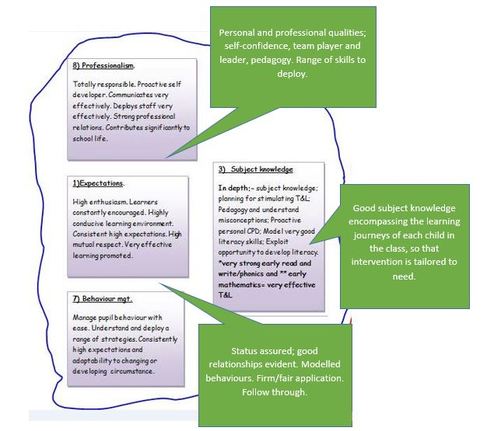
“Being a teacher”. There are a few key teaching standards that address this, 8,7,1 and 3, professionalism, behaviour management (theory), expectations, subject knowledge. These are the intrinsic aspects of the parts of professional status. Looking, sounding and acting as a teacher.

Picture
Order and organisation in everything.

Organise your space and the resources. Some will want to say that this is not behaviour management, but, over years, it has become clear to me that it can have a significant impact. Your classroom should be a place where ease of movement, and ease of accessibility of necessary resources will support both you and the learners. This will vary to some extent with the age range being taught and the needs of the teaching. Where furniture arrangement allows for bumping past each other, there is the potential for low and high level disturbance.

Not having the necessary resources to hand causes a hiatus in a lesson, “down time”, during which children become distracted. Most teachers have experienced what happens when the technology fails.

Books, paper, pens, pencils, etc, are all basic needs in a classroom. Keeping these topped up is essential, if that lesson and perhaps a neighbouring lesson are not to be disturbed. Never a lender nor a borrower be… sort the stock…

If you are using photocopied sheets, make sure there are enough and that they suit the purpose of the lesson. Poorly designed worksheets produce requests for interpretation, causing distraction.

Visibility and personal awareness is important. There’s a need for visual oversight throughout a lesson It is easy to turn your back on a class, at which point there’s the possibility that someone will take advantage. At an early stage in my career, a PE inspector gave some simple advice, which applies as much in a classroom as in a PE hall. He suggested that moving around the outside of the hall gave maximum oversight, that to get pulled to the centre enabled accidents to happen and they needed to be avoided.

It is so easy to get distracted into the needs of one group, especially one with a specific focus and to lose oversight of the rest.

The ability to spot and deal with issues as they arise is ultimately the most important point, as to leave low level disturbance will probably lead to escalation, through exaggerated behaviour or copying. Children need to know that you are looking, or are aware of what is going on. The “eyes in the back of the head” or “tune antennae” approach is needed.

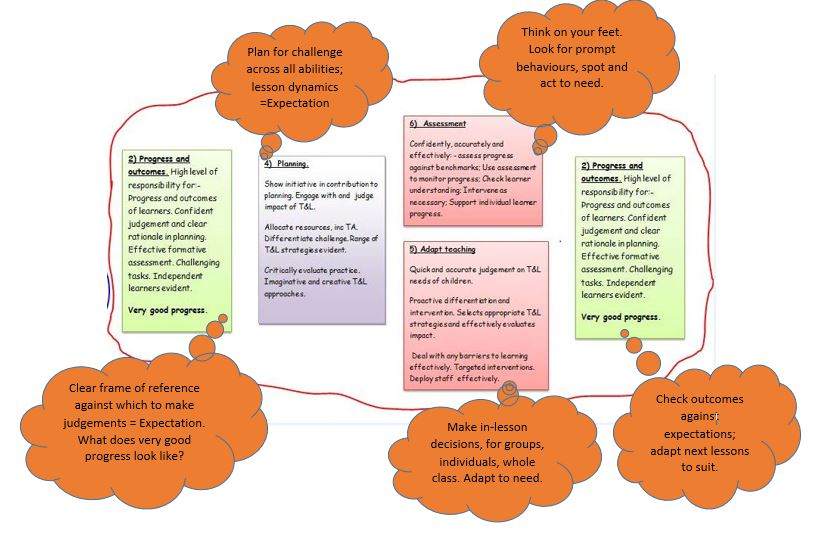
Knowing the children (TS2), including their home circumstances. This aspect underpins a great deal of behaviour management, especially for the “outliers”, those with known conditions, where specific approaches might be needed. As an ITE student new in a school, this is a missing part of their knowledge, which, applied to classes, has an impact on their planning (TS4) and their ability to think on their feet and adapt to identified needs (TS6&5), these latter issues being the most significant, as children can then “get away with things”.

This point also applies to NQTs, supply teachers and can apply to staff covering for each other with classes not normally taken, including SLT, the latter two categories perhaps covering a subject or year group other than their own. The normal precision of their “expert” teaching approach can be compromised by lack of pupil awareness.

Picture
Knowing about the individual needs of children who are regularly in the class is essential, especially such area as Autism (ASD) and Attention Deficit Hyperactivity Disorder (ADHD), or possibly those on medication, such as diabetics. To know about these children safeguards both the child and the teacher, who can take appropriate action to needs.

Keeping records, the bane of a teacher’s life, can become necessary for specific children whose needs appear to be profound and sustained. The lack of records can lead to inappropriate decisions being made, or an inability to apply for external support, often meaning that records are started too late, when a problem has occurred.

The essential approach to behaviour management, to me, would seem to be summed up as follows;

Constancy and equity should be bywords across all staff groups.

Articulate school expectations clearly and regularly.

Know the school rules and approaches to behaviour issues.

Know the children well, especially individual needs.

Spot and deal with issues as they arise.

Involve parents as appropriate.

Report and record as needed.

Even when you think you have “cracked” behaviour management, the chances are that a new cohort of children will include a new “outlier”, whose behaviours may need to be described, recorded and discussed in detail.

0 Comments

Arts for Art's sake

17/6/2015

0 Comments

 
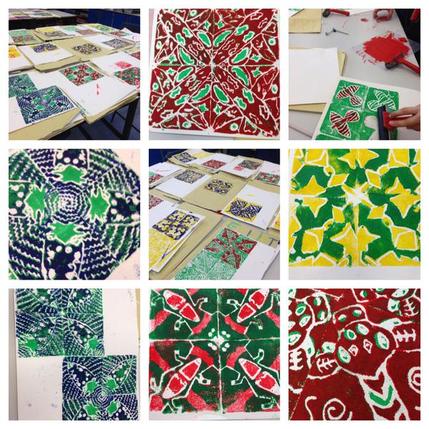
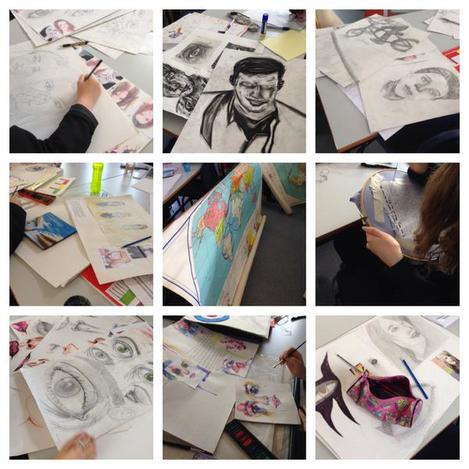
Images are "borrowed" from Jo Baker's regular series of Art Cubed tweets
Picture
I write this post as someone who started off life as a “scientist”, or rather with a greater interest in sciences which pushed me towards a career in science.

In fact, a year spent counting worms in the ICI biological unit, regularly getting seasick on the trawlers in the North Sea, put me off somewhat and enabled me to take my interest into teaching.

Last weekend, with my wife, I visited an artist’s open studios day in Eastleigh. This is something that we both enjoy. This visit was prompted by the fact that a work colleague had a studio open along with several others. The quality on display and the range of skills evident was very impressive, from drawing and painting to textiles of various sorts, metal and glasswork, including jewellery making, ceramics, and woodworking. Each of the studios enabled each artist to display significant talent, in ideas and expertise. There were examples of cross over techniques, with one artist embedding the skills of others in finished products. Every single artist had at least a first degree and some had evidence of further study.

All were working on significant commissions, so their talents were recognised well beyond the studios.

Beyond the essential paintings that would adorn house walls, there were book illustrations, clothes, new and “upcycled”, bed coverings, bowls and cups to drink from and furniture, all of which are essential to everyday life. There was one artist who had been commissioned to create a new civic mace for a local council. Without the craftspeople, working with design and seeking to enhance the world, the whole would be a great deal more dull.

As a Friend of Pallant House Gallery in Chichester and the Chichester Festival Theatre, both gallery and theatre interests are satisfied, the one on the same basis as the trip to Eastleigh, but with world renowned artists on display while the other allows access to West End quality theatre at a reasonable price and not too far from home. Theatre relies on acting and singing talent to be nurtured and developed. This talent is often obvious at an early stage and may be an over-riding passion for the participants. Having had a short spell “treading the boards” as a hobby in my early teaching career, I can see how people can get hooked. Such talent, as all talent, is as easy to discourage as to encourage.

Music can rely on what is euphemistically called a “misspent youth”, while the all-consuming passion and the dream is realised. Practice takes time and practice for performance takes even more focus and effort. My conventional youth precluded such activities, but, in my mid-20s, I learned the strum the guitar and a little later to play the Bodhran, the Irish drum. This latter led to performance for barn dances, Morris dance, Display dances, preforming at several folk festivals and to playing in France, reaching the finals of competitions. It is a real buzz.

The science part of my interest was continuous, with secondment to the Assessment of Performance Unit, local groups and running the Hampshire and Isle of Wight Wildlife Juniors (Watch Group). The skills of observation and drawing were supported by an interest in photography.

For some, the arts are a hobby, something to be done after the day job’s been completed. They are a great way to relax.

For others, it is a lifetime of passion, of challenge, learning, trial and error, lean times and good times, sometimes with widespread recognition, often without. They are often examples of the best way to learn as constant improvement is embedded within the activity, especially with performance or display in mind. The visual arts especially often draw on the skills of a scientist in materials science, the architect in designing models with awareness of strength and stresses, the mathematician in exploring and perfecting shapes, the linguist in interpreting ideas into imagery, to support communication, the historian, as art has grown and developed over hundreds or thousands of years. I should include medicine too, as artists who draw human and animal forms need a good grounding in anatomy. Leonardo da Vinci was a polymath, interested in everything, including mechanics. For him, life was everything.

In the not so distant past, scientists would also have been artists, capable of recreating what they were seeing into understandable pictorial form. Digital cameras may have reduced that need, but, scientists still need to be able to communicate effectively and imagery supports that.

It is very easy to downgrade the arts by seeking to amplify the benefits of the STEM subjects. There is significant value in all areas of study and maintaining a breadth through valuing every subject is important. Our collective lives would be much devalued if the arts were to disappear from school study.

They add the spice to the E and the practical applications for the M&S, while drawing regularly from the T. STEM supports the A.

No wonder many advocate STEAM. Pity it isn’t full STEAM ahead. The STEM always needs a few leaves and flowers to flourish. 

Picture
0 Comments

Getting better at getting better

12/6/2015

0 Comments

 
Building capacity breeds capacity

Variations on success breeds success? Or “Love the ones you’re with”, Dylan Wiliam. Building Professional Capital, Hargreaves and Fullan?

This view was first put into print by Sir Arthur Helps, in Realmah, 1868: "Nothing succeeds like success." [Rien ne réussit comme le succès.]

And apparently even earlier in a different form:

Picture
The most damaging thing a teacher can say is “I can’t…” There is a need to consider the problem being faced and to come up with a solution within any available constraints. In my book, teachers are paid thinkers and solution finders.

As a headteacher entering my own school for the first time, one of the main tasks was to get to know the staff, as well as the children, to establish a view of the overall capacity of the staff and where each was in their personal development. This was an important first step, as I set to the task of creating out of the available “raw material” the future picture of the school. This did involve a significant amount of reflection, from the staff and me, as each challenged to other to clarify thinking, so that meanings were clearer, enabling reflection that supported development. Some of that reflection meant that a few staff chose an alternative route forward. Living with challenge is not always a comfortable position. The school needed to be challenged. It was happy with itself, had create a comfortable existence for the staff, who did “nice things” with children. However, the general expectations were slightly too low and needed to be extended.

Challenge, time to reflect, within an articulated timetable, with resourced time, appropriate external support and internal evidence of momentum, through sharing improved outcomes, began the process of regular review, which ultimately was supported by release time for shared research, which further supported the collegiate approach and team development.

Internal moderation, or just sharing outcomes, became a regular feature of staff discussion, as illustrations of what was being expected and achieved.

Over time, the notion of success nourishing the staff led to deeper, sustained challenge, to staff and to children, with a further increase in outcomes, the achievement of which established much clearer expectations and benchmarks. The rich curriculum became richer, as teachers tried out ideas, with children feeling the pleasure of achievement, so improving their attitude and motivation.

Teachers had to adapt ideas to the context of the school. We were an open plan layout and areas were set aside for specialist activity at different points around the building, but each was within sight of a classroom, so every area could be overseen by a teacher, even if children were from another class. The “independence” being fostered could be put to good effect in supporting challenge in tasks, especially as the children got older.  

Over the past nine years of school visits through a variety of organisations and for different purposes, has allowed me to see a broader base of evident practice. Improving outcomes, so that both the teacher and the child can see what the next step looks like is essential. For the teachers, this has sometimes meant advice to go and look at years above or below, to better understand what quality outcomes can look like.

Only by having a deep understanding of progression within each subject, what success at different stages looks like and clarity in understanding where each child is in that continuum at any specific point, can a Primary teacher support incremental learning, as a combination of knowledge and capability.

Adaptability

It seems to me, after a lifetime in education, so based on many initiatives passing my way, that every piece of education research is interpreted to the profession through a filter that comprises national and press reviews, personal interpretation of the original material, or the ensuing book and inference from an existing practitioner, as the original ideas are adapted to the circumstances of a classroom.

By the time a teacher presents “how it’s working for me”, in a staff meeting, a Teachmeet, or some other external talk, it has been through several layers of interpretation. It has been adapted to the particular circumstance of that classroom teacher’s views. Copying, by a colleague, in another context, may not get the same result.

There are three main variables in teaching in a teacher control, even assuming a common knowledge base; space, resources and time. A classroom has a set size and shape that determines furniture arrangement for ease of working and movement. Organisation and availability of resources, for ease of accessibility and return will affect practice, to a significant effect.  Limitations of timetabling, especially the need to move as a whole class for activity, is further compromised by grouping and setting for different aspects, all of which impact on working approaches, not least the need to complete tasks within a set time.

Self-limiting

An inability to adapt can lead to teachers saying “I can’t do…” which impacts on children’s development. Self-limiting should not be part of a teacher make-up. The teacher who “prefers” to stay in year 6, or EYFS, for example, if they do not then have opportunities to explore practice across the school, can become entrenched in their working methods and expectations.

Self-limiting can apply to schools as well as individuals, where they do not communicate effectively, especially if there is a form of “competition” between phases and prior judgements are not fully accepted. Collaboration and excellent communication between professionals enables smoother transition and transfer.

“Novelty children”

Within the idea of adaptability comes the issue of “novelty children”, those with needs that the teacher has never encountered. The SEND specific need, the travellers, the EAL child with a never before met language, the extra-talented (gifted) learner, in a specific subject. How to deal with the new issue is likely to depend on prior experience and the base from which decisions are made. These will therefore range from rough-hewn, to refined. A self-aware teacher will admit to shortcomings and seek colleague advice, from within the school, as in the SENCo/ABCo, or through available language/specialist support, where the LA or Academy chain has access to expertise.

These “novelty children” extend the boundaries of teacher knowledge and expertise, which, over time, enables further adaptation to circumstance.

Adaptability and reflection is a precursor to personal growth. Adapting to new knowledge is a large part of how we learn, through reflection, adjustment to circumstance and a new balance point, based on knowledge and capability.

The more adaptable you are, the more adaptable you can become. Seeing the need to adapt is the first step. Getting better at getting better takes thinking time and a bit of effort, but getting better is positively reinforcing, for everyone, as teacher self-esteem can be a fragile beast.


0 Comments

Education 4-18; a pedagoo (local) talk

10/6/2015

0 Comments

 
Picture
I think it is probably a truism to say that children grow up. They start from birth, entering their specific environment with their embedded genetic code, then begin the process of making sense of the world around them. Indeed, it can be some time before, as parents, we begin to understand the infant “communication”. We put the words into the child’s mouth, long before they can articulate anything for themselves, requiring only a physical acknowledgement. The child’s early education is often unstructured, (hopefully) led by very enthusiastic and encouraging amateurs (parents), opening their eyes and ears to what is around them. Some will have attempted to engender specific areas such as counting and introduction to books. Of course, there will be a significant number who will not have had those advantages.

Education, in its formal sense, can start in pre-school, or certainly from the start of the Early Years Foundation Stage, with more specified routes into learning and the what of content. This journey lasts, now, until the child is 18. There appears to be a logic appearing that every child will progress through the same journey, with many (formal) checks on the way. The language of checking and judgement can have a significant impact on subsequent attitude and effort, both essential to sustained progress.

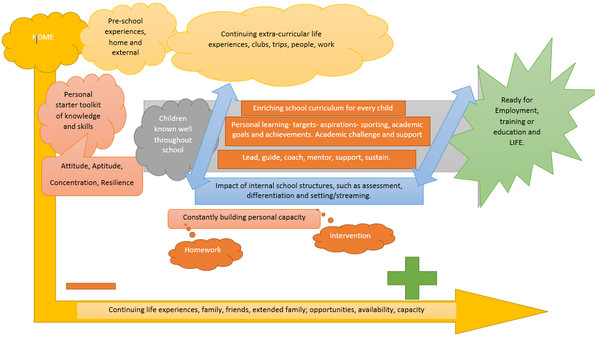
As part of Pedagoo Local (Hampshire), I have offered to run a learning conversation on the issue of education 4-18, seeking to identify potential barriers and explore how they could be overcome. I’ve come up with a few starter questions, but please feel free to add any others.

Are barriers created at transition and transfer points?

Does professional dialogue and understanding support/ease transition?

Is the expectation of “set points” at certain ages helpful to longer term effort and success? Should we have baseline expectations?

Is the same curricular route necessary for every child?

Do we have a clear definition of progress?

Do schools do enough to engage and support parents in the process of their child’s learning?

Does it matter which end of the educational telescope you look through?

Picture
I would invite comments from colleagues to help me to think on the subject over the next few months, to better inform the discussion. Please feel free to develop thoughts through the comment thread below, or tweet me on @ChrisChivers2, or through the home page.

0 Comments

In praise of Governors

10/6/2015

0 Comments

 
Picture
I am a school Governor. There, I have said it aloud.

After a long career in schools, I volunteered to become a school Governor, in a school in what has often been described as a very deprived area of Gosport. I had been involved with the school as a Link Tutor for Winchester Uni and had built up a relationship with the school and the staff, and, having lived and worked in the area for all my working career, I was fully aware of the area demographics and the challenges. The head and the staff knew that I’d sometimes ask insightful questions, so, along with my fellow Governors, and an extremely hard working and professional staff, we have supported the school to a “Good grade”, with some better aspects. The school knows what it feels like to be good, so has a qualitative as well as a quantitative benchmark.

Being a Governor these days cannot be taken lightly, especially as we are linked to the Leadership and Management judgements on the school. Everyone is acutely aware that a deficiency in the Governance could be the issue that took the school into “Requiring Improvement”. External, unpaid volunteers could have a serious impact on a school. However, the current composition of the majority of Governing bodies provides a broad range of opinions and expertise, not least the voice of the local community and the parents in particular.

In another role, I visit schools to support improvement in different areas, through supported auditing. A few of those visits have thrown up interesting scenarios in Governance, particularly in relation to (some) Academy chains. It would appear that the notion of Governance is embedded in the Trust, so that the Trust committee can act as the Governing body for all its schools, with, in one model, a School Improvement Partner acting as the Quality Assurance aspect of the Governance, but also te point for complaints against the school. There was no evident conduit to ascertain the local views on the school. The school could have been in danger of becoming an island in the community. The self-checking aspect could also isolate further.

Governors, in LA schools, do still retain a certain distance and independence.

The fact that academised schools can effectively become laws unto themselves, is one of the reasons why I’d be concerned at a mass academisation programme, as is being envisaged within the current Education Bill, with an as yet undefined group of school being designated as “coasting” and placed with academy chains. It is not just that the schools area taken out of Local Authority hands, but that they are also effectively taken out of locality hands. Local voices will count for much less. Chains can dictate their terms and conditions for entry, with some seeming to say, “If you don’t like this, don’t come here”, which takes away local choice from some.

Having worked in the State education system, within a strong Local Authority, I have valued the local knowledge that has supported personal and school development. As a LA school Governor, I can take advantage of the available training courses, free, as we pay our nominal sum each year. As a Governor, I can also contact local officers for advice when needed.

I am aware that not all Local Authorities were strong.

However, the developing evidence is that, while some academy chains perform well, others don’t. This may be because they have taken on schools in difficulty, with localise problems/inertia proving difficult to move. Equally, it could be as a result of distance, with advice being generic, rather than applicable to the local circumstance. The ability for a school leader to pick up a phone and ask a specific person for specific advice is enabling. To spend a considerable amount of time seeking the right person, available at the right time, can be frustrating. Stuff can happen quickly in schools. Systems need to enable speedy resolution, or personal damage can occur.

We have a Secretary of State for Education, running a Department for Education, on behalf of the state. Therefore every school is a state school. In the absence of a Local Authority, academies need the ability to find rapid answers to rapidly escalating issues. With additional schools being forced into academisation, will the centralised, or even regional organisation be able to cope? If not, who will pick up the pieces (children’s lives?)

What I can see is a gently fracturing system, with lots of bits that use to be more joined up to serve the needs of the holistic system, eg teacher supply.

The education system is a bit like an Airfix kit; the bits have to go in the right place, with the right amount of glue, if the finished model is to look like the picture on the box. As in many reorganisations in education, there isn’t a very clear picture on the packaging, so bits are in danger of being put in the wrong place.

Strong Governance needs to be a part of every school, but it needs a strong local base, supported by a supportive, easily available, local centre of information.

Think local, act global, not think global, forget local…

 
0 Comments

Personal development

4/6/2015

0 Comments

 
Picture
The idea of CPD (continuing professional development) can be a contentious one, in that every teacher needs to be continually developing, seeking to be better, while the restrictions of the school budget can mean that this is piecemeal, if it is seen only in the context of time at courses, off site, led by an expert in a field. This approach can be costly, with course costs, supply cover and some disruption to the classes being left behind.

A long time ago, when I qualified, all courses were run at our local teacher’s centre, as twilight offerings, usually led by a local teacher over a six week timescale, to a theme, which enabled reflection in between, trial in class and reportage and professional discussion, which was particularly valuable where for some this had meant success, while others found disaster. Context and background preparation was shown to be a significant factor.

If you were lucky, you got to go on a “Gurney Dixon”. This meant an overnight stay at the authority residential centre, for a two day course. These were special and often ran at weekends, so that working weeks became endless, even if you were one of the chosen ones. However, it also meant, on at least three occasions, sleeping in a single room where the caretaker had stored the toilet rolls and the shared bathroom facilities often left much to be desired. The quality professional discussion was often developed over a drink at a local hostelry, sharing classroom notes, away from the bustle of school life.

Lesson 1 CPD; talk with your colleagues; they have expertise and insights to share.

Working in an open plan school for four years, enabled much informal CPD, as a head round the curtain, a chat on the way to and from the staffroom, sitting on a table before or after school, chatting over activities, displays, specialist subjects, enabled a drip feed of ideas to be developed. Copying was allowed. Equally, where issues in a year group might be causing some concern, to be able to pop next door, to the year above or below, allowed discussion of what could be tried to remedy or accelerate the children with appropriate tasking.

Lesson 2 CPD; link with an ITE institution, take students and see having them as mentoring training and personal development across a wide perspective.

Having a student teacher, on an extended practice, ensures that the teacher, acting as mentor, has to unpick all aspects of their professional practice to engage fully with the student needs. It can also be the case that watching a student teacher prompts reflection on the part of the mentor. It certainly enables reflection on the class needs, as the mentor can spend time observing their learning approaches and work closely with specific individuals. This working closely can provide the basis for a more analytical approach than is often available, so deepens the teacher understanding and refines the T&L approach taken.

A good relationship with an ITE institution can result in a constant stream of good quality students, who provide additional personnel, and, once established as the class teacher, can enable cross-school release, for colleagues to observe each other, with mentors acting as cover.

Lesson 3 CPD; take advantage of local offerings, twilight or (occasional) Saturdays. Build up a personal network of colleagues.     

Newly organised, teachmeets can be a way to take part in free CPD opportunities. They are twilights, usually have some refreshments and are a good way to meet colleagues from other schools. It’s a chance to get away early, with a purpose. Ideas are shared, which can be taken away, stored and use when needed.

In addition, there is now a range of Saturday gatherings, some free, others at a cost, that support teacher sharing at a deeper level, with colleagues sharing their specialist areas. Examples are Teaching and Learning Takeover, ResearchEd, Northern Rocks.

Lesson 4 CPD; Blog, keep a weblog of your ideas, share them online, through social media like Twitter. Online conversations are fast becoming an outlet for professional discussion, sharing extended ideas with blogs, enabling feedback comments, which in turn enable further reflection.

Lesson 5 CPD; personal development takes time.

It is not something that happens on one day. Teaching is a reflective profession. Ideas are the bread and butter of teaching and learning. Working in collaboration, with internal colleagues or from another school, clarifies thinking and refines personal practice.

Lesson 6 CPD; do some extended study at Post Grad level.

Many institutions now support in-school research/investigation as the means to gaining credits, so that in-house development can also be linked with personal CPD. That can be the quid pro quo; you run the improvement, write it up, for school and uni and gain credit, both for school improvement and as a qualification. Both are very useful for the CV and promotion.

Lesson 7 CPD; it’s about you. Take charge, organise, join in discussions, lead idea development. Be proactive; CPD is you developing yourself, not (just) something that someone does to you. It is embedded in the teacher standards; no 8, professionalism.


0 Comments

Exercise books as personal organisers?

2/6/2015

0 Comments

 
Develop exercise books as personal learning organisers, for the learners and the teachers?

Some elements of this post are subjects of linked posts, so I have highlighted and linked them.

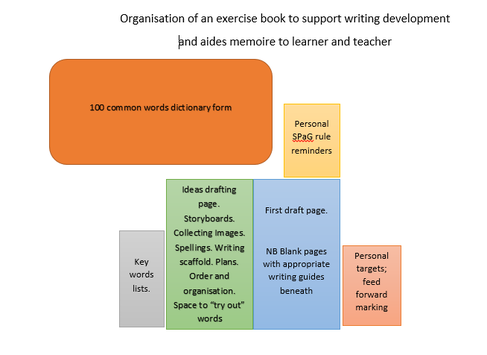
The essence of this post is based around the 2 page approach to writing, with the question of whether, in Primary, all writing should be in one book. At all times, the search is for personalised approaches to support each child’s learning journey. Blank page books enable differential writing guide lines to be used beneath, but also support the left hand page to be used for storyboarding, notes, images, word collections, planning, etc. The idea of flip out memory joggers can be very supportive of learning dialogue across a wide area of need.

Picture
As a classteacher, and often as a teaching headteacher, one of the difficulties was remembering the personal needs of each child in the class across the range of subjects.

Over time, a variety of aides memoire came into being, such as personal bookmarks to highlight reading needs.

Flip out personal targets were joined to the edge of the exercise books, so that they could be available to the child and me at any point, including when giving feedback or marking, when the focus was very much clearer. As children got older, they began to point out where they had achieved, so this was recorded and new foci created.

If generic reminders are needed of spelling and grammar (SPaG) rules, these can be on another flip out card.

Specific spellings which cause the child a problem can be highlighted on another card, or topic specific words can be developed, so that they are more regularly used.

Working in this way, the exercise book becomes a personal organiser surrounding the central need to focus on and improve writing, at whatever age. Card supports can be made for any purpose and, to be effective, should be personal.

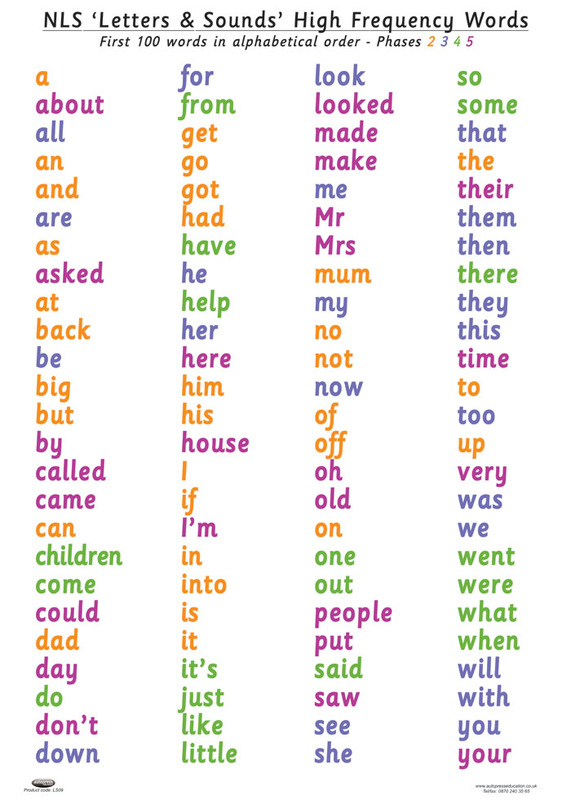
Where “word walls” exist in class, consider the potential for a table top 100 word dictionary, to be available the learners in front of them, so that they can check and reproduce common words accurately. Short term memory can be supported, of the child is trained to use look, cover, write and check, for all these words. An example, (from Autopress Education) is below. There are many around.

Children asking for spellings can cause a problem, so a solution might be using small wipe-on-wipe-off boards, to have a go, to hold up for adults to check and intervene as needed.  


To develop the best practice for each class, there needs to be a generic approach which can be tailored to the needs of each child. In that way, their developing personal independence can be used to support class organisation.

Picture
0 Comments

Growth Mind-set reflections

1/6/2015

0 Comments

 
Picture
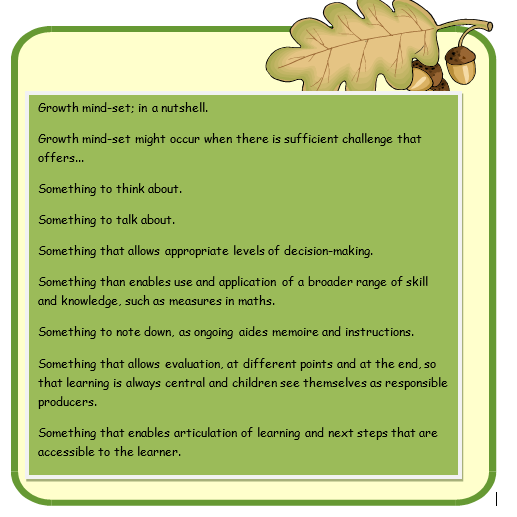
What is Growth Mind-set? I’d say it is what has driven my thinking since I became a teacher in 1974; it isn’t new. In fact, I’d say that it was a central tenet of the Plowden Report in 1967, which placed the child at the centre of the learning process.

Putting it simply, it is maximising opportunities for children to learn, through a rich diet of challenging and engaging learning experiences, with aware adults spotting and intervening when there are signs that a child needs some help or guidance.

In another post on practical science, I offered the following, as ideas that I used to challenge children, in this case, year 2 infants.

Science from the Postman…. Materials…

I looked out some ideas that I used in the classroom, to develop science related activities.

Get the children to make a collection of as many different types of paper that they can from within the school (and from home) Use a magnifier, microscope or visualiser to look even more closely at the papers. Sort, classify, display. Explain similarities and differences, as well as uses.

Devise a fair test to find the best paper to send a parcel through the post. (Think of the journey of the parcel)

Devise a fair test to find the best writing tool to write the label. (What will happen to the parcel)

Design an envelope or a parcel to send a delicate article through the post.

Devise a fair test to find which is the best material for a bag to keep the letters dry.

Devise a fair test to find the best materials to keep the post-person, cool, warm or dry.

The post-person often starts work in the dark. What is the best colour for a coat to be seen?

Fair testing is possible, guided, with very young children, who have an idea of what fair means, so this can be translated into the practical activity.

There was challenge, appropriate to the age and experiences of the children. So there was something to think about.

There was interest, it fitted with the post theme.

There was quality talk, within the remit of the challenge. This was sometimes checked with a tape recorder in the group.

There was specific purpose, with writing on different surfaces with different mark-making implements providing writing practice as well as the science activity.

There was decision making, as children had to decide what to do at each stage.

There was measuring, of length, of temperatures, of capacity; drops of water. So skills from other areas were used and applied.

There was recording, as lists, of things needed, of step by step instructions, notes of on-going outcomes and final reports of what they did and discovered. Maths records were also kept, as were drawings to help note making.

There was evaluation, as they got to a particular stage and took stock, as infants do, making appropriate changes during their working.

Another level of evaluation occurred at the end, when the children were challenged to articulate what they had learned and what they’d change if they did it again.

Growth mind-set thrives on broad, balanced and relevant experiences from which a great deal can be extracted, so, is that where it starts to go wrong in classrooms? It is, after all, in the teacher hands, if it is to become a reality.

Tasking is the essential aspect, to my mind and I have written more about tasking for challenge. It is very easy to underplay the challenge in activity, so that it remains totally in teacher control. If this is the case, then children can only demonstrate skills and knowledge within the task parameters. The death knell for some approaches came with the QCA schemes, the National Strategies and the over-application of sub-levels when deciding about next steps. Too often, children were under-challenged, and, I’d argue, still are, in many classrooms where “following the recipe” would summarise the approach; every step dictated by the teacher, so that child decision making is very limited.

Growth mind-set does not mean just getting better at doing, it means getting better at thinking, deciding, selecting, acting more and more independently, keeping ongoing notes and records, sharing thoughts with others appropriately and listening to them, using and applying skills and knowledge to the limits of current abilities, then identifying the skill and knowledge gap that needs to be filled in order to progress further.

In other words, it is the learner taking responsibility for the production of an outcome that summarises where they have got to in their learning.

The challenge for the teacher is coming up with the challenge in the first place. Growth mind-set in children requires a growth mind-set philosophy from the teacher.

Teacher questions.

What have they to think about, to talk about, to decide, to record, to evaluate at key points, to report (multi-media) to others on completion?


PS. Growth mind-set is not just for home tasks…   


Picture
0 Comments

Story maths?

1/6/2015

0 Comments

 
Picture
Every equation tells a story

Explain how you would tackle the problem; 37+45+26

As a child at school, we were always exhorted to show our working, then we’d get credit, even if the answer was wrong. This idea of showing working is important, as, unless that is available and the only available information is an answer, the teacher has no idea what the child was thinking through the process.

One day, as an experiment in an infant class, who had been spending time writing reports, I asked them to write the story of how they tackled an addition problem. At that stage, I had no idea how it would go, but, having written reports, they were used to putting ideas into some order. With one group, they had to solve the problem talking aloud throughout, with an adult scribe.

Their writing also became a de facto script, so that they were able to rehearse to their peers what they had done. The articulation sometimes identified areas where they had missed out a stage or instruction.  

Most were able to write and talk in terms of steps that they took and were able to explain to their partners what they had been thinking throughout. They had a very good context for time connectives, before they were on any curriculum.

Peer talk became, after a while, something that became a regular part of the classroom maths practice: the need to explore and explain their thinking when sorting out a problem. Working in partnership enhanced their articulation and clarified their thinking, so that, eventually, there was a marked improvement in basic arithmetic.

Showing their working became talking their working, became remembering their working.

0 Comments

    Chris Chivers

    Long career in education, classroom and leadership; always a learner.
    University tutor and education consultant; Teaching and Learning, Inclusion and parent partnership.
    Francophile, gardener, sometime bodhran player.

    Archives

    March 2021
    January 2021
    July 2020
    June 2020
    May 2020
    April 2020
    March 2020
    September 2019
    June 2019
    May 2019
    April 2019
    March 2019
    February 2019
    January 2019
    December 2018
    November 2018
    October 2018
    September 2018
    August 2018
    July 2018
    June 2018
    May 2018
    April 2018
    March 2018
    February 2018
    January 2018
    December 2017
    November 2017
    October 2017
    September 2017
    August 2017
    July 2017
    June 2017
    May 2017
    April 2017
    March 2017
    February 2017
    January 2017
    December 2016
    November 2016
    October 2016
    September 2016
    August 2016
    July 2016
    June 2016
    May 2016
    April 2016
    March 2016
    February 2016
    January 2016
    December 2015
    November 2015
    October 2015
    September 2015
    August 2015
    July 2015
    June 2015
    May 2015
    April 2015
    March 2015
    February 2015
    January 2015
    December 2014
    November 2014
    October 2014

    Categories

    All
    Assessment
    Behaviour
    Differentiation
    English
    Experience
    History
    Home Learning
    Inclusive Thinking
    Maths
    Parents
    Science
    SEND
    Sing And Strum
    Teaching And Learning

    RSS Feed

    Picture
    Click to set custom HTM L
Powered by Create your own unique website with customizable templates.