Chris Chivers (Thinks)

  • Home
  • Blog-Thinking Aloud
  • Contact
  • Contents
  • PDFs
  • Sing and strum

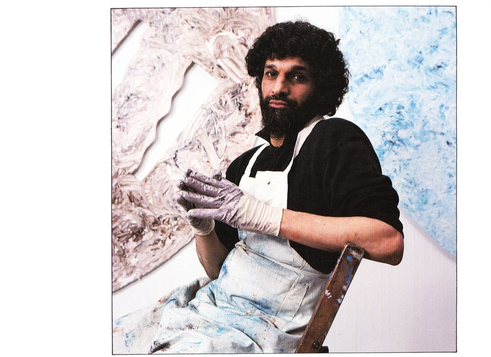
Saleem; The (first) artist who came to school

12/6/2019

0 Comments

 
Picture
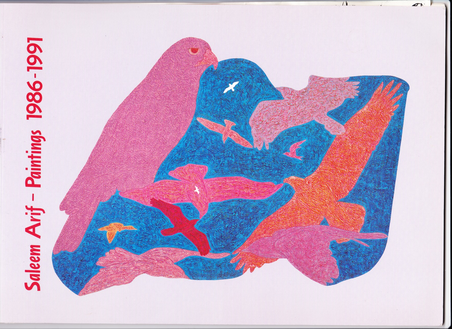
I had been a headteacher for 18 months, when our local arts centre sent out a flyer advertising a forthcoming exhibition by an artist then unknown to me, Saleem Arif. Saleem was born in Hyderabad, studied at Birmingham College of Art and the Royal College of Art before his first solo exhibition in 1982.
​
In addition to the exhibition, the arts centre offered to local schools the opportunity to work with Saleem, who would provide workshops for all Primary age groups, at a modest cost. I very quickly showed an interest, but no-one else apparently did; we were offered Saleem for ten days at very modest cost, if we could also offer some accommodation. One of my staff was prepared to do that, which was very generous.
​
Picture
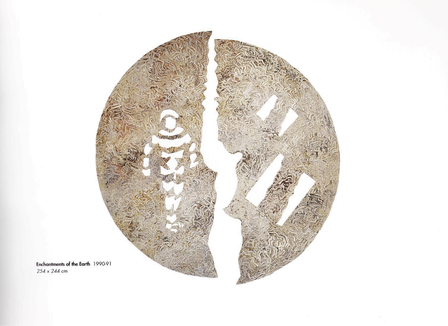
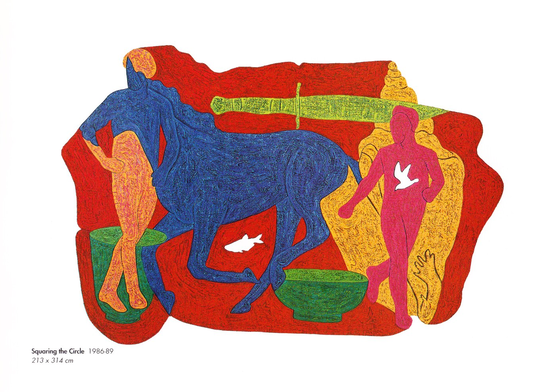
The exhibition, in the September of 1991, was based on a most recent series of work, deriving from earlier works, but with a very much more muted palette. Year six went on a visit on the first day of the exhibition, showed around by Saleem, who explained something of his techniques, together with ideas that he would be using in school. The children therefore approached the coming experience with insights.

Sharing a broad range of techniques as a starter, older children explored the creation of textures in paint, using sand, sawdust and earth. They used scrapers, spatulas, other broad bladed objects as well as paint brushes to apply the paint to different prepared surfaces.
​
Year six decided that they would like to recreate one of Saleem’s recent pictures, so working large, approximately 5m by 3m, they drew the shapes, then started using the learned techniques to fill them in, sometimes working through their lunchtimes to complete the task while Saleem was in the school.
​
Picture
Other year groups did a variety of experiences based on textures, with the Reception class creating a huge printed necklace, which led to some storytelling from Saleem, bringing cultural background and imagery together.
​
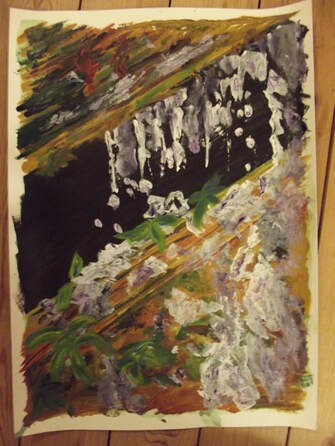
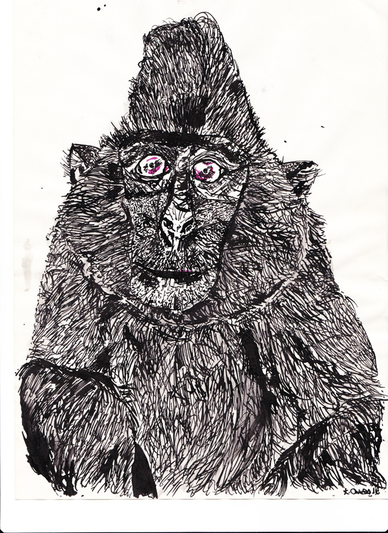
Saleem came to dinner with my family, entrancing the children, in part because he simply integrated with the family, rather than being an aloof guest. Leaving a signed catalogue of his 1986-1991 works inspired our eldest, then aged eleven to explore for herself. It was this piece of paper dropping from the catalogue that brought back the memories.
​
Picture
The experience of bringing specific expertise into the school as an inspiration for learning was sufficiently significant that it became a feature of school life. Especially where the expert was able to engage with processes of thinking and learning, they left the school enhanced by their presence; children met and could aspire to become real life artists, sportspeople or musicians. That on the whole bringing these experiences into school was often much more reasonable cost than an external trip, meant that they could be accommodated in the budget.

It was then a case of finding the right people… Many thanks to Saleem for making our first experiences so positive.

Saleem's website adds much greater biographical detail and an extended gallery.
   
http://www.saleem-arif-quadri.co.uk/
Picture
0 Comments

Review; The Ultimate Guide to Mark Making

11/6/2019

0 Comments

 
Picture

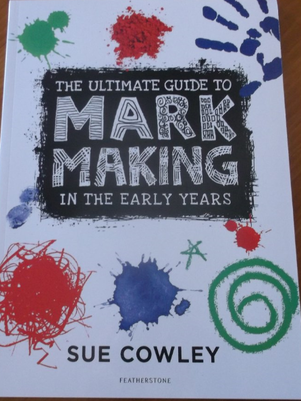
This new book, by Sue Cowley, is a very timely addition to my library. As a Governor of a Primary school, this will provide a huge boost to discussion on mark making with our EYFS children. The book provides a clear structure, with eight chapters starting with the idea of mark making as a form of communication through to letters, words and sentences. In between, the chapters develop different aspects of the mark making process, supported by a wealth of ideas on resourcing and organisation.

Sue makes the very important link between developing dexterity through handling objects, real life objects that demonstrate mass and volume, requiring different handling techniques. The development of finer motor skills is supported by simple activities like tearing paper.

Idea; this could be newspaper, which can then be used for papier mache, or tissue paper, to be incorporated into a collage; sea or sky from torn blue strips. Torn newsprint can be printed to make rocks, the whole incorporated into a wall display. Providing an additional purpose encourages involvement.


Using a variety of objects to make marks, Sue encourages mark making on different surfaces, but then adapting to use natural materials, such as feathers or sticks to manipulate paint. Zips, buttons, laces, threading, all add to developing dexterity.

​There are very useful ideas boxes throughout the book that focus on different aspects.


Gross motor skills and hand-eye coordination can be supported by throwing and catching balls or bean bags with a partner, passing balls between legs or over the head to a partner, or in a row. I’d add keeping a balloon in the air, using light muslin hankies to throw into the air and catch.

Idea; maybe playing a game that our French exchange partners called “tomate”; standing in a circle with legs apart, the object is to stop a ball passing through your legs. Both hands can be used. If the ball passes through, one hand goes behind the back, then two hands, then out…

Different materials are used to provide varied sensory stimulus, wet and dry sand, clay and plasticine or playdough, clear water to move or soapy water to explore the difference. Gardening and getting hands mucky to a purpose.
The book then goes on to develop more formal mark making, using different markers to explore the underlying shapes that eventually will form the basis of letter formation; verticals, horizontals, diagonals, circles, pushing, pulling, pressing. Working anticlockwise accentuates letter formation.

Idea; how about “magic colour shapes”, overwriting an initial shape in a variety of colours? This can be developed as “magic colour letters”, as names or specific words.

Idea; lines in tree rings. Draw a shape that represents the first year of growth of a tree. Repeat with a second line, trying to follow the first. Continue for perhaps ten years of rings. These shapes could be drawn from real life by cutting an onion in half, or maybe a cabbage as a real challenge?

The important message from Sue’s book is to make children confident in having a go; trial and improvement are the basis of all learning.

The book will provide a firm structure for a school to audit its culture, or for any trainee working with EYFS, probably year one, any activity ideas firmly embedded in process. It will definitely be shared with the school where I am a Governor and add to our articulation of expectations.
 
0 Comments

Being reflective on “retirement”

8/6/2019

0 Comments

 
Picture
​T
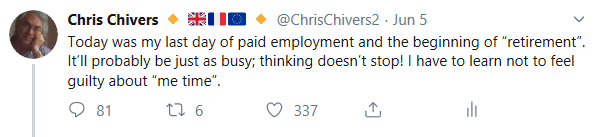
hree days ago, I typed and sent this tweet. I felt very strange about doing so but was soon overwhelmed by a string of lovely comments from close and more distant contacts.


Because of the freelance nature of my employment since stepping away from headship following the death of my first wife from cancer, I have had several “farewells”, each of which has offered commentaries that have been a surprise. I have always had the mantra of “just doing my job”. I could have added, “as well as possible” and, in many ways, I have worked with colleagues who have had the same approach, so it didn’t seem in any way special. Others have suggested otherwise. Perhaps I should have kept going…

In 1970-1971, after a return from Australia, I was working as a Lab Assistant for ICI at their biological research establishment in Brixham, exploring the impact of outfalls from ICI establishments. This meant visits to site, hours spent on trawlers following drogues to establish sea movements, or possibly walking shorelines to discover where certain vegetables and fruits had been washed up, after mixed sacks had been put into the outflow pipes. Bottom sampling meant further trawler days, largely in the North Sea, taking bottom samples, which then were brought back to Brixham, each one tipped into a white tray under a microscope and then the constituent fauna identified and counted. Hours of backbreaking, eye straining activity. Such was the stuff of “front line” science. With the career opportunity of becoming an Experimental Officer, and working with the incumbents, it was clear that the job wouldn’t alter very much.

In the June of ‘71 walked into St Luke’s Teacher Training College in Exeter, simply to enquire how to become a teacher. The head of the science department, Tony Staden, happened to be available for a conversation. Half an hour later, he sent me to the admin department to register, to start the following September on the Primary course. I know it wouldn’t happen now. After a year of straight science, I transferred to the small Environmental Studies department, providing the background to every subject area in some depth; the philosophy of the department.

Forty-eight year later, I am stopping paid work.

There’s a certain regret involved. I have thoroughly enjoyed my career, which makes me very lucky. I know that won’t necessarily be the same for everyone. I may have been lucky with timing; it was a period when teachers were lead thinkers in their classrooms, organising curricula and making do with relatively few resources.

Stopping being paid doesn’t stop the thinking about education. As a school Governor and grandparent, I have a continuing stake in the system, so I will continue to think, offer ideas and share in the collaborative discussions generated via Twitter.

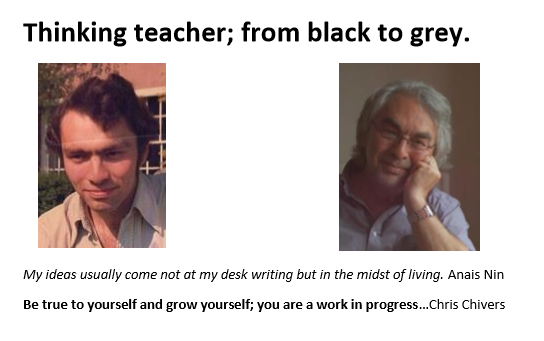
If you’re interested, I have explored the detail of my career in Thinking Teacher-from black to grey; another non-book of reflections. Download from https://chrischiversthinks.weebly.com/pdfs.html

As it says below, "Be true to yourself and grow yourself; you are a work in progress".
I'm looking forward to continuing my development, with a little help from my friends. 

Picture
0 Comments

How Did You Do That?

4/6/2019

0 Comments

 
Picture

It was always intriguing when walking around school, whether as a class teacher or management, to come across a piece of work, on display or in a book that made you go “Wow, how did you do that?”

The answers were inevitably illuminating, as the colleague or child recounted the stages that they had gone through to end up with a finished outcome, in whatever subject. They describe the process. In education, we can become obsessed with outcomes, to the detriment of the process, or the process is laid out in such a way that it becomes more a copy exercise than requiring the learner to make decisions and refine their own outcomes.

After four years of teaching, I went to a school that used the Dienes multibase approach for all its maths teaching. Despite being pretty reasonable at maths, and having used the base 10 materials as modelling aids, I was unaware of the background to the thinking and the multiple purposes that could be demonstrated using the materials. The school DH, Joe, as maths lead spent several hours taking me through the details of varied function machines and exemplification of equations. He also gave me a copy of the “bible”, from the Masters course that he and the head had completed. Tutoring through the processes strengthened my teaching for the rest of my classroom and school career. Worked examples enabled me to explore my own and possibly children’s misconceptions.

Therefore to improve the outcome, in any area of learning, there’s a need to refine aspects of the process. Just a few possible examples.

A writing outcome is hard to read, so it’s reasonable to look at improving the handwriting. But, in reality, it may be multi-layered, with a need to look at grip and basic letter formation, with alterations in both being practised outside the redraft exercise.

In maths, just having the correct answers in a book might hide the face that a child has copied from another. Asking the child to articulate (talk) their thinking through the process is more illuminating. This can become “show your thinking/working out”.

In art or DT, different elements can require a focus on the fine skills of material selection, colour, cutting, joining.
“How did you do that?” can become the basis for oral description, for written instructions to another or a report on what was done, with an evaluation of the outcome supporting subsequent attempts. If the process had been captured as images during development, the images can support the ordering and organisation of the talk or writing.

Virtually every area of school activity involves process in some form. Time for active processing (thinking) is often at a premium, as teachers move from one activity to another.

“How did you do that?” is also the essence of CPD. Listening to and learning from a colleague explaining the processing in their subject responsibility can enable insights for less experienced or confident colleagues. In a teaching force that can appear ever younger, it’s essential that the experience is passed on, otherwise it’s lost to the system, then requires a process of discovery. The art of explanation is based on clarity and ordering of thinking. The coach has to consider detail as well as an overview description.

So, my advice to all teachers is to acknowledge the expertise of colleagues and to seek to emulate them. If everyone was enabled to become as good as the “best”, the system as a whole would improve. So, over an end of the day cuppa, sit together and chat. Learn through dialogue and demonstration.

“Show and tell” works for children, too. “How did you do that?”
​
0 Comments

    Chris Chivers

    Long career in education, classroom and leadership; always a learner.
    University tutor and education consultant; Teaching and Learning, Inclusion and parent partnership.
    Francophile, gardener, sometime bodhran player.

    Archives

    March 2021
    January 2021
    July 2020
    June 2020
    May 2020
    April 2020
    March 2020
    September 2019
    June 2019
    May 2019
    April 2019
    March 2019
    February 2019
    January 2019
    December 2018
    November 2018
    October 2018
    September 2018
    August 2018
    July 2018
    June 2018
    May 2018
    April 2018
    March 2018
    February 2018
    January 2018
    December 2017
    November 2017
    October 2017
    September 2017
    August 2017
    July 2017
    June 2017
    May 2017
    April 2017
    March 2017
    February 2017
    January 2017
    December 2016
    November 2016
    October 2016
    September 2016
    August 2016
    July 2016
    June 2016
    May 2016
    April 2016
    March 2016
    February 2016
    January 2016
    December 2015
    November 2015
    October 2015
    September 2015
    August 2015
    July 2015
    June 2015
    May 2015
    April 2015
    March 2015
    February 2015
    January 2015
    December 2014
    November 2014
    October 2014

    Categories

    All
    Assessment
    Behaviour
    Differentiation
    English
    Experience
    History
    Home Learning
    Inclusive Thinking
    Maths
    Parents
    Science
    SEND
    Sing And Strum
    Teaching And Learning

    RSS Feed

    Picture
    Click to set custom HTM L
Powered by Create your own unique website with customizable templates.