Chris Chivers (Thinks)

  • Home
  • Blog-Thinking Aloud
  • Contact
  • Contents
  • PDFs
  • Sing and strum

Saleem; The (first) artist who came to school

12/6/2019

0 Comments

 
Picture
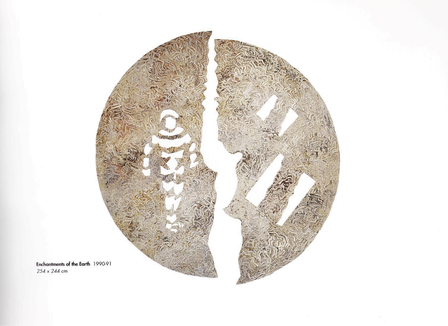
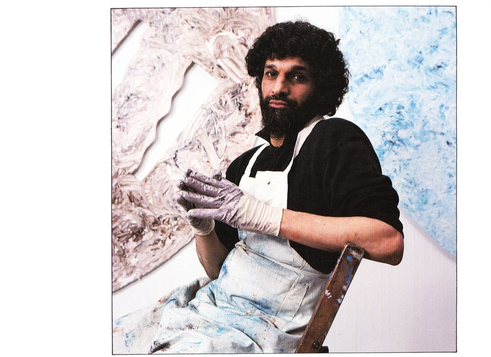
I had been a headteacher for 18 months, when our local arts centre sent out a flyer advertising a forthcoming exhibition by an artist then unknown to me, Saleem Arif. Saleem was born in Hyderabad, studied at Birmingham College of Art and the Royal College of Art before his first solo exhibition in 1982.
​
In addition to the exhibition, the arts centre offered to local schools the opportunity to work with Saleem, who would provide workshops for all Primary age groups, at a modest cost. I very quickly showed an interest, but no-one else apparently did; we were offered Saleem for ten days at very modest cost, if we could also offer some accommodation. One of my staff was prepared to do that, which was very generous.
​
Picture
The exhibition, in the September of 1991, was based on a most recent series of work, deriving from earlier works, but with a very much more muted palette. Year six went on a visit on the first day of the exhibition, showed around by Saleem, who explained something of his techniques, together with ideas that he would be using in school. The children therefore approached the coming experience with insights.

Sharing a broad range of techniques as a starter, older children explored the creation of textures in paint, using sand, sawdust and earth. They used scrapers, spatulas, other broad bladed objects as well as paint brushes to apply the paint to different prepared surfaces.
​
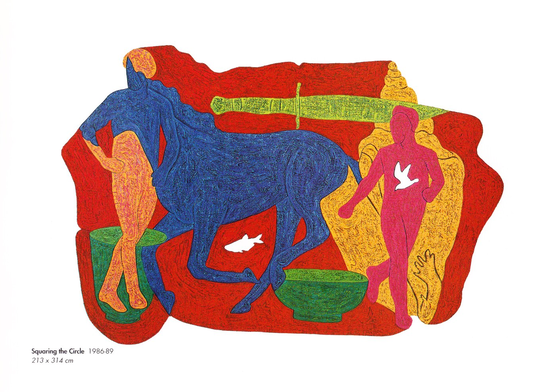
Year six decided that they would like to recreate one of Saleem’s recent pictures, so working large, approximately 5m by 3m, they drew the shapes, then started using the learned techniques to fill them in, sometimes working through their lunchtimes to complete the task while Saleem was in the school.
​
Picture
Other year groups did a variety of experiences based on textures, with the Reception class creating a huge printed necklace, which led to some storytelling from Saleem, bringing cultural background and imagery together.
​
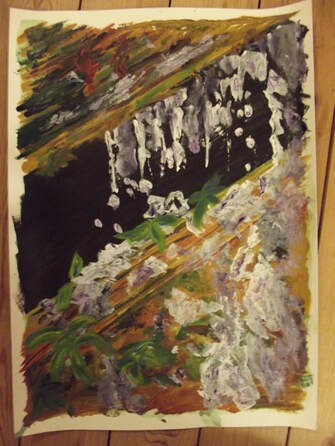
Saleem came to dinner with my family, entrancing the children, in part because he simply integrated with the family, rather than being an aloof guest. Leaving a signed catalogue of his 1986-1991 works inspired our eldest, then aged eleven to explore for herself. It was this piece of paper dropping from the catalogue that brought back the memories.

​
Picture
The experience of bringing specific expertise into the school as an inspiration for learning was sufficiently significant that it became a feature of school life. Especially where the expert was able to engage with processes of thinking and learning, they left the school enhanced by their presence; children met and could aspire to become real life artists, sportspeople or musicians. That on the whole bringing these experiences into school was often much more reasonable cost than an external trip, meant that they could be accommodated in the budget.

It was then a case of finding the right people… Many thanks to Saleem for making our first experiences so positive.

Saleem's website adds much greater biographical detail and an extended gallery.
   
http://www.saleem-arif-quadri.co.uk/
Picture
0 Comments

Review; The Ultimate Guide to Mark Making

11/6/2019

0 Comments

 
Picture

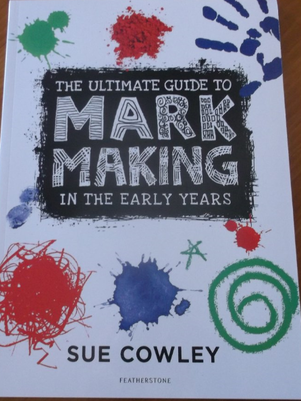
This new book, by Sue Cowley, is a very timely addition to my library. As a Governor of a Primary school, this will provide a huge boost to discussion on mark making with our EYFS children. The book provides a clear structure, with eight chapters starting with the idea of mark making as a form of communication through to letters, words and sentences. In between, the chapters develop different aspects of the mark making process, supported by a wealth of ideas on resourcing and organisation.

Sue makes the very important link between developing dexterity through handling objects, real life objects that demonstrate mass and volume, requiring different handling techniques. The development of finer motor skills is supported by simple activities like tearing paper.

Idea; this could be newspaper, which can then be used for papier mache, or tissue paper, to be incorporated into a collage; sea or sky from torn blue strips. Torn newsprint can be printed to make rocks, the whole incorporated into a wall display. Providing an additional purpose encourages involvement.


Using a variety of objects to make marks, Sue encourages mark making on different surfaces, but then adapting to use natural materials, such as feathers or sticks to manipulate paint. Zips, buttons, laces, threading, all add to developing dexterity.

​There are very useful ideas boxes throughout the book that focus on different aspects.


Gross motor skills and hand-eye coordination can be supported by throwing and catching balls or bean bags with a partner, passing balls between legs or over the head to a partner, or in a row. I’d add keeping a balloon in the air, using light muslin hankies to throw into the air and catch.

Idea; maybe playing a game that our French exchange partners called “tomate”; standing in a circle with legs apart, the object is to stop a ball passing through your legs. Both hands can be used. If the ball passes through, one hand goes behind the back, then two hands, then out…

Different materials are used to provide varied sensory stimulus, wet and dry sand, clay and plasticine or playdough, clear water to move or soapy water to explore the difference. Gardening and getting hands mucky to a purpose.
The book then goes on to develop more formal mark making, using different markers to explore the underlying shapes that eventually will form the basis of letter formation; verticals, horizontals, diagonals, circles, pushing, pulling, pressing. Working anticlockwise accentuates letter formation.

Idea; how about “magic colour shapes”, overwriting an initial shape in a variety of colours? This can be developed as “magic colour letters”, as names or specific words.

Idea; lines in tree rings. Draw a shape that represents the first year of growth of a tree. Repeat with a second line, trying to follow the first. Continue for perhaps ten years of rings. These shapes could be drawn from real life by cutting an onion in half, or maybe a cabbage as a real challenge?

The important message from Sue’s book is to make children confident in having a go; trial and improvement are the basis of all learning.

The book will provide a firm structure for a school to audit its culture, or for any trainee working with EYFS, probably year one, any activity ideas firmly embedded in process. It will definitely be shared with the school where I am a Governor and add to our articulation of expectations.
 
0 Comments

Being reflective on “retirement”

8/6/2019

0 Comments

 
Picture
​T
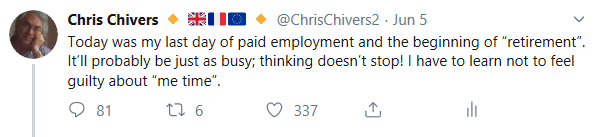
hree days ago, I typed and sent this tweet. I felt very strange about doing so but was soon overwhelmed by a string of lovely comments from close and more distant contacts.


Because of the freelance nature of my employment since stepping away from headship following the death of my first wife from cancer, I have had several “farewells”, each of which has offered commentaries that have been a surprise. I have always had the mantra of “just doing my job”. I could have added, “as well as possible” and, in many ways, I have worked with colleagues who have had the same approach, so it didn’t seem in any way special. Others have suggested otherwise. Perhaps I should have kept going…

In 1970-1971, after a return from Australia, I was working as a Lab Assistant for ICI at their biological research establishment in Brixham, exploring the impact of outfalls from ICI establishments. This meant visits to site, hours spent on trawlers following drogues to establish sea movements, or possibly walking shorelines to discover where certain vegetables and fruits had been washed up, after mixed sacks had been put into the outflow pipes. Bottom sampling meant further trawler days, largely in the North Sea, taking bottom samples, which then were brought back to Brixham, each one tipped into a white tray under a microscope and then the constituent fauna identified and counted. Hours of backbreaking, eye straining activity. Such was the stuff of “front line” science. With the career opportunity of becoming an Experimental Officer, and working with the incumbents, it was clear that the job wouldn’t alter very much.

In the June of ‘71 walked into St Luke’s Teacher Training College in Exeter, simply to enquire how to become a teacher. The head of the science department, Tony Staden, happened to be available for a conversation. Half an hour later, he sent me to the admin department to register, to start the following September on the Primary course. I know it wouldn’t happen now. After a year of straight science, I transferred to the small Environmental Studies department, providing the background to every subject area in some depth; the philosophy of the department.

Forty-eight year later, I am stopping paid work.

There’s a certain regret involved. I have thoroughly enjoyed my career, which makes me very lucky. I know that won’t necessarily be the same for everyone. I may have been lucky with timing; it was a period when teachers were lead thinkers in their classrooms, organising curricula and making do with relatively few resources.

Stopping being paid doesn’t stop the thinking about education. As a school Governor and grandparent, I have a continuing stake in the system, so I will continue to think, offer ideas and share in the collaborative discussions generated via Twitter.

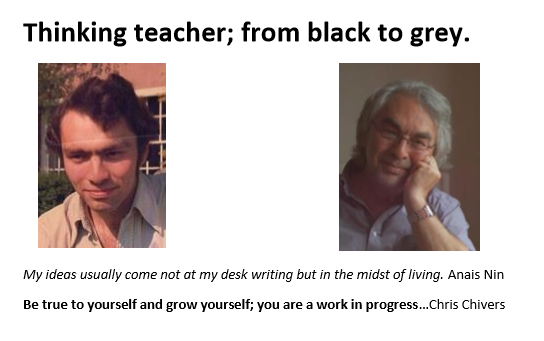
If you’re interested, I have explored the detail of my career in Thinking Teacher-from black to grey; another non-book of reflections. Download from https://chrischiversthinks.weebly.com/pdfs.html

As it says below, "Be true to yourself and grow yourself; you are a work in progress".
I'm looking forward to continuing my development, with a little help from my friends. 

Picture
0 Comments

How Did You Do That?

4/6/2019

0 Comments

 
Picture

It was always intriguing when walking around school, whether as a class teacher or management, to come across a piece of work, on display or in a book that made you go “Wow, how did you do that?”

The answers were inevitably illuminating, as the colleague or child recounted the stages that they had gone through to end up with a finished outcome, in whatever subject. They describe the process. In education, we can become obsessed with outcomes, to the detriment of the process, or the process is laid out in such a way that it becomes more a copy exercise than requiring the learner to make decisions and refine their own outcomes.

After four years of teaching, I went to a school that used the Dienes multibase approach for all its maths teaching. Despite being pretty reasonable at maths, and having used the base 10 materials as modelling aids, I was unaware of the background to the thinking and the multiple purposes that could be demonstrated using the materials. The school DH, Joe, as maths lead spent several hours taking me through the details of varied function machines and exemplification of equations. He also gave me a copy of the “bible”, from the Masters course that he and the head had completed. Tutoring through the processes strengthened my teaching for the rest of my classroom and school career. Worked examples enabled me to explore my own and possibly children’s misconceptions.

Therefore to improve the outcome, in any area of learning, there’s a need to refine aspects of the process. Just a few possible examples.

A writing outcome is hard to read, so it’s reasonable to look at improving the handwriting. But, in reality, it may be multi-layered, with a need to look at grip and basic letter formation, with alterations in both being practised outside the redraft exercise.

In maths, just having the correct answers in a book might hide the face that a child has copied from another. Asking the child to articulate (talk) their thinking through the process is more illuminating. This can become “show your thinking/working out”.

In art or DT, different elements can require a focus on the fine skills of material selection, colour, cutting, joining.
“How did you do that?” can become the basis for oral description, for written instructions to another or a report on what was done, with an evaluation of the outcome supporting subsequent attempts. If the process had been captured as images during development, the images can support the ordering and organisation of the talk or writing.

Virtually every area of school activity involves process in some form. Time for active processing (thinking) is often at a premium, as teachers move from one activity to another.

“How did you do that?” is also the essence of CPD. Listening to and learning from a colleague explaining the processing in their subject responsibility can enable insights for less experienced or confident colleagues. In a teaching force that can appear ever younger, it’s essential that the experience is passed on, otherwise it’s lost to the system, then requires a process of discovery. The art of explanation is based on clarity and ordering of thinking. The coach has to consider detail as well as an overview description.

So, my advice to all teachers is to acknowledge the expertise of colleagues and to seek to emulate them. If everyone was enabled to become as good as the “best”, the system as a whole would improve. So, over an end of the day cuppa, sit together and chat. Learn through dialogue and demonstration.

“Show and tell” works for children, too. “How did you do that?”
​
0 Comments

Curriculum, subject knowledge, Curriculum

23/5/2019

0 Comments

 
A great deal is currently being written about curriculum, books, blogs, whole or part magazines; there’s a huge amount to read. I hope I can be forgiven for adding to that. Bold type links to associated blogs.

It’s interesting to me that, nearly fifty years after I entered training college, we are having to return to an essentially structural aspect of school life. The curriculum is, in reality, little different from when I started. There are a few extra subjects. Subject knowledge informs curriculum construction, in organisational and detailed terms, which I will seek to explore through this blog.

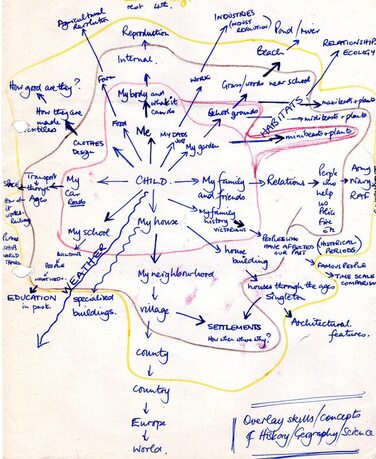
In the 1970s, the curriculum was in one of two forms, atomised into subjects, or themed cross-curricular approaches. In my locality, experience suggested that, where they were implemented effectively, both worked.

The broader curriculum embeds the concepts and vocabulary that children will encounter in their reading and may use in their writing. If nothing else, that should be sufficient reason for ensuring the broadest and deepest learning opportunities are available. The interplay of talk, reading and writing, based on experience often leads to enhanced outcomes. The availability of technology to rehearse before presentation, orally or in writing, often supported by digital images as prompts, is something that, when I started, I could not even conceive. When you had to wait for films to be developed, delays had to be planned in.

Curriculum exists within a number of parameters beyond the “knowledge”; space, time and resources. These have been constants throughout my career. It is easy to conceive the constraints on certain aspects of learning is any of these three are compromised. Good planning, including some flexibility in timetabling, available and accessible working resources for the class or group and an appropriate amount of space within which to work are key. All three are in school and teacher organisational control. Limited time, space and resources seriously limit learning opportunities.

 It’s also possible to overplan a topic, filling six weeks, when three might have led to tighter planning and learning.
Curricula have not essentially changed since I started. At core, it’s a means of divvying up the content areas across each subject in a way that is appropriate for the continuity and progression of each subject, selected for its appropriateness for a specific age group. Learning, in any environment is episodic, so the order and organisation of what is being offered to children is the central feature. A curriculum is not an ad-hoc collection of seemingly relate activities. What is to be covered and what is to be learned needs to be clearly stated. Activities that arise from this should enhance and embed what is being learned.
​
From the mid-1970s ( blog… curriculum; once upon a time)

Picture
What influenced decisions in this period were background teacher guides such as Nuffield Science 5-13, which explained the purpose, resourcing and running of science investigations, and, as such, I would hope that a future spate of publications will look at each subject and put learning in order, from the beginning. Resources today are lightyears ahead of anything that we had then. “Jam jar” science was a thing.
​
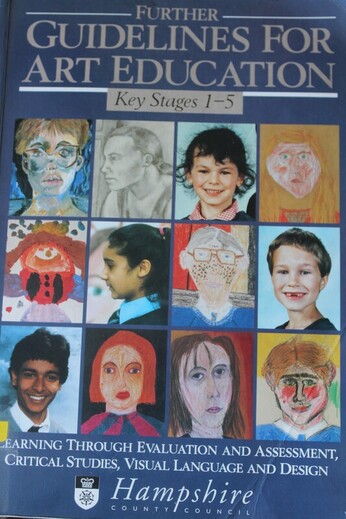
In the 1990s, Hampshire inspectorate published “Guidelines to Art Education”, KS1-5, which shared the developmental processes.
Picture

Learning, whether formal or informal, school or home, is always episodic, because it is time-ordered. In a formal setting, there is at least one formal adult lead, with a prepared diet of learning that constitutes a year, term, week or lesson. Where each lesson builds on previous learning, the whole becomes the sum of the parts. There was a mantra early in my career, whole-part-whole, which was linked particularly to PE teaching. This meant try and show current ability, focus teaching on the “next step” and have a chance to practice. This does have applications across all learning, as it enables some fine tuning to evident needs.


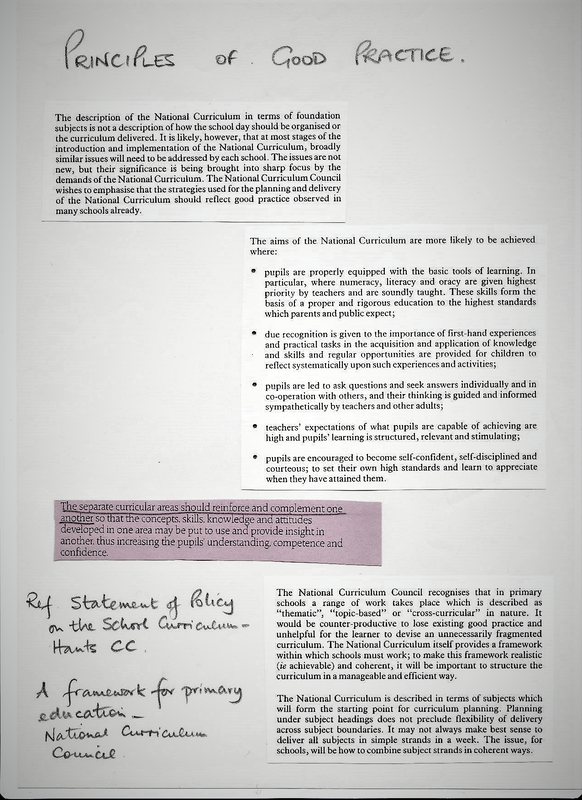
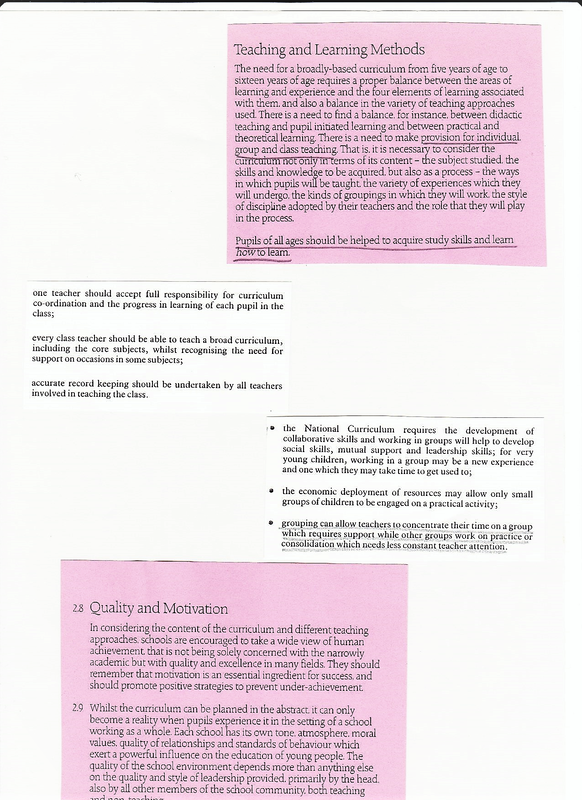
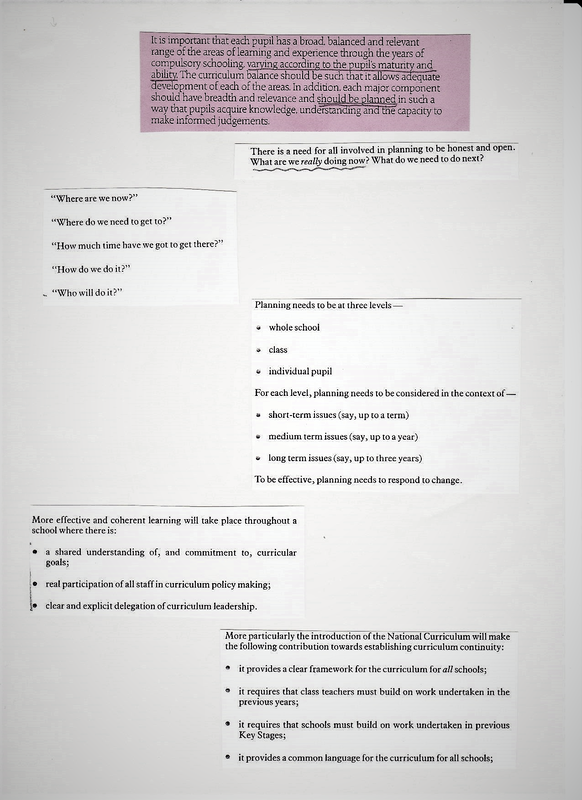
Having been a deputy when the 1987 National Curriculum was introduced, after a detailed audit of what the school was offering compared to the NC, the 95% correspondence led to a few tweaks. For interest, I have appended a cut and paste piece that I created to support a staff discussion. The discussion was more detailed and better informed as a result of having a common document to consider, having each read the subject documentation. There are statements in this document from 32 years ago that can be heard today. Some principles are central.
​

You have to remember, in reading these extracts, that in 1987 there was no such thing as a teaching assistant. All preparation, resourcing, organising and oversight was done by the teacher. As a full time teaching deputy, I had the same class commitments as every other member of staff.
​
Picture
Picture
Picture
Order and organisation are key aspects of quality teaching. Putting the learning narrative together is akin to the teacher being a storyteller, over a known timescale and with aspirational end points in mind. The planning is key.

In 1990, when I became a head, there was a very rapid need to organise the curriculum. While the nice school in a nice area was doing quite nicely, it was evident that there was considerable room for improvement. In many ways, this was accomplished through detailed planning, of overview curriculum expectation, but also looking at the available time and seeking to allocate appropriate topics and time periods to enable quality outcomes.

·         We allocated topics to year groups, ensuring progression of content challenge and contextual availability of resources.
·         We developed topic specifications, which some would now see as knowledge organisers.
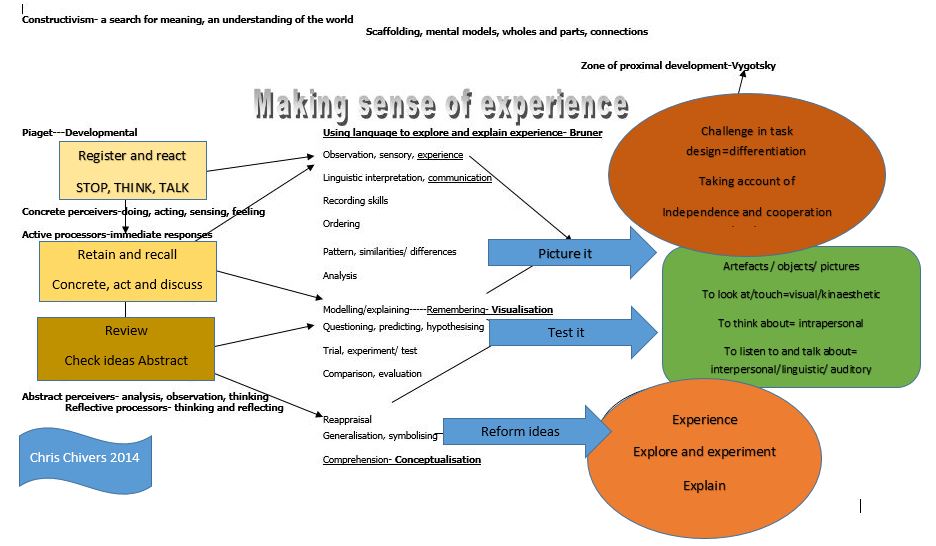
·         We looked at the idea of learning through episodic experience, premised on “Making Sense of Experience”, seeking to deepen challenge through the learning process.
​
Picture

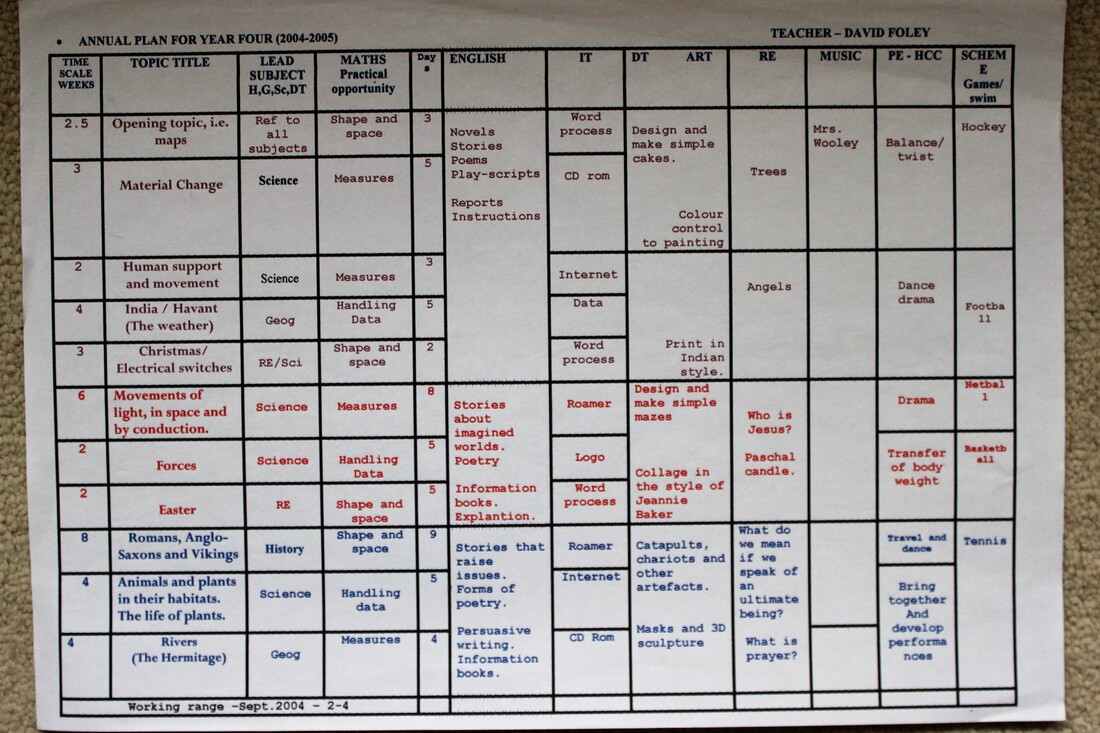
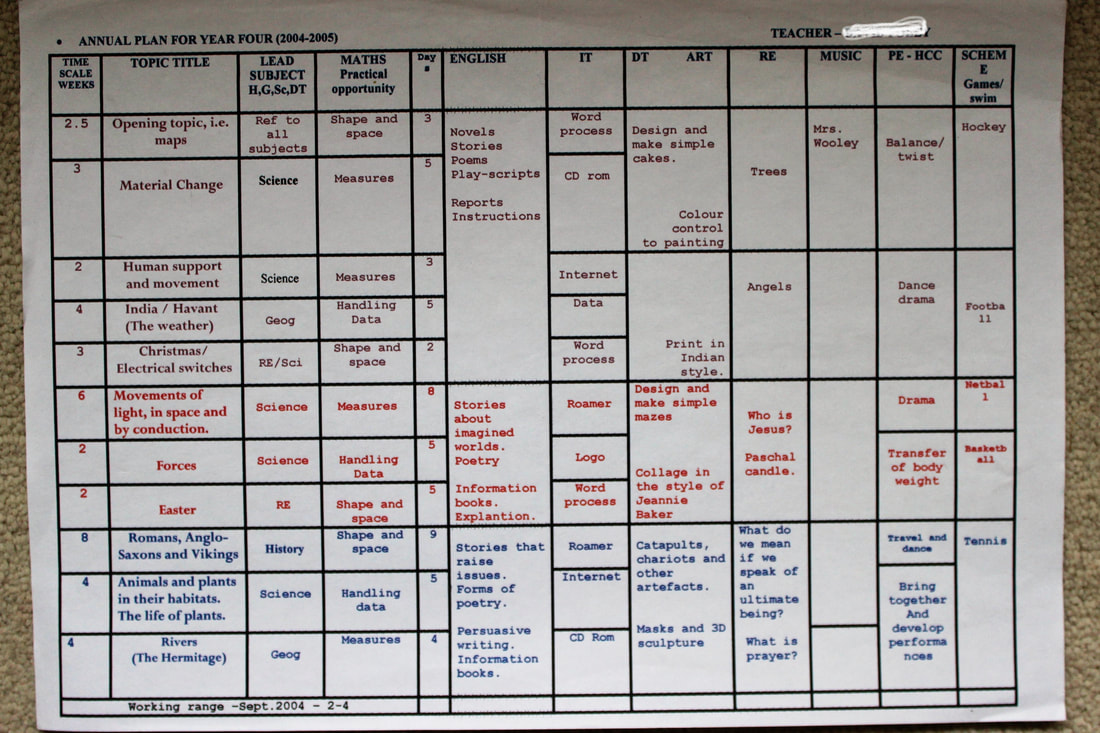
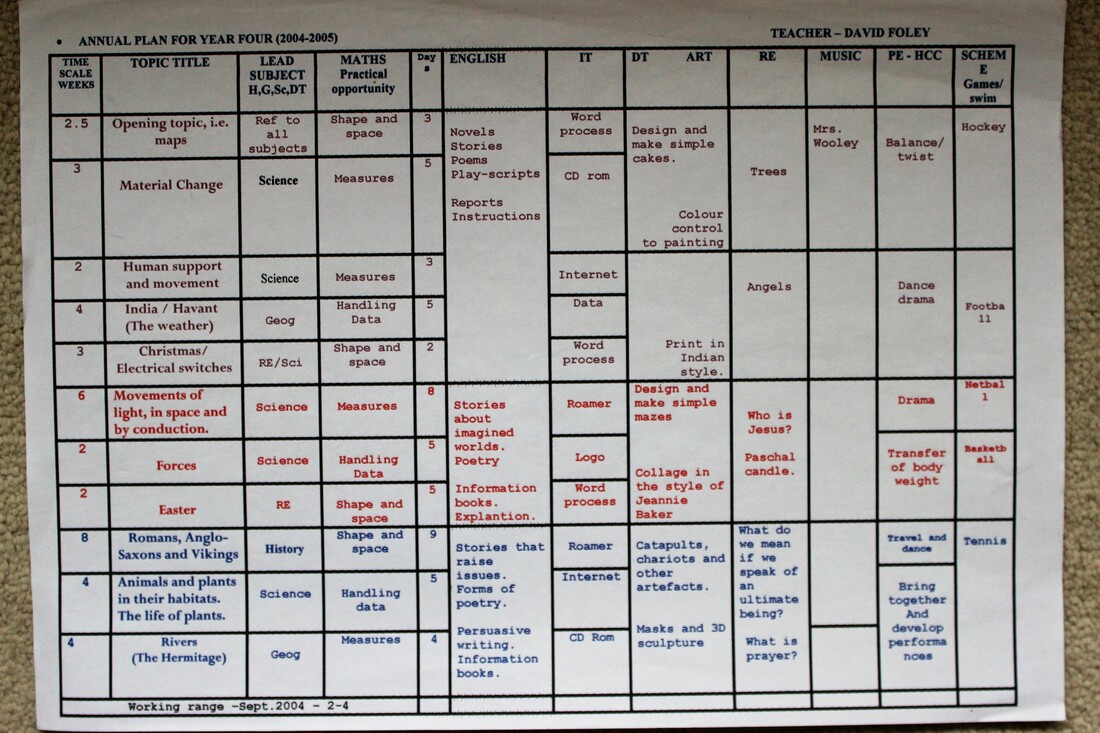
We created the notion of an annual plan, to ensure that learning was allocated a space in the year; it was evident that the previous approach allowed some parts to be missed off.
​
​
Picture
An annual plan example.
 
·         The first two weeks of the school year were “given” to the teachers to plan their own starter topic to get to know their new classes. On the second Friday, we held a closure dedicated to planning the detail of the coming term, tailored to the known needs of the class.  
·         We created further time during closure days to enable staff discussions and planning, across the one form entry school, to make the best use of the expertise and experience available.
·         Subject managers were responsible for ensuring that each topic was effectively resourced; initially with a pump-priming fund, but then, following LMS, with an annual audit that had to specify replacement needs and consideration of resources to enhance learning.
·         Time was bought from the inspectorate to enable one half day every two years for subject managers to review and update the topic specifications.
·         Books transferred with children to their receiving classes, to ensure continuity of expectation.
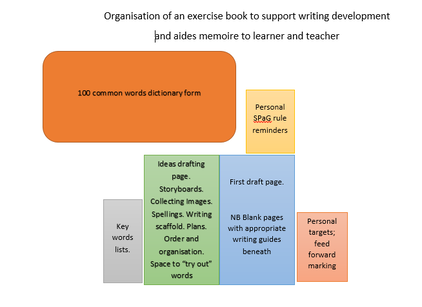
·         We developed the “flip sheet” of feedback and expectation that articulated to the child and the teacher what they should be concentrating on to improve their work. (Exercise books as personal organisers)
​
Picture
​
It is clear from this that curriculum development, to be successful, is something that can take (quality) time, for reflection, for research, for discussion, for dissemination, for oversight and evaluation. Time is a precious commodity on schools and, sadly, there is a cost element, too.

There is also the notion of progress, that some seek to diminish, as it relates to making judgements about children and their learning. Continuity and progression are important and need to be planned. Overlaying what is essentially content access is an often qualitative judgement about “how well” a child is doing. This has, at heart, an understanding of expectation for the year-group being taught, but also some appreciation of what went before and what comes next; articulated on page 3 of the NC Principles images.

The original NC had a “new” section on level descriptors. The Task Group on Assessment and Testing (TGAT) effectively created the idea of assessment of learning and, certainly in the first few years, the descriptors allowed detailed conversations about how well children were performing. Their use as data points distorted these conversations and, later, with APP (Assessing Pupil Progress) became so atomised that they added even more limiting, especially for children who could access learning quickly.

Any visit to a classroom today still shows that teachers will group and regroup children according to evident needs, so that they can focus teaching and support, remodelling or coaching to embed what seems to be less secure.
​
This is largely because schools still run on curricula organised by adults to benefit children.

Can we not enter a phase of evolution rather than regular tinkering at the edges, which only leads to distortion, or, being charitable, unintended consequences and a disproportionate amount of time in revising previous incarnations, largely to end up at the same place...?
​
0 Comments

Singing in Primary Schools

1/5/2019

0 Comments

 
Picture
It’s Mayday, 1st of May, the day for joy, merriment, dancing and singing. Our local Morris teams have been out since dawn and will spend the day travelling around to celebrate the day.

“As I walked out, one bright may morning”; the beginning of many well-known tunes collected by people like Cecil Sharpe for posterity, sadly largely forgotten.

Music “education” in the 1950s Primary school was a bit hit and miss. We sang hymns in assembly and we certainly had Christmas shows, but, for the youngest, this was often only an excuse for Cecil B Demille costumed productions, where I was, one year, a bee and another a “Chinese” person with lampshade style hat. There wasn’t much else that leaves any mark.

From 7-11, we lived in Australia, where song was popular, particularly the folk songs of Australia, like “Waltzing Matilda” and “The wild colonial boy”, so we had the printed song books and were encouraged to sing lustily, if not always in tune. Memories were being created and memorisation was being practised. Of course, our understanding of the songs was helped by “interpretation” of the words; swagman, billy, jumbuck, tuckerbag, troopers and billabong. And that is some of the great value of songs. They hold the language of their time and place.

Returning from Australia, and starting at Grammar School, during one of the first music lessons, the teacher used the lesson as an audition for the school choir, lined us all up and each was asked to sing “Early One Morning, just as the sun was rising… etc”. This seemed to be known to the early singers, but not to me. With panic rising, I could feel, with each rendition, my listening becoming more acute, for both the words and the tune. My turn came and I managed to “perform” adequately and was surprised to be asked to join the choir. None of us knew the importance to the school at the time, but, when we went to the South West Choir Festival and won, it became apparent. “Hoppy” Hopwood was delighted, for himself as well as us. Then my voice broke… and I had to leave the choir…

My next singing memory comes from Churston Grammar, where the librarian was in charge of the school production. I was asked out of the blue if I would like to play the part of the policeman in that year’s production, “Salad Days”. I must have been taken by surprise and said yes. From time to time, the lines come back, “We’re looking for a piano, a piano, yes a piano…” These particular memories are from fifty years ago. The words are part of my past but can be drawn into memory.

 I didn’t do a lot of singing between that experience and starting as a teacher, apart from singing on the coach before or after sporting matches.

Singing Together and other radio programmes were the bread and butter of singing and music education in the early 1970s. Based on folk and other traditional songs and tunes, a booklet of words accompanying the broadcast. Listened to live, you had to be in the hall at the right time, ready with books in hand for the start of the programme. If the school secretary remembered to set the reel to reel tape recorder, there might be a copy for a repeat.

At the age of 28, I learned to strum enough chords on the guitar, having joined the beginner group for a term, to take the next term’s beginners and also to accompany quite a surprising range of songs. From that point, building a collection of songs for children, I was able to add songs to any topic theme.

Being the time of the Overhead Projector, photocopying the words onto acetate meant that song lyrics could be interrogated as a part of an English lesson, as a reading exercise, dictionary work and oral exploration. This, probably, was the position until 2005, when the Interactive White Board was available, if only to do projection in a different way.

Songs often have a historical and geographical context. There are protest songs, songs that use comedy to make a serious point. These songs, of their time, can help children to understand the feelings of people living through, sometimes, very serious changes. Communal song helped people get through two world wars.

For a few years before headship, I was a part of the band for Woodfidley, a social dance group, and, in between dances, different members of the band filled the interludes with folk song. Part of the band moped into Pogles Wood, a barn dance group, with similar intermissions. This extended the repertoire of learned songs.

As a HT, I instituted a regular half hour (plus) singing slot with both the Infants and junior halves of the school, singing folk (UK and international), fun and hymns, depending on the needs of that part of the school year. The staff had a form of PPA before that became a reality. Our school “choirs” for village events were simply invitations for whoever was available. All were welcome.

A few weeks ago, a message came through my blog from someone who had been in my 1988 class, reminiscing about songs that we had sung, having found a blog on the Triantiwontigongolope. That’s not unique. Still living in a town where my 32-year school teaching career was within 14 miles of home (SE Hants has around 240 primary schools), I can meet ex-class members or their parents who will similarly recall songs that were sung and are being shared with their children or grandchildren.

Being able to join in with song turns you from an onlooker to a participant. Knowing the words is important. We talk of “Cultural Capital”. Songs often embed this in spades. And it you think you “can’t sing”, interpret and learn the words as poetry, “borrow” someone else’s voice for the tune and go back to how I started, with a disembodied voice leading singing through audio media.
​
Just don’t lose the music… Every topic can have a tune…
 
​
0 Comments

Shadowlands; theatre of tears

30/4/2019

0 Comments

 
Picture

One thousand people holding their breath in a theatre, knowing what was going to happen, but unable to move because of the incredible tension that had been built. Around me, I could hear others trying to stifle sniffles, just as I was, as the conclusion to Shadowlands drew closer.

Shadowlands, a 1985 TV drama, developed into a play, written by William Nicholson, shared the period of C S Lewis’ life when he encountered Joy Gresham, in 1952.

The programme outline written by A N Wilson, Lewis’ biographer, shared the earlier life experience of CS and his brother Warnie (Warren). Their mother dying of cancer when CS was nine, meant that he and Warnie were sent to an English boarding school, away from their Irish home. The undercurrent of that earlier, unaddressed issue, became a thread through the story; the small boys who spent their adult lives as bachelors, limited in their ability to relate to women.

Joy Gresham, an American with whom CS Lewis corresponded as a dedicated fan of his writing, arrived in the UK on an unexpected visit, with one of her children, Douglas. Their capacity to discuss and challenge each other led to a deep friendship and CS Lewis, having secured British citizenship for Joy by a marriage of convenience, eventually realising the capacity to love another. This was precipitated by Joy, having developed bone cancer, collapsing and CS realising that he might lose her in the same way as he lost his mother.

After hospital, Joy moved into CS Lewis home, with Douglas, supported by Warnie, so a form of normality was supported for a while.

Remission was followed by terminal decline, CS facing his loss, becoming aware of the impact on Douglas, having been in the same place. CS also facing the greatest challenge to his life-long faith and beliefs.

The inevitable happened, with a very powerful display of personal grief. Hugh Bonneville and Liz White sustained their characters through every possible emotion.

It is an exceptional play, on many levels; well written, well directed and acted, in a simple set that adds to the whole without distraction. It also holds many unstated truths, as it records the real lives of so many people. Love and loss are not uncommon situations.

I recalled my mother leaving the family home when I was 12 and the death of my first wife from cancer, both events creating their own distinct grieving. Many people carry their personal griefs without any outward sign to alert others, who are busy getting on with their own lives. We “get on with life”. Sometimes it takes an external event to enable us to externalise our feelings, but, when the lights go up, we revert to our “holding it together for others” demeanour; we can’t impose on others.
​
Twelve hours later, the sensations of the evening are still vivid. Shadowlands, running at Chichester Festival Theatre as a part of the summer season, is a “must see”, but take your hankies…

0 Comments

Education Knockabout

26/4/2019

0 Comments

 
Tennis, table-tennis, ping pong or whiff whaff, squash, badminton all games where two or more players take turns to hit a ball or shuttlecock, with scoring systems to see who ultimately wins. Just an example of the binary nature of sport, or possibly more generally in life?
​
Picture
Apparently it's my 7th anniversary on Twitter. Sometimes education can appear to be a giant form of whiff waff. I hadn’t heard of this name for a simple game before the 2012 Olympics when one Boris Johnson sought to claim that whiff waff predated table tennis, to be corrected by the sport historians. In doing so, standing by the claim in the face of evidence, he showed the capacity of humans to box themselves into a specific way of thinking.

When there are simplicities in education, they can be framed in such a way that they can appeal to a narrow form of teaching. Having taught since 1971 there have been some simplicities, which can be expressed as:-
·         If children need to know something the simplest way might be to tell them.
·         The order, organisation and articulacy of the teacher will impact on the potential for learning.
·         Any teaching can fail if the children don’t have the means to visualise what the teacher is saying.
·         If children need to overlearn something, they may need to repeat an exercise, or receive some detailed, dedicated teaching or coaching.
·         If teachers want to know if the children have learned something, it may need checking out in some form, a combination of recall tests and use and application challenges.

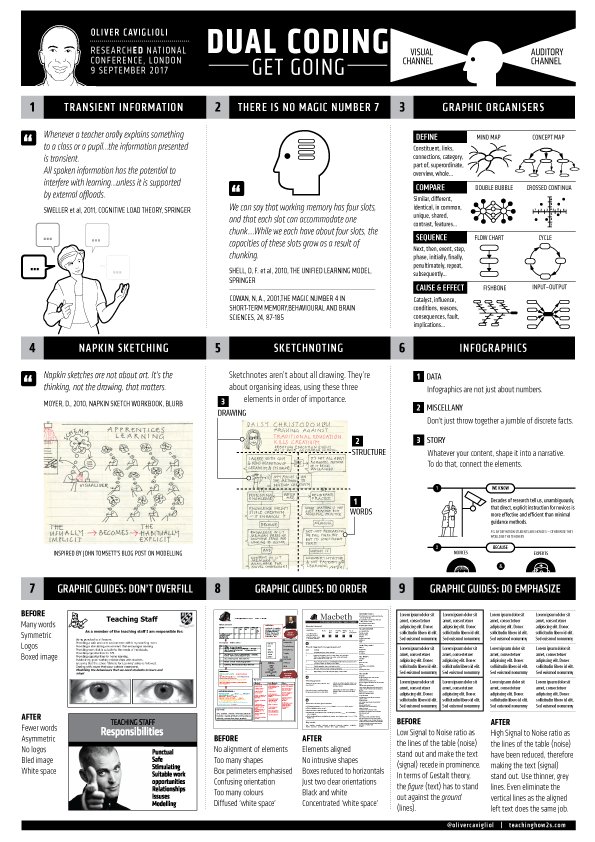
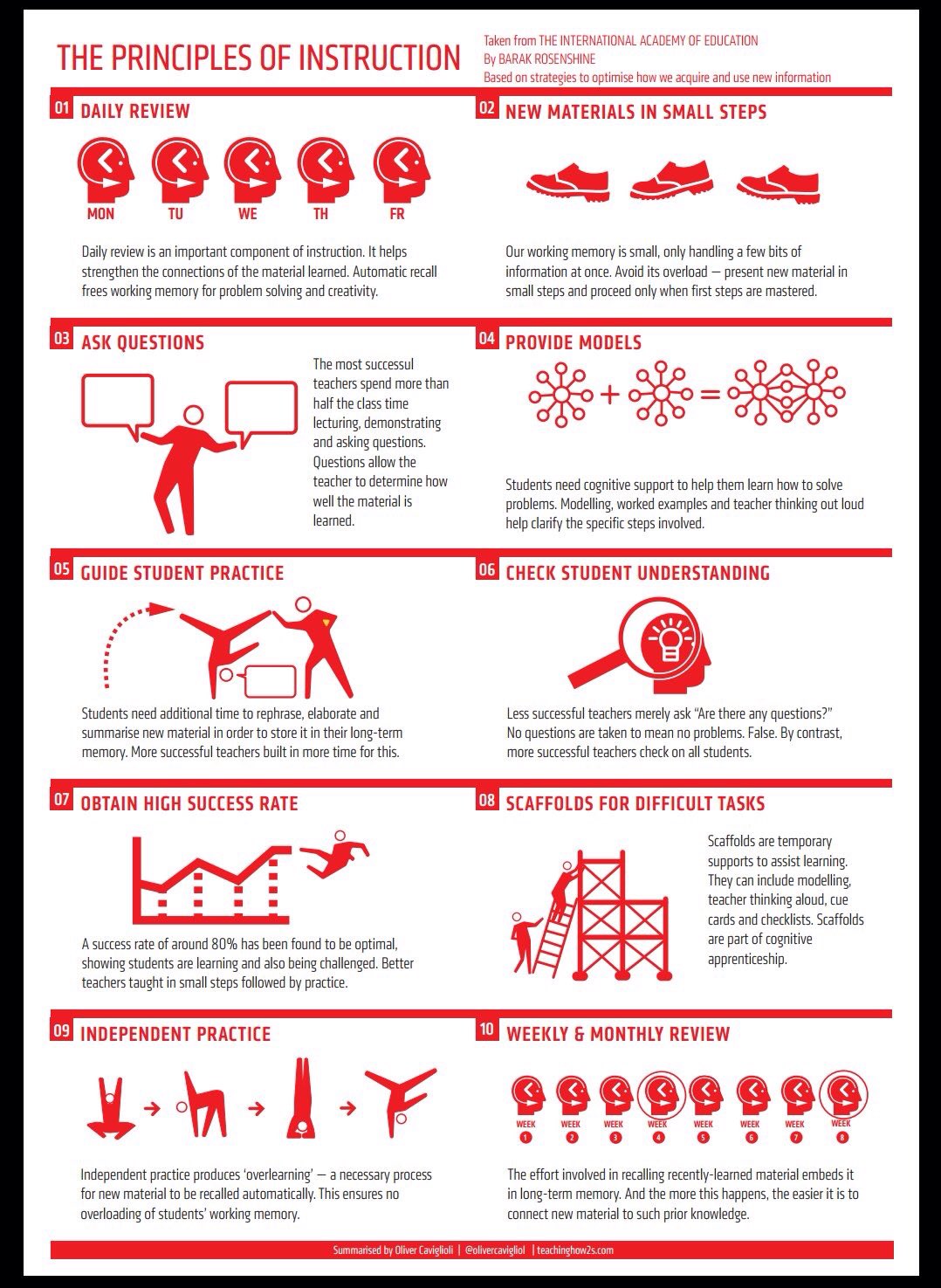
Having looked at various descriptor models of teaching and learning over the recent past, I think the diagrammatic interpretation of Barak Rosenshine by Oliver Caviglioli describes that approach, to which I would add the earlier CPA (Concrete, pictorial, abstract) thinking of Jerome Bruner and “Dual Coding” thinking.
​

CPA is an essential technique within the Singapore method of teaching maths for mastery. Concrete, pictorial, abstract (CPA) is considered to be a highly effective approach to teaching that develops a deep and sustainable understanding of maths in pupils. It is sometimes referred to as the concrete, representational, abstract (CRA) framework.
​
However, when I started teaching, with classes of 39 children, no TA, occasional parent help and one chalkboard, there was a need to provide for the range and needs of the children. This was done in smaller groups, run on an integrated day approach.

It was, to some extent, a form of survival, but more importantly, the structures within which we could teach our mixed ability classes providing the broadest possible curricular opportunities. It did mean well ordered plans and resources, to underpin the needs of independent actions by children in-task. It was a lot of plate spinning, but that was what we knew and had been trained for. During a pedagogic discussion during my post grad Dip Ed in Environmental Sciences, the discussion focused on the amount of “teaching” that we did in a lesson, with a follow up activity during the subsequent week to track reality. In both “traditional” and “progressive” settings, each of us was doing in excess of 50% of the lesson time as direct teaching, as whole classes or smaller group focused teaching. The remaining 50% was responsive teaching to needs as the arose. Group dynamics meant that there was a varied demand for marking; editing, coaching advice or critiquing/responding.

Task challenge was, from the beginning, central to the approach, differentiated (small tweaks) to the varied needs of the groups and support available to need. Reading was individualised, supported by a colour coded reading scheme and home-school reading records.

It would have been seen now as “progressive”, but children made good progress, as measured by standardised tests.
A great deal of curricular water has flowed under education’s bridges since, not least several iterations of a National Curriculum; each seemingly adding layers of detail to the preceding incarnation. Teachers have often felt the need to run to stand still. Regular readers of the blog will know that I am not enamoured of the 2014 version.
 

This week, as a school Governor, I attended the morning session of a training day, where the staff were looking to develop the broader curriculum. The subject leads had spent time with LA subject inspectors, creating the overviews of the curriculum. The staff role, collaboratively on this day was to put the detail into the outline, structuring the broader curriculum for the term.

As a fly on the wall, it was interesting to listen to discussions that could have taken place in 1986. It struck me that, after thirty years, the constant changes have rarely been evolutionary, too often disjointed and distracting.

Education benefits from reflective development, is supported by long career teachers able to reflect on change over time coupled with newer colleagues bringing their enthusiasm and newer understandings to the discussion. Firm decisions can impact on resourcing, which is then, on an annual cycle, considered for utility, quality and, where necessary, replacement or updating. Teachers and children are entitled to the best quality resources available. However, these can also be supplemented by found items, eg buttons, conkers, stones for counting.

So, if I was a Primary head today, what would I want to be doing?

·         Create an inspiring range of challenging topic and project areas that would embed the necessary knowledge to be used in other scenarios. These would have time allocations, not necessarily to fill a half term, so that Science, History, Geography and Technology all had a secure place.
·         Ensuring that each element was appropriately resourced so that it could happen and be of quality.
·         Link the English and Maths curriculum within themes in such a way that each could make use of the current and recent past topics, so that each fed the other, with opportunities to use and apply earlier skills and knowledge.
·         Ensure that art, drama and music were deployed as interpretative subjects of worth and each capable of supporting the oral English and Maths curriculum.
·         MFL, music and aspects of PE can be used to support the PPA needs of the school, by judicious use of specialists.
·         Utilise one closure day in June or July to enable staff to consider overview planning for the coming year.
·         Then only ask for teacher medium term plans, to see the direction of travel.
·         Short term plans are for the teacher in the classroom, so can take any form that suits.
·         I’d want children to know the focus for their personal efforts at any particular time.
·         Create portfolios of moderated in-house examples that could support discussion and decision making in the school or be used to moderate against other school outcomes to validate judgements.
·         Mentoring, especially of early career teachers, needs to be secure.
·         Every area of life is governed by a measure of capability in some form. “Can do” statements are a guide.

So, to summarise

​
·         Plan long, medium and short with different emphases on what’s recorded and share with supporting adults. Organise the “knowledge journey” developmentally.
·         Order and organise space, resources and consider the available time.
·         Pitch and pace each lesson to known needs of the curriculum and the learners.
·         Set learning tasks that provide some challenge.
·         Share outcomes as learner models of expectation within and between lessons.
·         Evaluate throughout, ensuring continuity of expectation.
·         Checks en route, memory, use and application in challenge.
·         Simple personal record systems of developing vocabulary and presentation needs.
·         Books to become personal learning records.
·         Know your children as fully as possible, recognising that you can’t see exactly what they are thinking.


Children are children, as they always have been. They deserve the best that can be offered.
Schools need to secure their curriculum, so that it can provide the essential core of experience, enhanced by incoming expertise.

​
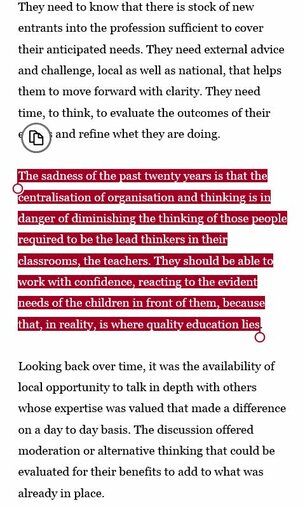
Something that I wrote a few years ago continues to resonate with me. Teachers are the lead thinkers in their classrooms. They must have every opportunity to be autonomous decision makers, in the moment.
​
Picture
0 Comments

Anniversaries; personal histories

18/4/2019

0 Comments

 
Picture
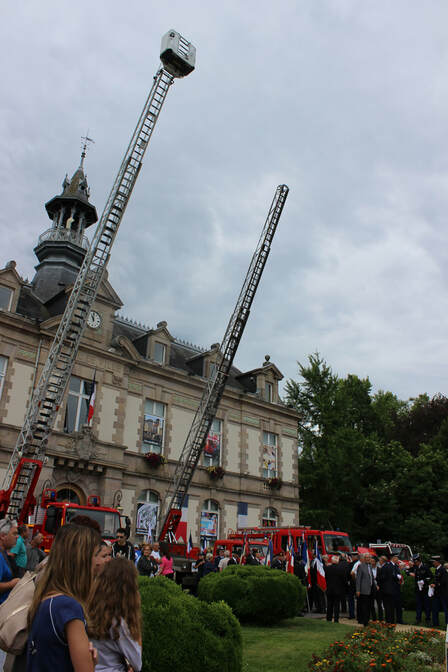
Picture; 14 July, Fete Nationale, our local town. Annual commemoration

On 15th
April 2019, a new date was recorded for posterity, with the devastating fire in the Notre Dame Cathedral, in Paris. Events, of every hue, in every life, create anniversaries; some that must not be forgotten, others that might disappear into, or be distorted by, the mists of time, simply because there’s no-one left to remember.


Our histories are marked by events, some small and insignificant, others world shattering. It's likely to be the latter that make the greatest mark on our continuing lives.

Recently, my eldest celebrated her  40th birthday. With birthdays, decades matter, so she took her family on a trip to remember. I still recall the day of her birth, a long day of waiting, followed by such a feeling of elation, of happiness that all had gone smoothly and all was well.

Marrying my first wife while I was in my final year of teacher training was the start of a 32-year journey until her death in 2005. In a quirk of fate, on our 20th wedding anniversary, a surgeon, using his kindest manner, told us that D had breast cancer. Our wedding anniversary, from that moment, became an anniversary of survival. Five and ten years were celebrated with a ceilidh for friends and family. D’s death created another date to commemorate.

 On June 1st, it’s the 25th anniversary of buying a small house in France as a “life project”, trying to thumb a nose at life in general and offering a different kind of stability during holidays.

The house in France is in the Limousin region. One town nearby will be remembering a devastating event that occurred 75 years ago. While many areas of France, starting on the north coast, will be remembering their liberation after D-day, on a rolling timetable from early June, Oradour sur Glane will commemorate the destructive nature of a defeated force taking revenge while withdrawing. A Nazi battalion encircled the town and herded people to the centre, before shooting the men, grenading the church with women and children inside and setting fire to buildings.

Meeting with my sister recently, we reminisced about our childhood, which was marked by our mother announcing that she would be leaving the family home on 11th October (1965) after her summer season job in a local hotel finished on the 8th. Leaving home for school on 11th October, seeing a travel bag packed by the door and being asked if we wanted to go with her created an indelible mark.

So, dates keep piling up. I have another anniversary and additional birthdays to remember now, having been lucky and found M, extending the family further. Mind, you, it’s just as well that we keep a diary with the information copied from one year to the next, as an aide memoire. I’m beginning to experience senior moments…
​

I wonder what anniversaries you mark?

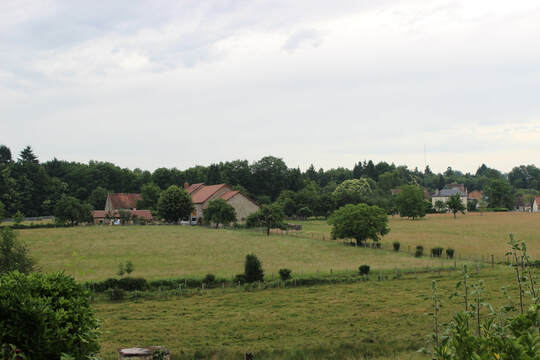
Picture; the view from our French cottage
​
Picture
0 Comments

Cultural Capital

9/4/2019

0 Comments

 
Picture
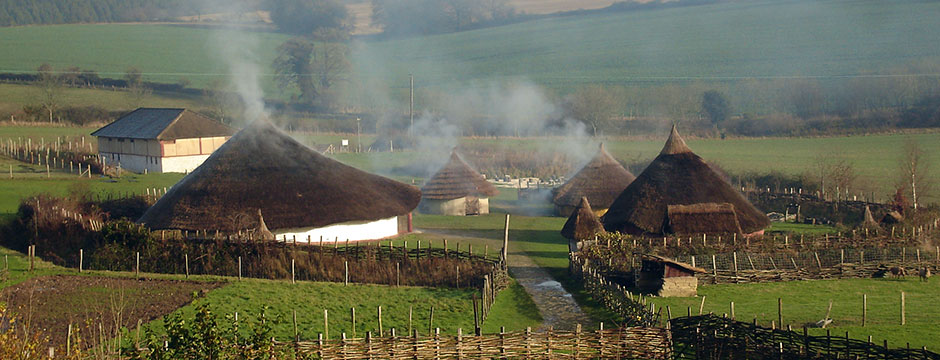
Picture; Butser Ancient Farm. Reconstruction Iron Age settlement, Chalton, nr Petersfield, Hampshire

I know we’re not supposed “to Google” things these days, according to some commentators, but in reality, unless one has an extensive personal library, it’s highly likely that the internet is a major source of information.

So, in looking up the notion of Cultural Capital, which is a "current" buzz phrase, Wikipedia threw up this opener: -

In the field of sociology, cultural capital comprises the social assets of a person (education, intellect, style of speech, style of dress, etc.) that promote social mobility in a stratified society. Cultural capital functions as a social-relation within an economy of practices (system of exchange), and comprises all of the material and symbolic goods, without distinction, that society considers rare and worth seeking. As a social relation within a system of exchange, cultural capital includes the accumulated cultural knowledge that confers social status and power.

In "Cultural Reproduction and Social Reproduction" (1977), Pierre Bourdieu and Jean-Claude Passeron presented cultural capital to conceptually explain the differences among the levels of performance and academic achievement of children within the educational system of France in the 1960s; and further developed the concept in the essay "The Forms of Capital" (1985) and in the book The State Nobility: Élite Schools in the Field of Power (1996).

As someone who was originally trained in 71-74, first year in science, then transfer to a Primary based environmental Studies course, where we explored the environment as a source of learning, Bourdieu was a bit of a revelation a few years later, as he appeared to validate the substance of my earlier study.

I think that we need to look at cultural capital as a product of a learner’s interaction with, first, their surroundings.

The home being the first environment and parents the first teacher, the richness of the surroundings is likely to be the original baseline opportunity. The quality of stimulus, toys, or natural opportunity, within the house or in the garden, supplemented by interactions with older siblings or adults capable of introducing language, naming and describing things that are experienced through the senses, is either enabling or disabling through a lack of potential. The willingness or ability of the adults to take their children further afield offers enhanced stimulus; consider the potential of a local park, a wood or an open grass area for example. A limitation could be disposable income available to a family. During a school visit in Redruth, Cornwall, the head spoke of the sea being only a few miles away, but families unable to afford the bus fare, so an opportunity was not available. This will have an unseen impact on children as they may not have the experiences common to their peers. Poverty can impact in many ways.

What a school offers children when they start, then progressively through their experience needs to be as rich a diet of opportunity as possible. Having experiences that they can then take into their locality to support further engagement, with natural or man-made environments, with living things, helping them to orientate themselves would seem key to progress(ive/in) learning. Building a vocabulary for description and for asking questions are fundamental capabilities. Learning is a social activity. Externalisation enables another to offer further or alternative insights, or to add their own understandings.

In many ways, this has a simplicity at the core. The richer the diet of opportunity, in experience and support, will lead to more independence in exploratory activity that enhances the core, enabling a child to become a greater partner in, or eventually to take responsibility for their learning. Greater experience embeds greater vocabulary, which in turn supports communication and reader understanding.

Why is this contentious?

Not everyone lives in, or near London. In a previous role, I was regularly visiting London schools. The quality of work was often absolutely stunning from children in “deprived areas”. The work was often based on school visits to places of interest, museums, galleries etc, all within relatively easy reach and supported by travel on the tube or a bus ride. Culture was on the doorstep and a “day out” meant a day out. These experiences were available to families at weekends, as were broader opportunities from national organisations offering “scholarships”, Saturday morning dance or musical opportunities to areas in need.

My career was Hampshire based. The schools were sufficiently far from cultural centres to require coach hire, even for Portsmouth or Southampton. London was a minimum of a two-hour coach journey at £450+ for a class of thirty children; Southampton could cost £300 and that meant building your day within school run timetables. It was often the case that the cultural experience had greater potential if bought in; a writer, poet, artist, drama group visit.

One such that will remain in my memory, was a six-week project for year six, where I was able to ask a former London teacher to create a Hindu experience using his contacts. This involved art, drama, music, dance, art and a visit to the Southampton Hindu temple. The quality of involvement throughout was a delight to experience, as the children encountered the specifics of the culture through interaction. We were able to repeat this for a number of years, with different partners. Real people sharing their culture, making it a part of the children’s world.

Cultural capital should enable children to interact with the world as they experience it, to orientate them to their locality and to be aware of the people who inhabit their area.

Schools should be facilitators of this, offering the “best of what the area has to offer”… which can lead to the best from further afield and in time.
 
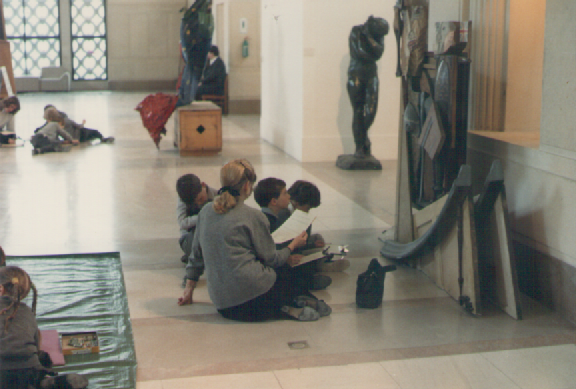
Pic below; a visit to Southampton art gallery, to learn how to "read" a picture.
Picture
0 Comments

Do system Changes Militate Against School Development?

3/4/2019

0 Comments

 
Picture
As a school Governor, I am involved in staff appointments. We are currently looking for an Assistant Head Teacher for Teaching and Learning; Curriculum Development, our previous, very good AHT having been promoted in another school. What such an activity does is to create opportunities for broad and deep discussions about the details of teaching and learning, particularly in the context of the school and its point of development, both before and during the interview process. It was during one interview that this thought was generated.

I have touched on this idea before in a blog entitled “Tribal memory”, where staff loss can be debilitating.
Picture

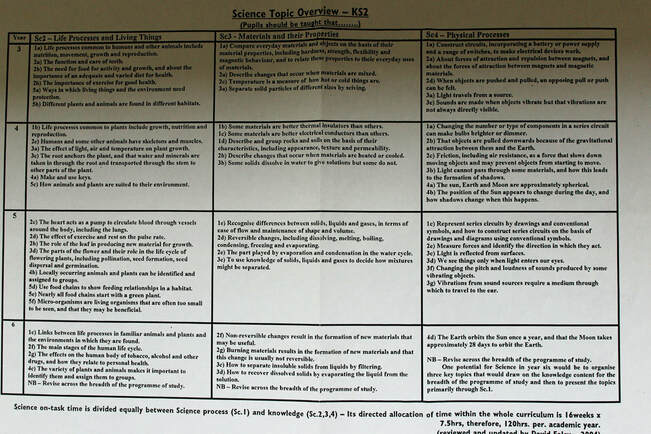
Teaching and Learning and curriculum development have been the bread and butter of my whole career. You decide on a range of “stuff” that you consider children need to know at particular points in their lives, then decide the best approach to making sure that it “sticks”. Knowledge is broad and the accompanying pedagogies are equally broad.

Schools therefore have had to make strategic decisions. Some of these are likely to be general, in that the “knowledge” in different curriculum areas has been relatively consistent throughout my career, in Primary this can be broadly summarised as variations on Maths, English (R,W,S&L), Topic (H,G,Sc lead, Art, DT interpretation), Music, PE, RE, MFL.

In school and curriculum development terms, the key can be the availability of colleagues with appropriate background to be able to, at least, map out curricular development statements, if necessary, drawing on broader collegiate expertise within and outside the school. This may be particularly acute in smaller schools.

One interview raised the question of personal ambition as a potential drag on development. It is conceivable that, after a period of leading development in one subject area, an experienced teacher might be asked to then oversee an area that had received less attention, in so doing relinquishing responsibility to another. Equally, another teacher might be brought into a school and will wish to “make their mark”, with an eye to their own future promotion prospects. In either case, there will be a hiatus, as stock is taken and proposals made for “improvement”. This could be seen as “change”, a regularly used word in education.

Whereas improvement implies a strategy, unless a comprehensive strategy is articulated, change can become distracting; wholesale change can mean abandoning what went before. As a result, nothing gets fully understood or embedded.

This can be as a result of Government decisions. I'd quite like Government to hold back from initiatives, allow teachers to take stock, to be able to plan securely, in order to put in place structures that can stand the test of time, by allowing consideration of improving parts rather than wholesale alterations every few years. 

​I would still contend that much of the 2014 changes wrought on education were change for change’s sake. After five years, the impact has led to poor implementation in SEND and Ofsted altering their 2019 approach to look at the broader curriculum. Strategy is complex, a bit like a Gaia principle of “wheels within wheels”. Knee-jerk alteration in one area has a knock on into another, often causing unintended, or unforeseen consequences.

School managers need to plan development with care, mapping clearly how different elements work together, seeking to avoid duplication of or wasted teacher effort.

Distraction destroys continuity. Continuity and progression were by-words of my school career; progressively building from one phase of education to the next, within an overall aspiration for all children.

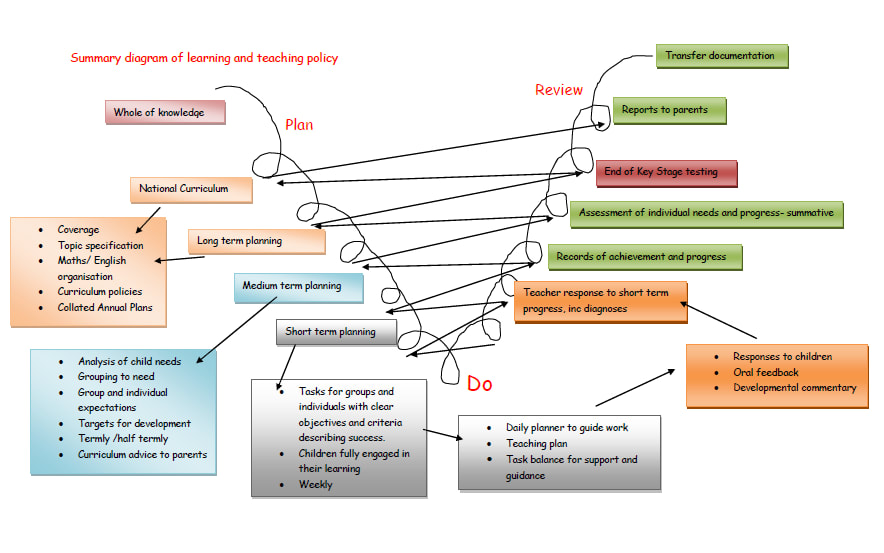
To illustrate this, I now draw on the “Learning and Teaching” policy that was my school’s articulation of purpose. It was set as a central plank that supported developmental colleague dialogue, enabling discussion of detail without distorting the whole, or the proposed learning journeys through a child’s life at the school.

While no statement is perfect, it gave clarity to teachers appointed to the school. Communication is key to development, from overall strategy to the detail of a specific area. If teachers are informed, they can support the strategic direction.

The "class of 1993"; stability supported development, embedding qualities that survived change.
Picture
Learning and Teaching Policy (first articulated 1993, developed to 2005)
A Statement of School Vision

Everyone involved with the educational process at X School is a partner in progress
This, in terms of children, is encompassed in the motto Thinking, Working, Playing Together.
Educationally making guided progress, through individual and group effort.

Our Aim
A typical child leaving X School will have these attributes
Confidence in themselves, as people and learners.
Awareness of the world around them, locally and wider, showing sensitivity, an enquiring approach, and a developing sense of awareness of themselves as spiritual beings.
Capable of working in many different ways, with different grouping of others, and be able to sustain effort when required.
Solve problems with different, but developing, levels of independence.
Think creatively and reflectively when appropriately challenged, organising their needs, and being able to talk clearly to anyone with an interest in their activities.
Accept guidance to achieve the best they can, with a clear understanding of their strengths and areas for further improvement.

A policy for learning, achieving the vision
Children, their thinking and learning, are our core purpose, within the context of a broad, balanced and relevantly challenging curriculum. They are to become active producers of learning, rather than passive consumers of teaching.
Children will start as information gatherers, capable of clear description.
Children will progressively become problem solvers, applying a range of relevant skills, able to articulate clearly in speech and then writing, the detail of their learning, and to have a developing repertoire of presentational skills through which they can show their ideas.
Careful consideration of information, and logical thinking, together with the ability to explain their thoughts, using 2-D or 3-D models, will lead to secure links in learning.
Learning processes will be clearly articulated to children, who should be able to explain what they are doing, and why.
The processes through which the children will be challenged will be known to teachers, parents, support staff or any other assisting adult.
The potential for learning across and between different abilities needs to be maintained, to ensure that children derive learning from as many sources as possible.
The taught curriculum will be well taught, with teachers working to improve their personal skills and practice across the curriculum.
ICT in all its forms will be a central tool of development.
The school and each of its constituent parts, will see itself as part of a wider learning community, deriving information and good practice from sources that complement our own developing practice.

Putting the vision into practice
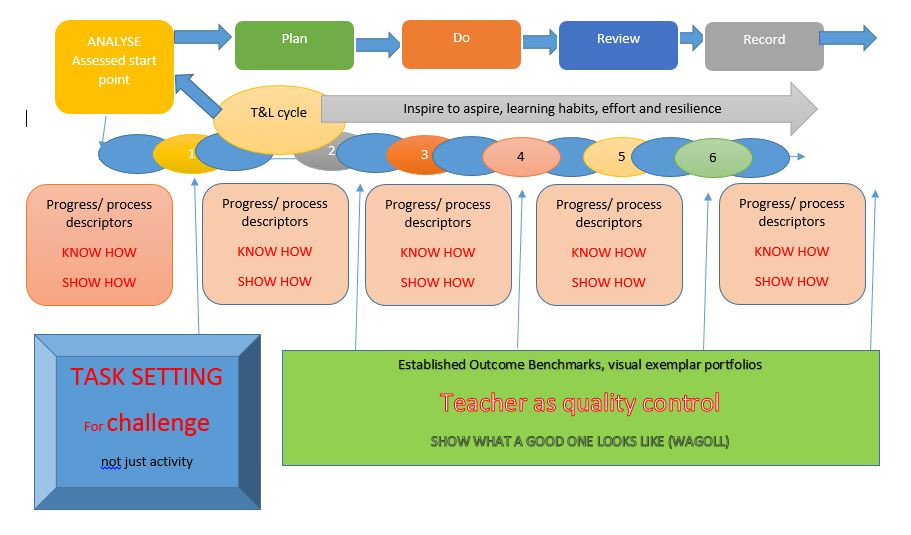
Teachers at X School plan to ensure that the vision and aims are put into practice, employing methodologies outlined in the policy for learning, through an approach summarized as Analyse, Plan, Do, Review, Record, Report.

Analyse… Teachers will receive information from a range of sources about the prior attainment of each child. This will provide a framework upon which to base decisions about working arrangements, suitable objectives for learning and tasks to achieve these.
​
Plan… Teachers plan over different timescales, annual, based upon allocated topic specifications. It is for individual teachers to use these specs creatively to provide a dynamic approach to learning.

Picture

​Contributing to school level Planning Detail;
see blog on “Planning”

Whole of National Curriculum interpreted through School-based Topic Specifications for each topic within each subject.
Literacy and numeracy frameworks.

Planning at different levels (teachers)
Content
Learning needs
Space, timescales and resources

Do… Tasks given to children will be creative, challenging and engaging, leading to anticipated progress.
Task design. Tasks will have a definite purpose in progressing an aspect of a child’s progress, known to the child and any assisting adult.
Activity presentation. All activity will be clearly presented and understood by children before being active.
Independence levels, skill, knowledge and attitude will all be considered when devising the task parameters, as the different learning attributes of individuals and groups should be encompassed in the task challenges.

Children as learners
Understanding task… Children will have a clear grasp of what they are being challenged to achieve, be able to discuss and articulate purposes when asked.
Task behaviours… Children will be expected to demonstrate appropriate approaches to tasks, developing persistence to achieve.
Team working… Children will be challenged to operate as collaborative, independent learners on tasks specifically created to allow for qualities of cooperation to be developed.
Oral skill…Children will develop appropriate descriptive, analytical, exploratory languages to communicate clearly to a peer or interested adult.
Recording skill, written, pictorial, mathematical…Within any learning experience there will be opportunities for children to use different forms of recording to help them to remember sequences of events within an activity.
Evaluation… Children learn about learning by doing, by reflecting on the process and activity, and evaluating changes to approaches for future reference.
Review… Children will develop as primary evaluators of their drafts. Peer reviews will be developed over time, with the teacher giving informative feedback to help with the next phase of development.
By being given tasks that they will need to discuss, decide on action, carry out, review, re-evaluate and repeat, they will develop an insight into the ways in which adults work and solve problems.

Outcomes..Review
Teacher as reviewer and quality controller…Any piece of work from a child is the current draft capable of being reviewed and improved. Ongoing oral feedback should support the child within the learning process. Marking should provide opportunities for advice, and an overview of quality.
Feedback to children…should enable each child to review their own needs in learning for subsequent pieces of activity.
Room for improvement… advice on areas for development.
Objective and subjective…Correcting spelling or an aspect of grammar may be clearly objective, whereas a commentary starting “I liked…..” would be subjective.

Moderation…At intervals it is clearly good practice to share views on achievement. Moderation allows a consensus view about a discrete piece of produced work.

Record… Teachers will keep records which assist them in progressing learning for individual children.

Report… At half year and year end, teachers will write reports to inform parents about achievements and room for improvement.
​
Review, Recording and Reporting, especially individual needs
To colleagues
To parents
Significant others
Picture
0 Comments

Imagery

21/3/2019

0 Comments

 
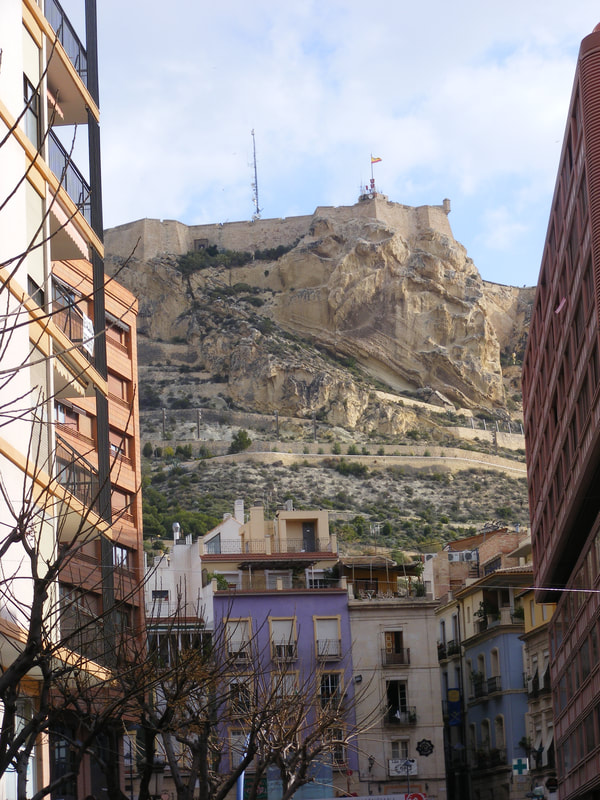
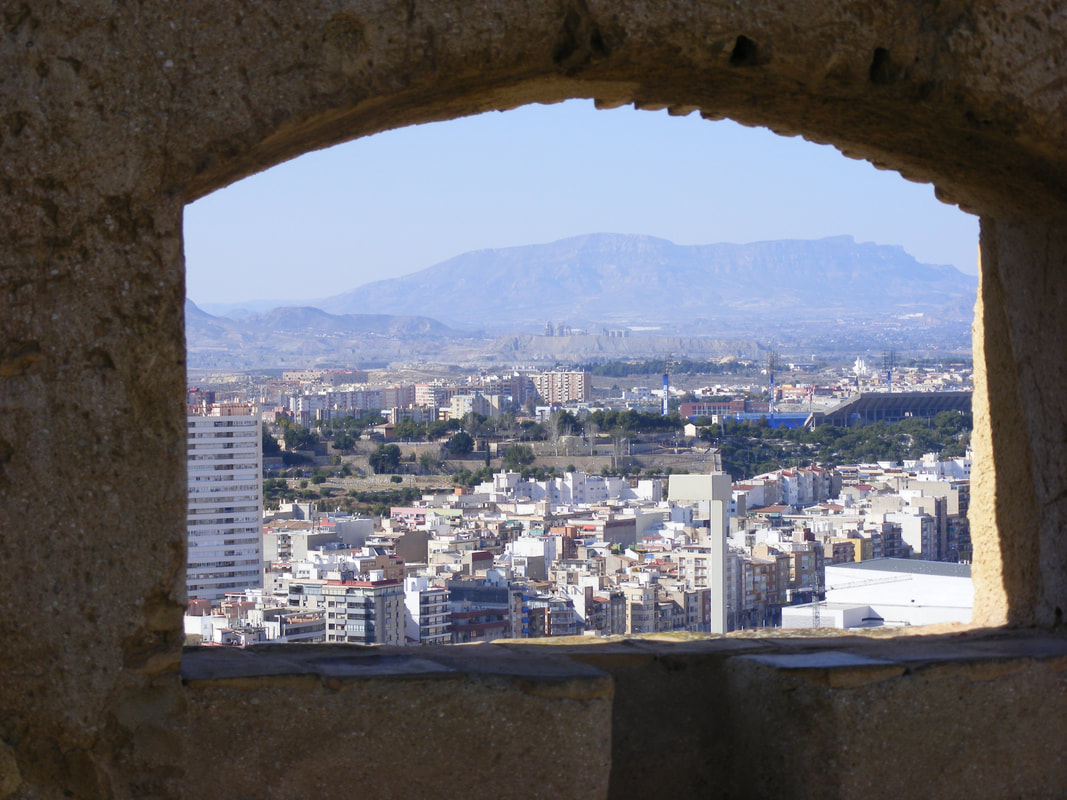
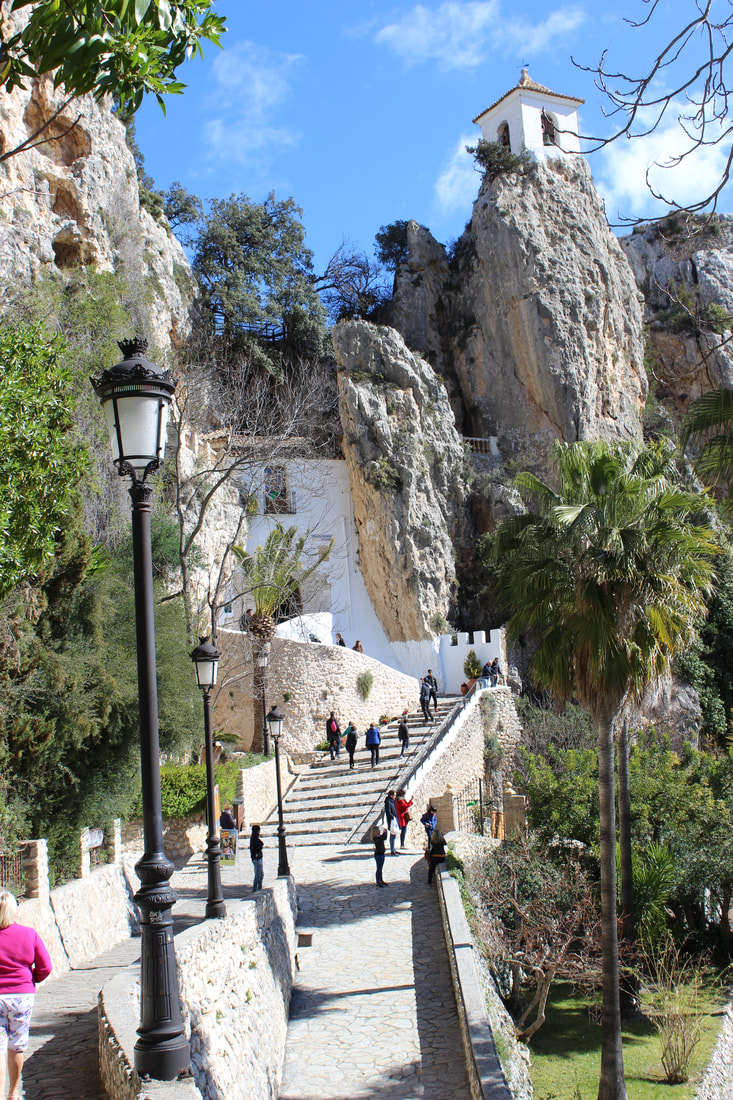
The pictures above are from holidays to Alicante.

Why do we take and keep photographs?

In some ways, it’s an easy answer, because we want to remember someone, some thing or a place that we have visited. In other areas of life, we might make notes or lists.

They are memory joggers, aides memoire, because life’s busy and we forget things, often the little details, which are then remembered in detail because you’re looking at a specific photo. Remembering appears to be the new definition of learning. The amount of information that passes by us in the course of even a short period of time can be lost, or, more likely, replaced by subsequent imagery and associated experiences. We are sensory beings, from birth.

This week, the idea of imagery has cropped up in virtually every conversation that I have had with ITE students, uni and SCITT. This has been prompted by interrogation of lesson purpose and the value of the imagery used.

If one assumes that a teacher is the keeper of the lesson narrative, this, in turn develops the notion of the keeper of the images. The images in a teacher’s head are translated through talk, diagrams, pictures, artefacts or direct experiences; the pedagogical choices of each lesson. This is now being shared as a concept as dual coding, but I would contend that this has been a truism for every generation of teachers. One significant change over time has been the technological improvements that enable an ever broader range of imagery to be shared in a classroom, such as video enhancing the stills to moving images.

Learning to “read” the images presented is a key element of early learning; description encouraging reflection, similarities and differences, inference and deduction, working towards hypothesis and imagination. The whole, if supported by an engaging talk element, discussion within a small group, dialogic discourse with adult lead enables a broadening of vocabulary, embedding concepts more firmly in memory.

Imagery impacts on overall planning, as teachers “conceive” of a learning journey or narrative, that then becomes a scheme of work that ensures each lesson “chapter” has significant “sub-headings, that then can be reviewed before moving to the next chapter. The images at the head of this blog were taken in Alicante. In order to driver there, I ensured that I had a mental map of the journey, with the sub-headings as the key towns that we would encounter en route, so could reflect on choices and adapt to any deviations away from the sat-nav directions.

Teachers need to “narrate” a coherent story, in every subject, supported by carefully chosen images that amplify the story.

It’s a bit like an early reading book, where the pictures add significantly to the written storyline. Interrogation of both add to the overall experience.

Open the pages carefully, sharing appropriate images in order, use quality modelling of language and the whole learning story becomes available.

Teaching minus images leaves talk, with mental imagery totally dependent on stored images which may be incomplete or may not exist, so disables the learner from participation.

If they can’t “see” it, they can’t manipulate it. Let’s make “seeing” and enhancing talk more overt.

0 Comments

A "Dinosaur" Looks at Curricular Extinction

6/3/2019

0 Comments

 
There is a truism in natural history;
​
You probably don’t know what is currently becoming extinct, because you’ve never see it. Reports of the demise of animal and plant populations may not affect people who don’t spend time outdoors, nor know what they are looking at when they are out and about.

And it can be a case of if you can’t see it, or name it, it probably can’t be very important.

But, every minute living entity has developed to adapt to it’s surroundings, sometimes becoming part of a broader food chain.

And, when it’s gone, it’s really difficult to get back again, especially if the special habitats required are altered or damaged.

Extinction can be caused by one-off catastrophic events, or, perhaps given the current climate debate, slow changes that gradually alter life patterns.

Picture
In many ways, it’s exactly the same with schooling.

Schools are habitats where young organisms spend a part of each day hopefully soaking up the knowledge and life skills that enable them to fully participate in the world. Inevitably, like all organisms, plant or animal, they grow and develop at different rates. While that is something that nature caters to, school organisation and external “quality assurance” can sometimes give the impression that the fledgling is somehow of a less than adequate standard. Given the complex nature of the human organism, being deemed in need can, in itself, become a further depressant on future achievements.

Unlike nature, school habitats are created and controlled completely by adults. What the adults choose to put into the school environment demonstrates the values that they hold; broad, balanced, rounded experience, or narrow and very focused on a specific end point.

There was a time where organisation was completely controlled by local needs and available expertise. There was a focus on maths, English in it’s different elements, talking, reading and writing, but also topics for interest, covering history and geography. Science, in the 1950s was often limited to nature and phenomena, like shiny things; playing with knives and spoons. Music was from the radio, PE was outdoors on the tarmac on rush mats. There was an art and making table, which is the source of many of my earliest school memories.

The 70s were developmental years, introducing some additional structures into experiences, led by thinkers such as Zoltan Dienes in maths and Seymour Papert in early ICT (Logo). Science education grew stronger, with schemes like Nuffield Science 5-13, offering structure, background reading, knowledge and pedagogy. Other subjects also took on greater structure, as various advisory teachers brought their expertise to bear on generalist colleagues, through twilight sessions at local Teachers’ Centres, or you just chatted with one of your colleagues who explained what you wanted to try.

Working in Hampshire, a broad, balanced, structured, relevant curriculum was developed and in place across large parts of the County in 1986.

“HMI were also supportive of developmental thinking. Curriculum Matters was a series of 17 booklets published by HMI between 1984 and 1989. They were intended as a contribution to the 'Great Debate' about the nature and purpose of education which Prime Minister Jim Callaghan had called for in his Ruskin College speech on 18 October 1976.”
​
You can see more of the “Raspberry Ripple” series at http://www.educationengland.org.uk/documents/hmi-curricmatters/
Picture
​The 1987 National Curriculum, therefore, when audited, provided a 95% correspondence with existing practice. A few tweaks and we were “good to go”. We kept most of our experienced teachers, so systems were not compromised.

Subsequent revisions put pressure on schools yet again, but, this time, as a result of change, some experienced colleagues decided to leave, rather than spend another period revising plans and working approaches. It took a lot of effort, from 1990-2005, to hold the breadth, balance and quality of what we were offering. As people left, new colleagues had to be inducted and mentored into the breadth on offer. This was, for some, particularly after the introduction of the National Strategies, an extreme challenge, particularly as their training had been based on that approach, through Government requirements.

In 2005, the last full year of my headship, we achieved SATs scores in the 90s, (L4+ with 50% L5 in some subjects) across all tested subjects. Talking with that class’s year 6 teacher recently, we reminisced about the full year that they had had, with a nod to SATs from around Easter. The breadth and depth of their varied studies had prepared them for reading and answering questions, across each subject.

Then came my catastrophe, the death of my first wife from cancer, a teenager at home requiring support and so I became extinct in that role. It required a bit of nurturing to re-establish myself in school habitats, in a series of support and advice roles. A bit of a use for ageing experience?

Of course, a significant systemic catastrophe (my thoughts) occurred in 2014, with an almost seismic alteration to seemingly every aspect of education. It was not an evolution, as whole swathes of prior working were cut down dramatically, leaving schools with the tattered remains of what went before, seeking to understand the new requirements and every school independently having to rapidly create structures that ensured curricular stability.
An analogy would be the wiping out of vast areas of the rainforest, with commensurate wildlife damage. See the potential demise of the Sumatran Orangutan, as a result of a dam project.

The 2014 vision for the curriculum was so heavily maths and English focused in Primary schools, that more “minor” subjects were marginalised, from their earlier place as “foundation” subjects; to me the word foundation implies that on which the main structure is built.

In 1970, James Britton said that “Reading floats on a sea of talk”. You could extrapolate this to talk floating on a sea of experience, with someone to help, guide and tell...
This has impacted my whole career, in that the broader curriculum has offered the areas for exploration, for conceptualisation, for thought; playing with ideas. In so doing, building vocabularies that can then inform what is being read, if the words are to evoke imagery in the reader’s head. A rich curriculum offers the potential for a rich vocabulary, which, in turn enables engagement with further spoken and written challenge.

Giving children something to think, talk, read and write about, to me are central to learning. Passing children from Primary to Secondary with a love of learning is key to future success.

By putting the wider curriculum back to the foreground, it has highlighted the demise over a relatively short period, of the Cinderella subjects. The next period will be one of sharing knowledge and expertise across the board, and, in some ways, social media can be a great help, rather than seeing each school making everything up from scratch.
Like all things that are bordering extinction, it will take the identification of need, the recreation of supportive habitats, appropriate resourcing and regular oversight and nurturing, if subjects are to re-establish themselves in the Primary experience.

And it may need a period of play by teachers seeking to reacquaint themselves with areas that they may have allowed to become rusty through less use.
How about we set the first challenge to make every teacher as good in each subject as the best in a school, cluster or area? Share ideas; collaboration not competition.

Let’s rebuild the foundation.

Ps. I could have used the story of Winchester Cathedral, whose Norman foundation was on tree trunks, which needed to be excavated and replaced to avoid the cathedral falling; foundations are essential to strength, rich habitats are the foundation of successful ecosystems.
0 Comments

Planning For Students

26/2/2019

0 Comments


I am just back from a day of visiting students on their final teaching experience and have spent the day considering the idea whether trainees should plan their own lessons, from a few elements that arose.

I would have to say that this has exercised my thinking at different points in the past thirteen years as a link tutor, for universities, Teaching School Alliances and a SCITT.

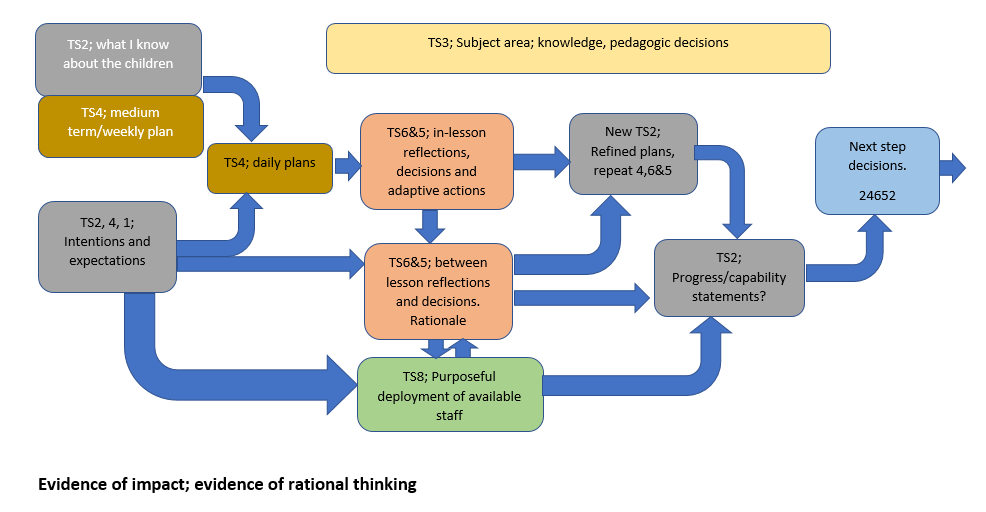
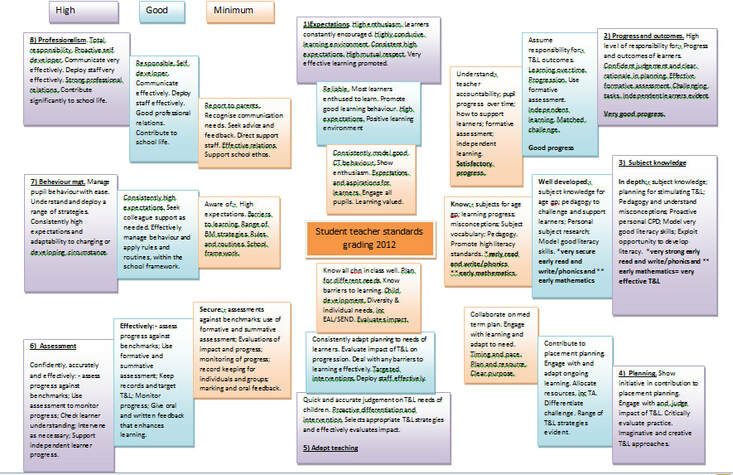
This thinking has been premised on a relatively straightforward notion; how does one get better at thinking about being a teacher? Teaching is a multifaceted set of demands, beyond the personal attributes of professionalism (TS8), behaviour management (TS7), having expectations (TS10) and subject knowledge (TS3).
​

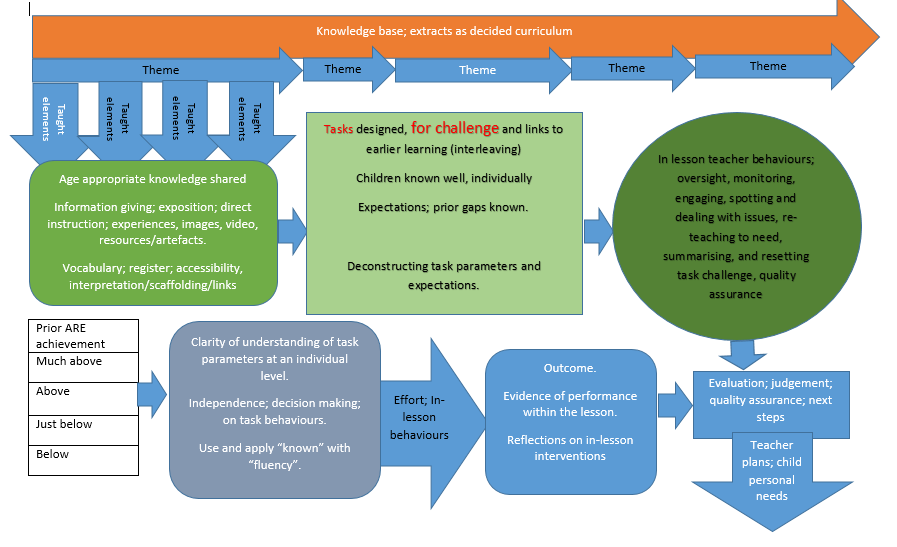
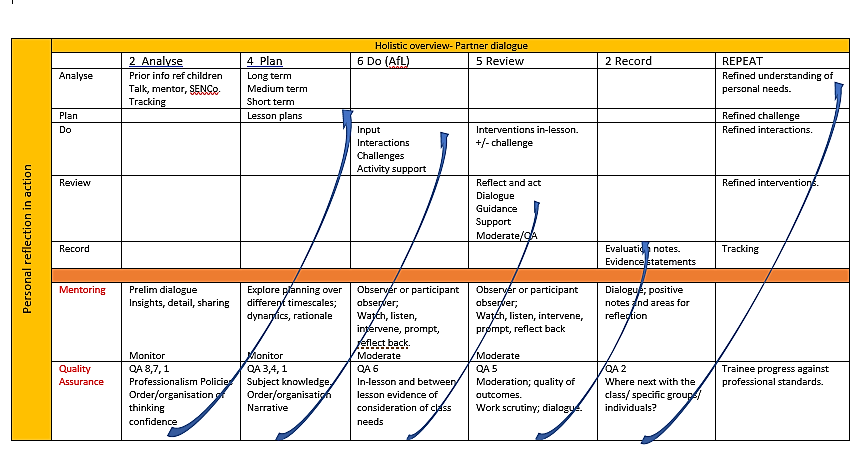
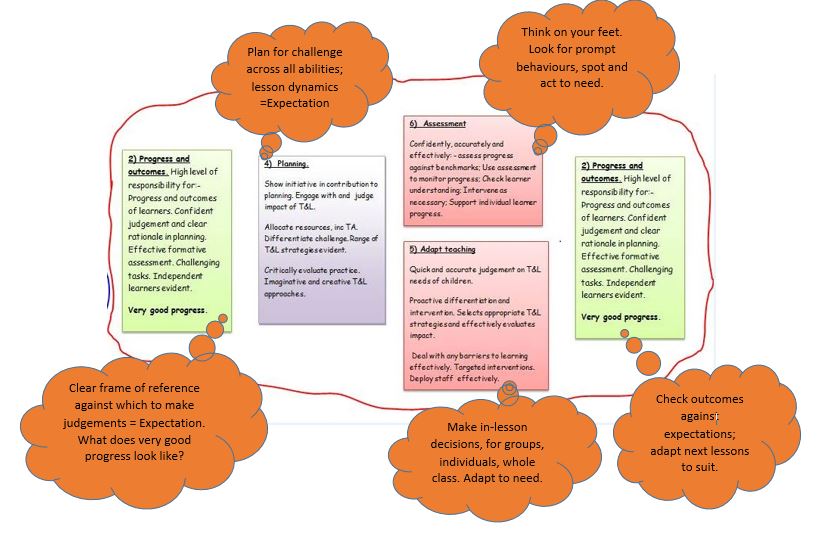
It’s very hard to describe a dynamic event in a 2D diagram, but a while ago, I sought to describe the idea of impact, to help trainees explore the thinking elements of teaching in a way that would fit with their day to day experiences and came up with this…
​
Picture
Trainees often find themselves in a 2 or more form entry school. On occasion, these schools allocate specialist responsibilities to each other to write the plans for the year group, which suits a settled team, especially where the plans are reviewed in the light of previous experiences. However..

·         Plans are a distillation of broader thinking.
·         An experienced teacher should have the capacity to interpret the narrower plan into a more holistic whole and add personal value to the plan.
·         An inexperienced teacher or trainee may take the plan as a whole and find themselves in difficulty if children start to demonstrate that they are insecure in learning.
​

Trainees and NQTs are learners and need support, as per this diagram.
​
Picture

Trainee placements are in disparate schools, with variable approaches to planning and other school elements. The best that a training organisation can do is to provide generic advice on these, with the understanding that the trainee will encounter different realities in different schools.

They therefore need mentoring into planning in the school style and will still do so in their NQT year or even as a new appointee. The assumption that anyone is “ready-made” is misplaced.

Trainees, at the end points of their training may be offered the opportunity to plan a theme over a period of time, where they can explore all the different dimensions, but equally it is likely to be already decided. They still need to be taken through the process to fully understand the pre-determined lesson plans, in order to extract the essentials for their own lessons.

It shouldn’t be a magical mystery tour through someone else’s planning idiosyncrasies.

They also need to know the children to be able to calibrate their challenges and to be able to consider when children may not understand something.

Rather than argue that trainees should be following detailed school plans, I’d argue that both the trainee and the mentor gain a great deal from the reflective journey of mentoring and coaching, reviewing the school approaches.

Schools need to talk with trainees about their planning approach.

​It’s the bread and butter of their existence, but should be capable of review, even within the learning journey of a trainee. It should be based on easy to understand concepts.


Order and organisation (TS4) is fundamental to good teaching for progress. Disorganisation or lack of understanding of the nuances of the intended plan have more often been reasons for a trainee receiving negative feedback from an observation. Where they have receive the plan from a colleague, they do often feel aggrieved or let down. 

 Evidence of Impact? Rational thinking...
​
0 Comments

Do some systems Embed Excess Workload?

24/2/2019

0 Comments

 
I would want to suggest, in this blog, that system leaders should, as a priority, look at the demands made by their system and adjust accordingly, to reduce or ameliorate external demands where possible. Workload has an impact on well-being and work-life balance.
​
Picture

I’ve spent the past 47 years in schools in some capacity, so have a lifetime’s experience of workload over an extended period. I’ve written some blogs about this in the past and the links are at the bottom of this post, for anyone interested.

A Twitter question in passing led to me offering some thoughts on the needs of a first time headteacher.
·         Start from a clear, preferably audited, description of where the school currently is.
·         Strengths/areas to develop.
·         Essentials/priorities.
·         Aspirations.
·         Create a map for development, term, year, 3 year.
·         Projects; what, who, when, how much?
·         Evaluation schedule.
·         Communicate fully.

When I reflected on these, it gave rise to broader thoughts on the workloads of individual teachers and the demands that can be made by management.

Workload has always been a relatively simple thing to express in terms of work; expectations and available time.
The time is a finite element, in terms of the teaching load and associated expectations from disparate parts of the system, planning, preparation of resources, marking and assessment and any necessary meetings.

Expectations are also personal, in that each of us is aware of the need to ensure that our knowledge is appropriate for the teaching that we have to do. I have never met a teacher who didn’t want to d a good job. Maybe I have been lucky in that, but with teaching being a thinking job, thinking doesn’t stop at the school gates. In addition, it is probably a truism that a less experienced teacher will take longer over planning, preparation, marking and assessment than an experienced teacher.

System demands vary between schools; some expect x amount of planning, while others might need x+ or x-. This may be as a result of school insecurity in a world where external (Ofsted) validation is needed.

System and personal demand can alter from one year to another, especially in Primary, where total responsibility for a year group can alter from year to year. If this is coupled with a change of school, contextual differences can be significant. This is very evident when working with ITE trainees moving to a second key stage in a different school; earlier confidence from the first placement can soon be dented.
​
Ok, so what can be done to seek to support this variety of needs and avoid teachers looking like this?


Picture
As a headteacher of a one form entry Primary, I was very aware of these different aspects as I regularly taught as first line supply cover, which in some cases was extended periods. Organisational demands need to be capable of achievement within available time.

·         So, as a school, we looked at planning demands. There is a need to look at the planning needs over different timescales, long, medium and short.

·         Every subject area developed subject specifications for each year group, showing what was anticipated as a minimum level of understanding to be developed during each topic. This took place during staff meetings, closures or bought in cover time. This was occasionally supplemented by taking finalists ITE students, which enabled a small amount of extra release.

·         We eventually settled on an annual plan to show the coverage of the whole curriculum for the year. The structure changed with each new teacher, who could look at the overview and see their own linkage to get best advantage from successive learning. It allowed some element of creativity and utilised personal expertise. This was then captured within topic spec reviews.

Picture


·         This was developed during half of a closure in late June or early July, before the summer holiday. It included a two-week topic of the teacher’s own devising, which would be the only detailed planning that would be needed during the summer holiday.

·         On the second Friday of the autumn term, we had a closure, half of which was administration, the other half given to refining the planning detail of the rest of the term, based on the teacher knowledge of the new class. These plans were the teachers’ own plans and would only be referred to by others in development discussions, only on one occasion with reference to capability.

·         School resources were sought to needs, especially after Local Management of Schools (LMS). Every February/March, subject leads were asked to list those things that had to be replaced or updated and a list of those “nice to haves” that would enhance the school offering. These lists fed the budget decisions and gave each subject lead their allocated budget. Resources were listed on the topic specs.

·         Staff time was bought before PPA became an expectation, through the employment of PE coaches and a music teacher. In addition, I took the school, as infants and juniors for a half hour singing session, so that each half of the school could have a short meeting. How PPA time is allocated and then used to good effect is important.

·         The timetable of meetings was decided largely at the outset, in general terms, with additional demand such as parent evenings or reports leading to no staff meetings in those weeks. Closure plans were linked to staff meeting schedules, so that follow up could be more effective; retrieval practice for staff meetings? Closures and staff meetings were largely devoted to subject development, once a month for admin, or a ten-minute noticeboard, to need.

·         The NQT or newbie will need some support, so partnering or mentoring may be necessary for both, if there are not to be avoidable issues. A bit of help at the right time can be all that’s needed. A school where help is generally available, rather than “someone’s job” is better, in my opinion. Everyone a mentor would be my maxim, but I accept that for some purposes a single talk partner is needed, even as a headteacher.

·         It’s also a need for every member of staff to be the eyes and ears of the school, looking out for each other, seeking to avoid the inevitable additional demands when a colleague is off.

       There is one overriding question that everyone should continually ask; why are we doing this?

                                    Collegiality and communication are key components.

More on workload
https://chrischiversthinks.weebly.com/blog-thinking-aloud/on-workload
https://chrischiversthinks.weebly.com/blog-thinking-aloud/workload-thoughts
https://chrischiversthinks.weebly.com/blog-thinking-aloud/education-house-of-cards-workload
On planning
https://chrischiversthinks.weebly.com/blog-thinking-aloud/planning-learning
 
0 Comments

Longitudinal thinking

1/2/2019

0 Comments

 
Picture
It’s interesting having a perspective on working in education and learning that now spans 48 years from walking into Training College. There have been many changes and challenges along the way, but, in essence, there is much more in common across the ages than difference.

Let’s start at the very beginning
A very good place to start.
When you read you begin with ABC
Let's see if I can make it easier

As a parent of three, step-parent to three and a grandparent to eight, I have had a lot of opportunities to view children growing up; the current span is from 15 months to almost 15 years. Each of the family settings varies, in place, parental jobs and therefore available time and in disposable incomes. These variables inevitably play some part in the opportunities that are available to each family and therefore on the cultural potential made available to each child.

The children grow and flourish through their parental love, diet and their spoken language, with appropriate encouragement to make marks and to enjoy books.

The environment that surrounds young children today is different from that which I enjoyed. Not in terms of the natural world, where there are still plants, animals and natural features; in some cases just… but perhaps their opportunity to engage with it, with an interested adult able to point out the different elements and to provide the names of things. There are also the distractions of the digital world. Whereas as a child, I was more au fait with string and a penknife and den making, today’s young have early access to screen distractions and can very soon work their way into desired apps.

I have long worried that a school cannot rely on a child’s ability to identify easily with the elements of their locality to support their speaking, their reading and their writing attempts. Having spent time as a volunteer, leading wildlife groups, it was clear in the 1980s that it was a minority interest. Education does still rely, to some extent on a child’s experience beyond the school gates.

How does a child describe the feeling of walking on sand in bare feet, paddling in the sea or lake, getting caught in a rain storm, walking through long grass, the sound of leaves being walked on or kicked, and so many other things, if they haven’t had the opportunity?

Can we build a strong curriculum and strong education on missing experiences? Is experience the beginning of “knowledge rich” education, in that it provides a base for things to “stick” to?

What’s school? People, places and things

Organise rooms, which used to be defined as 55 sq m for a group of 30 children, or a currently defined infant classful.
Supply desks and chairs; this has varied over time, with discussions about the amount of table space needed.

There’s also been wide variation on whether to supply personal storage space for books; should children be responsible for their own exercise books or should they be centralised? Either decision can cause logistical issues when books are needed for a lesson; either movement of each child to find their one book, or teacher/monitors to give out books. This can be pre-empted between lessons, getting out books on entry to the classroom, or someone must give them out before the lesson; assuming places are known…

Classroom resources need a retrieval and return system that can facilitate whole class lessons as well as intermittent needs; variation between age groups, from picture clues to written headings.

Space, resources and time have always been the variables within a school and teacher’s organisational control.

Space…

How much space is available to support the learners, and how is it orientated to support the teaching that is likely to happen?

How desks are arranged, to allow sight lines, ease of movement around the classroom, for children and adults, but also to facilitate different areas of the curriculum. Alteration to the needs of different subjects and teaching may need to be easily accomplished; I have seen whole classroom reorganisation within a couple of minutes, accompanied by a piece of music. “I can’t do x because of the way tables are arranged.” does not seem to me to be a reasonable response. Where there’s a will…

Picture

Resources…

Throughout my teaching career, there have been shelves of resources that have been bought at some stage, because they seemed a good idea at the time or because the sales patter was irresistible. They gathered dust through lack of use, often because newer staff were unaware of the potential of the resource. There’s a significant need to keep on top of learning resources, to ensure that they are up to date and do the job that’s required of them. Collated and identified, they are more likely to be used than if they are just in a pile somewhere.

There’s probably a similar kit of resources in every classroom, centred around the stationery, which also needs some organisation. Painted tins and glass jam jars were a feature of my first classroom. Today there’s a variety of plastic tool boxes (scissors, erasers rulers), cutlery drawers (paint brushes) or cutlery holders for pens and pencils. Classroom desks can also sometimes be awash with SPaG reminders, or similar prompts.

Maths, reading, writing, art corners might be created, as resource bases, with topic resources brought in to need, from a central collection.

Time…

It’s sometimes easy to forget that time in school is under teacher and school control, but, some organisational elements can exert control over the available time that puts pressure on lesson dynamics, especially for some vulnerable learners who can’t quite get things finished. If it’s clear that a child has worked hard, for them, and needs a bit of finishing time, does this mean part of a playtime lost, or can the teacher allow a few extra minutes in order for the child to finish?

We have been in a period where maths and English have seemed to dominate the curriculum. Some organisation of this, sets for example, impose a timetable need. This can mean that some children might not be able to access the learning in the available time, but, in a classroom setting, perhaps the teacher can make an executive decision to add a few necessary minutes to a lesson, to bridge a playtime and allow children some “finishing off time” rather than rushing and not completing or not being able to show their best efforts.

It’s also possible to find many examples where tasks/activities are chosen to fill the set time, rather than being able to challenge all children, limiting some.

School time is often extended through “homework”. At Primary, if homework is to be seen as a useful adjunct to school work, I would prefer to see talking homework, eg a question or an image to discuss, with the outcomes of discussion feeding back into lessons. Click on the blue title to open a linked blog.

 Primary Curriculum; a child’s world?

There have been great similarities across my career in the curriculum offerings of every school. For a start, there was always mathematics, more often than not supported by a bought scheme. The strictness of adherence to the scheme varied from school to school, but, in all cases, we were required to use the Teacher’s Guide as our methodological “bible”, to ensure consistency of approach.

English varied more from school to school, with the majority drawing heavily on the topic curriculum for stimuli for talk and writing. Reading, from around 1975 was supported by the Cliff Moon colour coded system, with different layers of books available to the children; one at teacher level, where there might be a small number of errors, and one at more fluent levels, to read in free time or at home, with or without a parent. Most of the schools in which I worked in the 70/80s also had a Home-School reading diary, with parents encouraged to record their thoughts from hearing their children read. It was very much individualised and we were encouraged to hear children read regularly. Writing was collated into excellent practice during the National Writing Project 1985-8. It mirrored what good schools were already doing, but also gave the basis for conversation between schools about what constituted good writing experiences.

Topic work enabled science, history and geography to lead investigation, with music, PE (dance), DT and art to be used to interpret the outcomes of the investigation. This element of the curriculum provided the opportunities for report writing, letters, note taking and a range of genres with imaginative narratives. The school library was a source of investigation through reading non-fiction texts, using the index and contents list to find out facts for themselves and to share with their classmates, often producing a glossary display; an alphabet of…topic.

It is interesting to me that the 1987 National Curriculum was a 95% correspondence with that which my and other local schools were doing. It meant small tweaks rather than big alterations.

I am finding the current discussion on the broader curriculum a little stilted at times. There will be significant similarities across time and there will already be a lot of good practice that can be retained.

Picture
Topic titles allocated to year groups.

Planning is essential.

Topic details; essential knowledge to be shared; key questions to be explored; resources available within the school or locally. When I was a head, we developed “topic specs” in around 1993.

Link opportunities between the topic and spoken, read and written English, or mathematics; using and applying knowledge from each to benefit the other, making appropriate links.

Timescales allocated and the order of study, to enable learning from earlier topics to impact on subsequent learning.  

Organised into an annual plan, it’s possible to ensure coverage and also sufficient opportunity to explore specifics in depth, knowing that the year was planned.
​
It’s useful to have an end point for each topic area, maybe a small museum, a display, a performance, piece of art, music or drama/movement, with the potential for an audience to provide the spur for higher quality outcomes.
​
Picture

​In many ways, it is sad that we have reached a point in our education history where we are having to reinstate that which was already there in many cases. The 2014 curriculum changes were such that elevating maths and English to such heights distorted teacher efforts, in schools and across training providers who have to follow Government expectations. It takes time and effort to develop curriculum, to articulate a school approach, to embed this into daily practice and then to evaluate and refine, with a constant need to revisit when there are new staff who will need support and mentoring.


For interest, here’s my school KS2 science overview from 2004; based on 7.5 hours per week, blocked time to need.
​
Picture
In the meantime, while this development is actioned, five years on from the changes, another generation of children passes through the school, potentially fed a diet limited by the school interpretation of it’s needs at that point in time. Data in maths and English define external judgement. If a school feels vulnerable, concentrating on what is measured can seem an appropriate course of action, but is can also lead to a diminished learning opportunity, which, if coupled with a diminished home opportunity can doubly exclude children from wider life opportunities.

There’s much talk of cultural capital. We need to look at life experiences, too…
​
Is showing children pictures the same as being there?
Picture
Picture
0 Comments

A Cautionary Tale; are they ready?

28/1/2019

0 Comments

 
Picture

After a lifetime of dedication to the cause of education,
I’m feeling much frustration at the machinations of an administration,
And the implementation of education policy based upon the fiction that all learners have a disposition
To arrive at the same fictional destination at the end of a phase of exertion;
By that token, many don’t arrive in Early Years “school ready” so have even further to travel!

For some the cause of celebration,
For others a feeling of desolation,
Being told they’ve missed the accumulation of marks,
In addition, subtraction, diction or story creation.
(The other subjects aren’t measured, so don’t count)

The prescription of specified method; by default the proscription of others,
Feels like the confiscation of tools which worked in the past, and still do,
Especially where the curriculum needs personalisation.
The thinking teacher’s invention or adaptation of an idea,
Helped the visualisation, by the learner, of complex concepts,
From which the child’s own imagination could indulge in acts of creation,
Exploration and experimentation, sometimes of invention,
Often through collaboration, supported by the intervention of an aspirational adult,
Determined to harness the combination of exertion and deliberation,
With a soupcon of consolidation, to arrive at a destination,
Worthy of celebration and appreciation.

The demonisation of a school of thought,
Seen as the antithesis of tradition,
Has allowed a faction to develop, determined to create a new fiction,
Tradition good, progression bad, in contravention of common sense.
Real education is a balanced, nuanced affair, an oscillation between the two extremes,
Teachers selecting the best tools for the job, just like any master craftsman,
Dedicated to the cultivation of a living tradition.
Education is the sharing of the accumulation of understanding across time and space.
The world in which, without direct explanation, they learn to walk, talk, look and explore.
Their natural disposition to be curious, enjoying exploration, experimentation, discussion,
Expanding vocabularies and concepts through vocalisation,
In environments where error is the cause of reflection, adaptation and active intervention,
To ensure correct interpretation.

It starts with parents and the home, continuing with a school’s help.

The teacher organisation of the available space and resources,
Coupled with their interpretation of records, their perceptions;
Anticipation of the disposition of each child,
To decide whether individualisation of challenge will be needed.

Good teaching is a complex action, where the reactions of the learners can help or hinder the flow.
Good learning requires exertion on the part of the learner, in the clear knowledge of the destination,
Or direction of travel, the co-creation of a visual map,
For a specified duration. 

Intervention may lead to the need for consolidation or reinterpretation, to avoid a period of disaffection or alienation, both unhelpful to learning.

Celebration of outcomes might include the admiration of peers,
An appreciation of effort, capability or talent.

Good learning is only a competition with oneself.
Self-awareness, self-belief, self-reliance,
Being responsible for oneself, for how others and the environment are treated.

Just getting better every day.
0 Comments

BrewEd early Years January 2019

20/1/2019

0 Comments

 
Picture

Thanks to the good offices of Simona McKenzie whose Twitter handle is @signoramac, there was a gathering at The Alexander Pope hotel in Twickenham to discuss Early Years issues. By no means an expert, I wanted to avail myself of the collective expertise and I wasn’t in any way disappointed.


There was Sue Cowley (@Sue_Cowley), Dr Lala Manners (@MattersActive), Ali McClure (@AliMcCureEP), Bethlyn Killey (@StarlightMcKenz) and June O’Sullivan (@JuneOSullivan). It was good to see Sue and Bethlyn again, after significant gaps between events, but equally interesting to hear the view of a broader group of speakers.

Sue Cowley gave a barnstorming opener for the day, as she put it, a bit of a rant, particularly about the general direction that it can appear that even early educational experiences are talked of in more formal terms, with testing and more structured “delivery” models being interpreted as “what’s wanted” from the “powers that be”. That this is external and top down can give the pronouncements greater weight, which in turn becomes interpreted into localised approaches, which, whether “liked” or “disliked” by the inspection regime, inevitably becomes the stuff of the local grapevine with other local providers changing to anticipate the needs of their next inspection, simply because no-one wants to be found wanting.

Topicality is the stuff of young lives, something that they have seen, heard or found and want to share with others. Equally, the adults will also want to bring in items of interest that will generate interest and inquiry. Sue spoke of “door handle planning”, in this context. Sue has a healthy scepticism of what is asked by others without the expertise in the age group.

Lala Manners is a professional who has links with Government decisions in the area of Physical Development (PD). With Sue, Lala shared the values of physicality in young lives, with specific mention of avoiding obesity at young(er) ages. In this regard she made reference to the need for EYFS professionals to be role models. One would think that getting children to be active would be one of the easiest things to organise, but the discussion moved to packaging of approaches, so that they required some form of preparatory training in order to deliver the programme.

While space can be an issue for some settings, there are many ways in which PD can be enhanced with limited equipment. Running and jumping are probably the easiest, dance can be supported by music and movement, as it was for many generations of children. General movement can be directed within a space, perhaps with floor markings helping instruction, or even masking tape, as a “balance beam”. Putting out scaffold boards, with bricks to enable them to be raised, can add to the balance challenges. Throwing stones or other natural objects (fir cones), balls, bean bags into a bucket. In many ways, it’s often limited by teacher imagination.

In my own mind, I linked physical development with literacy. I wonder how many teachers have considered that movement PE provides some of the oral base for many verbs and adverbs in describing movement that can be drawn into reading and writing?

Ali McClure worked with a wide range of ideas drawing from her career. She is a practising SENCo, as well as EY specialist and EP, so brought ideas about brain development through stimulus. While some colleagues might have argued with some interpretations of the internal workings of the brain, the idea of stimulus and vocalisation leading to some kind of mental schema organisation was central to Ali’s discourse. Using the term “Anchor of Attachment” made me think about the place of educational settings on the lives of children. For a number, the order and organisation of the setting may well be one of the few oases of calm in their lives; settled staffing, room organisation, resources and opportunities and understanding their place within the organisation can be stabilising factors.

Bethlyn Killey is well known to Twitter, as a strong questioner of SEND legislation and opportunity, or the lack, within the broader system. Bethlyn use the example of her son who had had nine settings by year seven. He’s now in a much better place, thankfully. The process of getting to this stage has been effectively analysed by Bethlyn, utilising the skills drawn from her work life. It is a salutary experience to listen to someone trapped in the complexities of EHCPs and the endless seeking of access to the relevant specialists, or advice, then to find school settings capable of addressing identified needs, but also to be aware of the potential for further diagnoses. In an education system that is gradually losing expertise, even staff in senior positions might not have had experiences that enable them to fully adapt their approach to the new needs. The system established in 2014 is complex, appears to offer a great deal for children with needs, yet often lacks the essential external expertise to support non-specialist staff. It is also budget constrained, as is regularly evidenced by contributors on Twitter.

When Bethlyn finished her talk, there was a collective gasp, as if we had all been holding our breath. It was more moving because it was her real-life experience.

June O’Sullivan was reticent to follow such an emotional experience, so we had a short break for refreshment or comfort.

June was another contributor who has the ear of Government. Her company runs a significant number of EY settings across London, including the House of Commons. Her brief was pedagogy and she took us on a journey that explored the philosophical background to pedagogies currently available. June is very down to earth, though and her approach is very child based; children doing, making, experiencing, exploring, discussing. She talked of dialogic reading as her philosophy, getting children into books. With over 100 languages across the settings, speaking is a key aspect; a mantra that I express as, something to think about, talk about, record (write?). In fact, the teaching and learning approach that she shared would have been seen in many successful mainstream primaries in SE Hants in the 80s-mid 00s. June’s organisation runs its own training for staff, calls each member of staff a teacher, so giving equality of status. It was always going to be the difficult “twilight” slot, but such was the knowledge base, delivered with humour and humanity, of June’s talk, that she held us over the planned finish time, yet the time passed very quickly.

As a first, Simona McKenzie can count BrewEdEY as a significant success. Thanks Simona.

All the speakers encouraged dialogue within their talks, so the significant collective expertise could be brought to the fore and available for everyone. Thanks to everyone for such a positive day; even on a Saturday… I was pleased that the Munster-Exeter rugby was still running on Channel 4+1 when I got home… even if it was a disappointment that Exeter lost…
​
Picture
0 Comments

Book Reviews; writing

17/1/2019

0 Comments

 
Picture
Books to support writing development

I was fortunate to be able to share a couple of books from Bloomsbury Education with practising teachers in the school where I am a Governor and to get some feedback, which I thought I would share.

Teaching for Mastery in Writing, by Mike Cain had the greater impact of the two. The English lead used this extensively in looking at the writing process at the school, using extracts to supplement a broader PowerPoint presentation that had been supplied through an authority training opportunity.
​
Jacqui Hyde wrote; This book is a useful resource when reflecting on current school practice in the delivery of writing. It has clear guidance on the importance of feedback, self and peer assessment and how this helps to improve children’s writing. There are clear steps in learning, for each year group, which emphasise the importance of building on current skills and, if there are steps missing, how this will impact on a child’s progress in writing.

The steps for each year group were shared with all teachers at the staff meeting on mastery in writing and were particularly useful for NQTs who were not so familiar with the whole writing process. There is clear guidance on how to embed grammar and some interesting ways to edit and redraft writing. The staff meeting helped staff to reflect on their current practice and the broader school approach.

From the 100 Ideas stable, Rob Smith (@redgierob) and Katherine Simpson’s book on Literacy was seen as providing some useful reminders of activities that could be incorporated into discreet lesson planning. The teacher who used this book identified some of the ideas as having been shared on courses, so the book was seen as a distillation of very useful prompts, collated into one volume.

In combination, the two books would provide a very useful basis for any developing teacher to get to grips with the process and also to have a well-rehearsed set of practical ideas from which to be able to plan over longer and short terms.
​
The books were certainly recommended by the teachers.

For interest, personal blogs on writing.
​
Note making, not note taking...
Draft-check-improve/redraft
National writing project; revival time?
All writing in one exercise book?
Writing process; tweak your books
Exercise books as personal organisers?
 

0 Comments

Bullseye or Double Top?

10/1/2019

0 Comments

 
Picture
Build a high-quality teacher; structuralist to holistic. Putting some flesh on the bones...
​
Much of my working life is spent working alongside developing teachers, at different stages in their careers. In 2012, the Teacher Standards changed, from 33 statements to 8 headings. It still surprises me that, after nearly six and a half years, many teachers still cannot identify all eight standards, even though they are supposedly working within them each day.

However, in my developmental roles, they can be very interesting, as it is possible to play with permutations of the standards that exemplify what it means to become a complete teacher, especially during university degree, PGCE or School Direct (shorter) experiences.

One of the things of which I am very proud is that, for the 2012 teacher standards, I created what has become known as the “Dartboard” at Winchester University and forms a part of every student record of progress. It is useful, in that it’s a dynamic and embeds action in a holistic framework which can be unpicked to individual needs. You may need to click and make the picture full screen.
​
Picture

​It did lead to much reflection on how the teacher standards are considered and whether the language might lead to isolation rather than purposeful combination. Teachers have to be good at a wide range of reflective, reactive and communicative behaviours, often exaggerated further when working with younger children or with children with SEND.

For information, the eight standards are

1)      Expectations
2)      Progress and Outcomes
3)      Subject Knowledge
4)      Planning
5)      Adaptation
6)      Assessment
7)      Behaviour management
8)      Professionalism

Plus there’s a part 2, which describes further the professional standing of a teacher within the broader community.
https://www.gov.uk/government/uploads/system/uploads/attachment_data/file/283566/Teachers_standard_information.pdf

Behind these headings are many lines of exemplary materials. Click to link to pdf download, with a shortened version.

However, the headings are quite useful, in themselves, as supports for a narrative that seeks to describe teachers in development. I’ve given them nicknames where they might suit.

Presenter approach

34 – Not necessarily the ultimate age for a teacher, but this could describe, say, a wildlife expert, or similar, who knows their stuff and can put it across in a clear narrative to an audience, using age appropriate vocabulary and language structures. The chances are that children in the audience are with parents taking control of behaviours. As a local leader and County organiser for Watch Wildlife Groups, I often invited such people to present their specialist knowledge to the children. It's similar to inviting  special speaker into a classroom. They share their knowledge.

To some extent, it also describes some television presenter approaches, although they can take for granted that their core audience is watching. If people are also looking at a mobile phone, making a cup of tea, or are in any other way distracted, it’s not the presenter problem.

873 – A person of professional standing, who has the skills to control an allocated group, for a period of time, who can be trusted to get across some subject knowledge in an ordered manner.

This could be used to describe a teaching assistant, or other adult whom a head deems appropriate to lead an activity. They can work within any prescribed approach to behaviour, dealing with issues that arise appropriately.

Anyone in a professional role in a school is highly likely to have at least GCSE level education, while teachers will have a degree plus a teaching qualification. I would also expect Primary teachers to have at least five GCSE good grades and three GCE A levels, so they will have some subject experience across the Primary curriculum.

If they don’t, they can be expected to address this; teacher standard 8 talks of the proactive self-developer.

Structuralist approach; eg a trainee still making sense of the longer term organisational and learning needs.

8731 – Having appropriate expectations of behaviour and learning (TS1) raises the expectations of the adult, as the conduit through which some level of progress in a subject area might be accomplished.

It is often the case that these standards are the first and easiest to be evidenced for a trainee teacher, as, by and large, they describe the personal, professional persona of the adult, who knows their subject and can organise a classroom to get information across in a coherent form over time.

It is also likely to describe a teacher confident in their professionalism and ability to get what they know across to a range of school audiences, within an overall planning approach. 

The limiting factor from this point is embedded in standard 2, progress and outcomes; in other words, how well are the children known and how well does the adult understand the learning outcomes appropriate to different year groups?

Holistic approach

432-65-2 - You’d want the person described above to have a wider range of skills; 432, being able to organise their subject over different timescales, so that the subject requirements were built up appropriately and checked on the way, with the intention that children should embark on a journey towards an expected point.

It can depend on how you understand children making progress (TS2) and how you determine whether they have. If the definition is coverage - then test for memory, it might preclude analysis of the needs of specific individuals (TS6), leading to further engagement with them, undertaking adapted approaches (TS5). 

Interaction with learners, engaging with the ongoing learning and making subtle or more significant alterations to the expectations of some, responding to evidence within the classroom, TS6&5, are probably the key to ultimate teacher success, in that it is the sum total of progress of each child (TS2) in a class or cohort, that ultimately is the signal that the school is doing well by every child, whatever their needs.

See also 24652 blog

Picture

Teacher standard 2 also covers the full range of needs likely to be encountered. If, for example, a teacher has experience limited to one year group, as can happen in some organisations, knowledge of achievement in years above or below enhance and extend the outcome knowledge base, enabling the teacher to make more nuanced decisions about challenge and intervention needs. Mentoring and moderation are key elements in this area, to allow the less experienced teacher to benefit from the wisdom of more experienced colleagues.

Teacher standard 2 is also the area that is currently causing concern, in looking at assessment and tracking needs for teachers. It’s the one area where experience provides the basis for personal development, in making accurate judgements about children as learners, leading to better planning, interaction and adaptation; TS 465. The bottom line question; “How well, breadth and depth, can you show that you know your children?”

It takes time, and is a stage in a progressive development, based on analytical reflection, from reading and first-hand experiences on behalf of the developing teacher. Self-development is a constituent of teacher standard 8; developing yourself into the best possible professional, as a team player and a team leader, is key to long term success in teaching.

Teaching, in many ways, is an investigative role, based on an original hypothesis that the planning is pitched at the right level, with in-lesson evidence showing the need to alter course, or to provide additional scaffolds to support individuals.

Thinking takes time and that can be a rare commodity in a busy school room. So it is incumbent on each teacher, especially trainees, to make best use of available time to think and talk about the role. It is a job where it can be difficult to switch off, too.

Many will use holidays as time to catch up on thinking. As a head, I often thought of the job as 24/7/365.
 
Getting better at getting better… personal development or CPD?

Building capacity breeds capacity

Variations on success breeds success? Or “Love the ones you’re with”, Dylan Wiliam.
Building Professional Capital, Hargreaves and Fullan?
This view was first put into print by Sir Arthur Helps, in Realmah, 1868: "Nothing succeeds like success." [Rien ne réussit comme le succès.]
And apparently even earlier in a different form: Success nourishes them. They can because they think they can...Virgil

The most damaging thing a teacher can say is “I can’t…” There is a need to consider the problem being faced and to come up with a solution within any available constraints. In my book, teachers are paid thinkers and solution finders.

As a headteacher entering my own school for the first time, one of the main tasks was to get to know the staff, as well as the children, to establish a view of the overall capacity of the staff and where each was in their personal development. This was an important first step, as I set to the task of creating out of the available “raw material” the future picture of the school.

This did involve a significant amount of reflection, from the staff and me, as each challenged the other to clarify thinking, so that meanings were clearer, enabling reflection that supported development. Some of that reflection meant that a few staff chose an alternative route forward. Living with challenge is not always a comfortable position. The school needed to be challenged. It was happy with itself, had create a comfortable existence for the staff, who did “nice things” with children. However, the general expectations were slightly too low and needed to be extended.

Challenge, time to reflect, within an articulated timetable, with resourced time, appropriate external support and internal evidence of momentum, through sharing improved outcomes, began the process of regular review, which ultimately was supported by release time for shared research, which further supported the collegiate approach and team development.

Internal moderation, or just sharing outcomes, became a regular feature of staff discussion, as illustrations of what was being expected and achieved.

Over time, the notion of success nourishing the staff led to deeper, sustained challenge, to staff and to children, with a further increase in outcomes, the achievement of which established much clearer expectations and benchmarks. The rich curriculum became richer, as teachers tried out ideas, with children feeling the pleasure of achievement, so improving their attitude and motivation.

Teachers had to adapt ideas to the context of the school. We were an open plan layout and areas were set aside for specialist activity at different points around the building, but each was within sight of a classroom, so every area could be overseen by a teacher, even if children were from another class. The “independence” being fostered could be put to good effect in supporting challenge in tasks, especially as the children got older. 

The past twelve years of school visits through a variety of organisations and for different purposes, have allowed me to see a broader base of evident practice. Improving outcomes, so that both the teacher and the child can see what the next step looks like is essential. For the teachers, this has sometimes meant advice to go and look at years above or below, to better understand what quality outcomes can look like.

Only by having a deep understanding of progression of learning within each subject, what success at different stages looks like and clarity in understanding where each child is in that continuum at any specific point, can a Primary teacher support incremental learning, as a combination of knowledge and capability.

Adaptability

It seems to me, after a lifetime in education, from the many initiatives passing my way, that every piece of education research is interpreted to the profession through a filter that comprises national and press reviews, personal interpretation of the original material, or the ensuing book and inference from an existing practitioner, as the original ideas are adapted to the circumstances of a classroom.

By the time a teacher presents “how it’s working for me”, in a staff meeting, a Teachmeet, or some other external talk, it has been through several layers of interpretation. It has been adapted to the particular circumstance of that classroom teacher’s views. Copying, by a colleague, in another context, may not get the same result.

There are three main variables in teaching in a teacher control, even assuming a common knowledge base; space, resources and time. A classroom has a set size and shape that determines furniture arrangement for ease of working and movement. Organisation and availability of resources, for ease of accessibility and return will affect practice, to a significant effect.  Limitations of timetabling, especially the need to move as a whole class for activity, is further compromised by grouping and setting for different aspects, all of which impact on working approaches, not least the need to complete tasks within a set time.

Personal self-limiting

An inability to adapt can lead to teachers saying “I can’t do…” which impacts on children’s development. Self-limiting should not be part of a teacher make-up. The teacher who “prefers” to stay in year 6, or EYFS, for example, if they do not then have opportunities to explore practice across the school, can become entrenched in their working methods and expectations.

Self-limiting can apply to schools as well as individuals, where they do not communicate effectively, especially if there is a form of “competition” between phases and prior judgements are not fully accepted. Collaboration and excellent communication between professionals enables smoother transition and transfer.

“Novelty children”; apologies…

Within the idea of adaptability comes the issue of “novelty children”, those with needs that the teacher has never encountered. The SEND specific need, the travellers, the EAL child with a never before met language, the extra-talented (gifted) learner, in a specific subject. How to deal with the new issue is likely to depend on prior experience and the base from which decisions are made. These will therefore range from rough-hewn, to refined. A self-aware teacher will admit to shortcomings and seek colleague advice, from within the school, as in the SENCo/ABCo, or through available language/specialist support, where the LA or Academy chain has access to expertise.

These “novelty children” extend the boundaries of teacher knowledge and expertise, which, over time, enables further adaptation to circumstance.

Adaptability and reflection are precursors to personal growth.

Adapting to new knowledge is a large part of how we learn, through reflection, adjustment to circumstance and a new balance point, based on knowledge and capability.
​
The more adaptable you are, the more adaptable you can become. Seeing the need to adapt is the first step. Getting better at getting better takes thinking time and a bit of effort, but getting better is positively reinforcing, for everyone, as teacher self-esteem can be a fragile beast.
​
Picture
0 Comments
<<Previous

    Chris Chivers

    Long career in education, classroom and leadership; always a learner.
    University tutor and education consultant; Teaching and Learning, Inclusion and parent partnership.
    Francophile, gardener, sometime bodhran player.

    Archives

    March 2021
    January 2021
    July 2020
    June 2020
    May 2020
    April 2020
    March 2020
    September 2019
    June 2019
    May 2019
    April 2019
    March 2019
    February 2019
    January 2019
    December 2018
    November 2018
    October 2018
    September 2018
    August 2018
    July 2018
    June 2018
    May 2018
    April 2018
    March 2018
    February 2018
    January 2018
    December 2017
    November 2017
    October 2017
    September 2017
    August 2017
    July 2017
    June 2017
    May 2017
    April 2017
    March 2017
    February 2017
    January 2017
    December 2016
    November 2016
    October 2016
    September 2016
    August 2016
    July 2016
    June 2016
    May 2016
    April 2016
    March 2016
    February 2016
    January 2016
    December 2015
    November 2015
    October 2015
    September 2015
    August 2015
    July 2015
    June 2015
    May 2015
    April 2015
    March 2015
    February 2015
    January 2015
    December 2014
    November 2014
    October 2014

    Categories

    All
    Assessment
    Behaviour
    Differentiation
    English
    Experience
    History
    Home Learning
    Inclusive Thinking
    Maths
    Parents
    Science
    SEND
    Sing And Strum
    Teaching And Learning

    RSS Feed

    Picture
    Click to set custom HTM L
Powered by Create your own unique website with customizable templates.