Chris Chivers (Thinks)

  • Home
  • Blog-Thinking Aloud
  • Contact
  • Contents
  • PDFs
  • Sing and strum

Groupwork; Talk your Thinking

11/10/2017

0 Comments

 
Picture
Much is talked about the perils and downfalls of group work, usually in terms of not being able to guarantee that every child is giving equal effort or learning the same as the others. I would suggest that, even in the quietest classroom, it is highly unlikely that every child will be learning equally which could be demonstrated by the range of marks should a test be administered to check what they knew.
Group working, for some becomes a ritualistic activity, where children are given “roles” to be enacted almost within a scenario. Where this falls down, in my experience, is that the child then has to think how a chair or reporter has to think then possibly act out of character. It is the equivalent of playing charades, something I seek to avoid at parties!
Having a problem to solve and talking together, making decisions about working methods, structuring a plan of action and then following through together, with permission to evaluate and adapt on the way, has always been my personal approach, across a range of Primary subjects.
Given a challenge, as equations or an investigation in maths, a collaborative story/play in English, a cooperative piece of art work, a science investigation or DT working model, each has given sufficient idea of an “end point” to provide the stimulus for activity. Self-determining groups also became self-moderating groups, ensuring that everyone contributed.
I have used this approach with every age between 4 and 16, with positive outcomes. Yes, some may contribute a little less than others, but peer pressure can be a very powerful driver.
The need to articulate thinking, so that every member of the group is fully aware of what is happening, is an important element. Good communication enables clarification, the bringing together of multiple viewpoints. Planning processes support action, with the ability to harness specific skills, enhancing the status of some who may have a chance to demonstrate often hidden abilities. Permission to evaluate and to reassess working methodologies, in-task, allows for an “oops” moment and a rethinking of ideas.
The independence that can be created through high quality, purposeful group activity enables a teacher to identify and focus on those who need support through different stages. It is important for the process to be evident, as reflection on the process, as well as the outcome enables children to improve stages and therefore subsequent efforts.
Ultimately, the essential components of independent group work are quality challenges to get their teeth into, a manageable group size, possibly 2/3 at 5-7, 3/4 at 7-16; although some topics may lend themselves to other sizes.
They need something that requires high quality talk that offers a clear purpose and has a definite end point, preferably with a broad audience, as a presentation or display.
Group work can embed much of the social curriculum; getting on together and seeing the other side of someone.
Group work is effectively a life skill.
0 Comments

Metacognition and TLT17

8/10/2017

0 Comments

 
Picture
Top image by Gaz Needle, as part of an earlier project, seeking to collect 1000 years of reflected experience. It got to around 700 years, so if you’d like to add something, on a cold autumn evening…
NB. Everyone mentioned is on Twitter.
​
Teaching and Learning Takeover, at Southampton University, organised by Jenn Ludd and David Fawcett, is always an opportunity to catch up with friends and Twitter links. This, 5th birthday event, was no exception. Over cups of coffee and pastries, the day started with the inevitable melee of hello’s and how are things; a chance to put faces to names or sometimes unknown avatars.

I could have entitled this blog “a tale of two Moys”, as, after Chris Moyse’ excellent introduction and reflections on the learning process, especially considering issues deriving from sporting excellence, passing through the experiences of Gaz Needle, Kev Bartle, Shaun Allison and Andy Tharby, concluding with Daniel Muijs; I’m sure he pronounced this as “Moys”. Apologies if not, but it spoils the introduction if not…

To some extent, it was Professor Daniel Muijs session that enabled my thinking throughout the day to become crystallised, in that his theme was directly metacognition, with reference to work that he is doing for the Education Endowment Foundation in this area. Daniel made us think of what we mean by metacognition; a definition is often a useful start point, especially when engaging with an unknown, mixed audience. His interest, to some extent appears to be in the area of the effectiveness of interventions in the learning process. Self-regulation is a component, with learner awareness of personal achievements and further needs underpinning learner engagement. Daniel unpicked cognition as information gathering, memory, understanding and use/application in practice, with metacognition being the self-knowledge, of need to seek additional information from valid sources, skills of ordering and organisation, in-task checking behaviour and post-task evaluation. It is somehow embedded firmly in the process, with the known used and applied.

This took me back to classroom teaching and approaches, where task challenges that embedded all these elements were the norm, both at infants and junior level and I would hazard a guess that the loss of quality use and application of the known in appropriately challenging situations might be a contributory factor in concerns for a lack of metacognitive awareness. If everything is recipe based or teacher-led, children have limited space and time to think for themselves.

Taken from an earlier blog on task design this describes one activity that took place at that time.

One day the teacher challenged the children to design and make a crazy golf hole, as part of a geography topic. They could use whatever they wished, as long as they wrote on their plan what they wanted, so that it could be checked before they started. Julie and Jim were in the same group.

During their discussion time, Julie tried to tell the others what they should do, Jim was quieter, thinking about the problem, while some of the others started to argue with Julie. The teacher noticed the argument and the fact that Jim had been quiet, so joined the group and asked him what he was thinking about. At this point, Jim articulated clearly and thoughtfully what he thought that the group should do, while the rest of the group listened respectfully. They had not heard Jim speak as much before. When he had finished, the group decided to use Jim’s ideas and drew careful plans based on them.

By the end of the short topic, not only had the group designed and made an effective golf hole, but they had measured it, drawn it to scale, tallied and collated a list to show the number of hits each member of their class had taken on the hole, from least to most, created a bar chart to show the frequency of the hits, as well as writing a report on what they had done and how they had done it.

My own contribution to the discussion with Daniel Muijs was on the topic of task challenge and the experiences that flow from engaging with the process. This was emphasised by Candida (Gould), from her experiences with Primary learners.  

Honesty and humanity were the themes that flowed through the talks by both Kev Bartle and Gaz Needle. Keven talked of trust underpinning high quality relationships, based on interpersonal skills that will be the product of self-awareness; self-regulation to accommodate others, or real-life team skills. Gaz took us through the somewhat tortuous journey to his becoming almost an accidental headteacher. To some extent, there may well be similarities for Keven, as an internal candidate for a role that had been part of day to day life. Retaining the team ethic can sometimes be challenging as a head, in that there is a degree of separation that can be bridged, but sometimes becomes a separation. I’ve always articulated my belief that all leaders achieve through the efforts of others, in any form of life. If leaders assume special status, they are ripe for criticism when things go wrong. Politicians take note…
Picture
Time to think can be at a premium as a head. Gaz gave the example of the knock on the door and the request for “five minutes”. We all know that this is likely to be much more than that. As a head, I felt that I had cracked things when the “five-minute” requests diminished in quantity and in significant need. Thinking time, as a teacher can also be a premium commodity. Busyness is often the order of the day and making time to order time more effectively can be rare, ensuring that busyness remains the status quo. This was why, as a head, I incorporated thinking time into training days, by perhaps having a concentrated morning session, with time to talk and reflect with colleagues after lunch. On one occasion, the day started with a long walk to an area of interest to discuss the potential of such an activity for classroom learning across the curriculum. This significantly enhanced the use of the locality by every year group.

Shaun Allison and Andy Tharby spoke of their journey to “Make Every Lesson Count”, now a series of books covering a wider remit. They brought the word autonomy into my frame of reference, which linked with Kev’s earlier trust. Autonomy is the hallmark of trust in a working environment; people knowing what they had to do and the parameters within which they were able to make significant decisions, or perhaps make decisions for themselves. In each classroom, the class teacher should reign supreme, as long as they are making rational decisions that progress learning and the aims of the school.

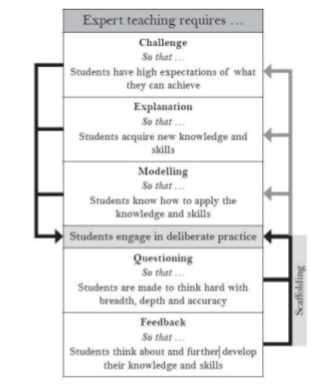
Shaun and Andy have a diagram that describes the parameters clearly, to both teacher and learners; note the "so that", which is the area for having a rationale.
Picture
Chris Moyse, as the start keynote, had us engaging with sporting analogies, including the New Zealand rugby team success over such a long time-scale, the successes of Sergei Bubka as a pole-vaulter, seeking to “raise the bar” by a cm or two each time. Practice or rehearsal were key elements of but areas of success. The ability to visualise, to put oneself into a “game situation” mentally may well be a significant part of these successes. I reflected on such a situation from my own earlier sport activities, as a cricketer, playing imaginary strokes, or practicing bowling. It’s akin to anticipation or expectation, preferably with the guidance of an aware coach, to reflect back to you what you are demonstrating. This can be now enhanced with video. Both coaching and video for self-reflection are now available in many schools, so the ability to facilitate self-reflection and self-development are more easily accessible.

Lisa Jane Ashes closed the event with a significant challenge “Why are you still here?”. She may well have been gasping for a cuppa at this stage, although the image of beer did perhaps give the after-show game away!

In many ways, the answer to why are you still here is simple. The hall was filled with thinkers, prepared to give up a Saturday to hear high quality speakers enthuse about a current area of interest. That many will have gone away, like me, with nuggets that have rattled around for the best part of twenty-four hours, is testament to the quality of the event.

Teaching is a thinker’s game. 
Teachers are the lead thinkers in a classroom:-

  • They need to know the subject at hand, which may be different for a graduate specialist in a Secondary school compared to a Primary generalist, responsible for a range of subjects, where some will be stronger than others.
  • They will have ordered the curriculum into discrete themes, topics or programmes of study.
  • They order and organise the coherence of their plans over a known timescale, ensure that classroom and the resources for learning support the learning proposed.
  • They know their children, to varying degrees, depending on their contact through the week, but they are trained to understand learner development through the age range.
  • Their plans seek to match the needs of the subject with the needs of the children, providing appropriate challenge to all abilities.
  • They plan learning over a timescale to ensure a dynamic is established which fully engages learners, in and out of school, and assures the imparting of a particular body of knowledge.
  • They create tasks appropriate to the challenge, with an understanding of the subsequent developmental stages of the learning, so that by engaging with the learners while on task, they are able to guide and support their developing understanding.
  • They ensure that any input gets across the essential information on which the lesson is to be founded, through a variety of means, which are enhanced by the availability of in-class ICT facilities.
  • They ensure that behaviour allows learning to take place.
  • They interact with outcomes, orally in class and in writing after the lesson, while marking books. They are constantly making judgements, on an individual, group or class level.
  • They use the outcomes as new reference points against which to plan the next steps.
  • And they add broader value to schools in many other ways………………….
  • They undertake personal CPD that enhances their practice.

 Much current time is spent seeking to understand the latest edict from a politician, interpreted through a MAT or LA, cascaded through senior leaders to classrooms. This can lead to assimilation of simplistic methodologies rather that consideration of change within a holistic approach. Anyone connected with teaching will be aware of the myriad needs in every lesson. This needs agile thinkers, aware of, and adaptable to, evident need.

That, to me, is where “evidence-based”, metcognitive teaching sits; the teacher ability to rationalise the what and why of their teaching. It’s down to (inter)relationships and, inevitably, a level of trust.

0 Comments

Listening To the Experts

5/10/2017

0 Comments

 
Picture
Hants CC Special Ed Governors’ Conference

I feel that am lucky enough to live in, to have worked for, and to be a Governor in a County that has maintained a strong LA structure. This means that Governor Services play a very active role on Governor development, including an annual conference for Governors with interest or responsibility for SEND. It is an opportunity to meet together, but also to listen to speakers with a national profile, to bring experience and expertise from a wider perspective.

I hope that I have caught the flavour and some of the key details of the day.

This year’s conference started with Matthew Barnes, Specialist Adviser for SEND, HMI and Ofsted, whose key message was that Ofsted, while still maintaining rigour in processes, would be looking more closely at in-school systems, the impact of activities, whether a broad balanced curriculum was available to every child and personal development, including behaviour and welfare.

Learning and progress of all pupils was paramount. Leadership and management were highlighted, in that, in the absence of graded lessons, progress and rigorous evaluation of elements such as Performance Management and interventions, with clear evidence of investigation of anomalies would be needed.

Matthew emphasised that school tracking and data is for each school to determine and explain rationally, as well as being able to show the progress of children. He also shared thoughts on the IDSR, the Inspection Dashboard Summary Report, which Ofsted use to create points for investigation, utilising scattergrams and trends/outliers to clarify areas for consideration.

With a significant background and interest in SEND, Matthew also highlighted the need to track children whose performance is always likely to be described as “low”, giving examples of independence in various contexts, developing essential life skills, especially communication.

Questions that arose in my mind, as a result, were connected with a growing number of early career teachers, with, as Nick Gibb stated recently, a chance for “rapid promotion”.
  • Much teacher/child interaction is based on judgements, derived from previous experiences. Is the experience sufficiently broad to encompass the skills to deal with the needs of the children in a class, or, if promoted, in a school?
  • Linked to; have they had experience of teaching every year group for which they are responsible? Implications for decision-making?
  • Do teachers really identify their concerns (personal/professional and about the children) sufficiently quickly and in sufficient detail to support their own and subsequent, supported investigation of anomalous outcomes or behaviours?
  • Do early career teachers fully understand their responsibilities as teachers of SEND children? Do they fully understand, and adhere to, school systems?
  • It is very easy for individual children to fall through or get tangled in supposed safety nets. Clarity and consistency are key.

Gareth Morewood
, asked to be introduced as “a SENCo from Stockport”. Gareth is well respected among the SEND community, working at local and national levels. His title is Director of Curriculum Support, which, in some ways, could more clearly define the role of a SENCo. It is in coordinating curriculum support, teaching teachers and creating appropriate support programmes for children, that underpin the SENCo role.

His talk was essentially two parts of a whole, entitled Accountability in Action and Parent Partnerships and, in some ways, might have benefitted from being a whole session, to avoid a split in the narrative journey.

Gareth clearly highlighted the legal aspects of SEND legislation, including a very clear background to SEND changes effective from 2014. He suggested that schools should consider IPSEA online legal training module for the SENCo and possibly other members of staff. There is a need to consider the broad aspects of every teacher being a teacher of SEND, as legal responsibilities.

That teachers as teachers of SEND is especially highlighted in the legislation, was referred to often. Each teacher plays a central role in every aspect of learning, making reference to existing plans and developing and sharing personal targets, but also in highlighting anomalies as they arise, recording and discussing with the SENCo in timely manner.

A focus on definite outcomes, aspirational or otherwise, underpinned much of Gareth’s talk. To have clarity about where you want the child to end up offers guidance on interactions along the journey. In fact, it was interesting that both Gareth and Matthew talked of the importance of the journey, the process and the progress, through progressive outcomes.

Discussion of EHCP, education health and care plans was a central feature of Gareth’s talk, as this is the “sharp end” of SEND, when the way in which the school has managed a child’s needs to a particular point is placed under scrutiny by an external audience. The quality of record keeping, the interactions and interventions, with evaluations of outcomes, the involvement of external expertise and following through with their advice. The central place of the child and their parents was regularly emphasised.

In talking about personal target setting, Gareth was not a fan of IEPs, but preferred student passports. He has details of these on his blog, www.gdmorewood.com
​
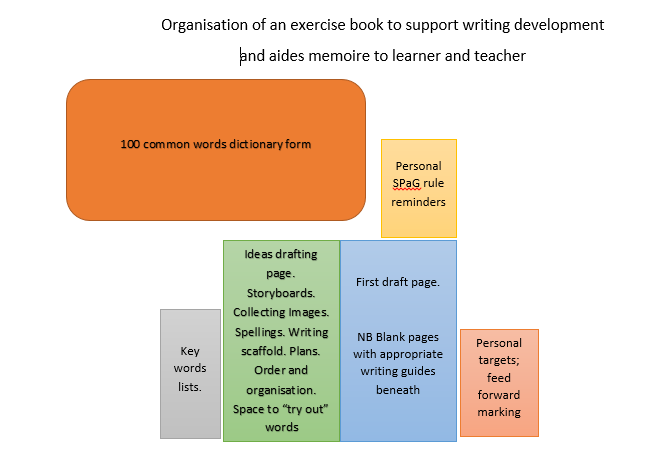
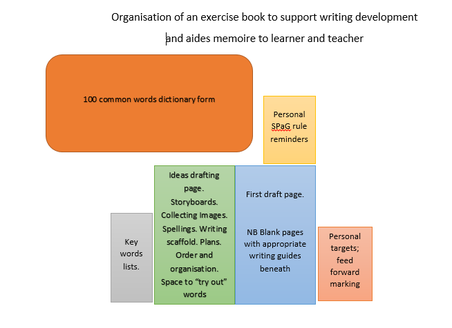
For me, a significant element in learning has always been how to keep the detail of current, key aspirations in front of teachers and children, so that they can be live within each piece of work. With a class of children, to remember the personal targets of each child might just be asking too much of the teacher. However, to articulate them in a form that can be easily accessed allows the child level targets to be discussed within activities. I’ll mention again the flip out sheets, within a drafting approach to written work.
Picture
For a number of parents, just to access the school can provide challenges, eg some may have had difficulty in school as children, which has left them uneasy in such settings. Making it easy to make contact with specific staff who are in a position to help or signpost a parent to help can allow easy resolution of issues. If parents know who’s who, who to contact and how to do so, with telephone, email or text access, they can more easily pass on their concerns and, if the school has a response system in place that can offer reassurance that the problem has been picked up and is receiving attention, they may well be calmed as a result. A case of a problem shared…

Staff training is of paramount importance, in creating structured approaches that help teachers and TAs to develop case studies that might support EHCP applications. Having easy to use systems, which can be digital or paper based, or a combination, allowing contemporary notes to be collected and collated, might just reveal patterns of behaviours that can give insights into issues.
​
Parent Partnership issues were explored through both sections. It is important that these are established early and with some strength, ahead of potential need, especially where SEND needs are already clearly established and recorded. Active and productive parent partnership is not something that can be taken for granted as a natural part of the family-school “bond”, but, where it becomes a proper meeting of minds, can lead to proactive interventions that benefit the child and, by extension, the family and the school.

It’s something to work on.
Picture
Troy Hobbs, a HCC SEND officer, gave background to current position in HCC regarding EHCP, budgets, and possible future system pressures. He highlighted some key elements that he saw as school level issues.
·         Insufficient impact at SEND support stage of the SEND CoP, leading to increased EHCP requests.
·         Too few parents and professionals convinced about the effectiveness of inclusion, driving special school placement requests.
·         SEND reform areas in an “immature state”.
It was clear that the authority was busy “behind the scenes”, but there were some question marks in my mind over the dynamics involved; busyness does not necessarily mean defined actions within a strategy. A “recovery” strategy was outlined, however, it is constantly seeking to hit a moving target.
Picture
Considerations, for me as a Governor, after the event.
  • In a culture of early career teachers, it is more essential to quality assure teacher judgements through regular, recorded mentoring and moderation activities. Overt expectations?
  • Consider IPSEA online legal training module for SENCo and others?
  • Potential to co-opt the SENCo onto Governors, to enhance the strategic role?
  • SEND target in Performance Management outcomes? Focus on teacher standards 2,6&5.
  • Who does interventions? Why, where and when? Impact assessments? Interventions cf whole class expectations? Tracking progress within interventions?
  • Consider all aspects of parent communication. Possible use of single question questionnaires?
0 Comments

Developing Reading teachers and Readers

30/9/2017

0 Comments

 
It is a truism, but a teacher usually prefaces any commentary with “in my experience”. This is largely because teachers will always seek to develop high quality practice which a) suits their children and b) suits their way of thinking and thereby develop a coherent, working practice. After an active career of 43 years, which included Post Grad Advanced Dip Edn in Reading and Language Development, this post is based on the evidence of reflecting on experience.

Learning to read should be a dynamic activity and be based on a whole school approach, to ensure that children pass through different classes, but still are enabled to make steady progress. This can still allow for trialling of different methodologies, with evaluation and feedback to develop others. Passing through the schemes can be as simple as that for the majority, flowing through the system in an ordered manner.

Dealing with individual needs has always been an issue, often requiring specific teacher-level intervention.
​
Picture
I started teaching so long ago that it was certainly almost the dark ages for reading. The book stock in my first school was very limited and largely based on the Ginn 360 scheme, which gave a progression, so weekends and holidays were spent rummaging in charity shops to build up a personal class collection which would support the broader range of needs.

The prevailing advice from inspectors was that those with identifiable specific learning needs must be individually heard daily, those not quite keeping up at least three times and the better readers at least once.
With a class of 39 children that created a need for a lot of reading time.
​
An integrated day, child-centred approach afforded some time, while playtimes and lunchtimes offered more. USSR, Uninterrupted Sustained Silent Reading happened straight after lunch, sometimes, but not often becoming ERIC, Everyone Reading in Class. Parent helpers were always welcomed. In the era of tape recorders, children had a personal tape, to be able to record themselves reading and to listen back to themselves as a self-correction activity. Almost another adult.

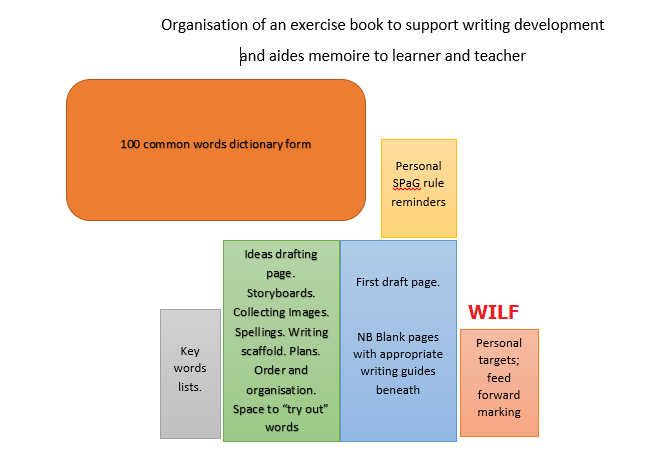
Phonics were taught, either directly to the whole class, to specific groups of children or within games situations. Approaches were multisensory, with sand trays, sandpaper shapes, plastic models, painting letters while saying out loud. We often did “rainbow letters”, overwriting or painting letters with different colours along strips of cardboard that came from the local materials bank. There was a link between gross motor and fine motor skills, enhanced by the use of blank paper exercise books with different width guide lines.

At the same time personalised phonics skills and sight vocabularies were regularly checked, developed and supported with spellings home and regular tests. Spelling was based on the look, cover, write and check approach, developing aspects of short term memory.

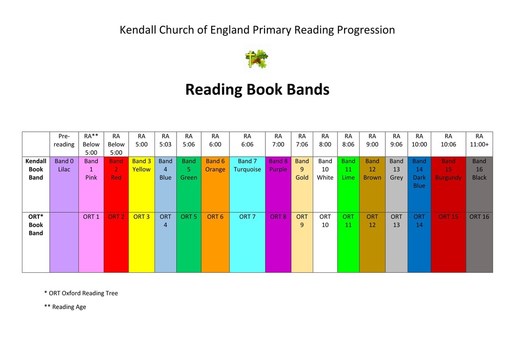
Cliff Moon’s Individualised Reading approach effectively colour coded the available reading schemes into bands within a defined readability level, from approximately age 5, rising by 6 months for each colour. Variation occurs, but an example from a school is below.

Picture
If each colour was stocked with sufficient books, this allowed free access to children to change books as and when they finished them, rather than waiting for a defined change time. Any commentary on the book was oral or shared through the home-school record, with any written responses limited to a postcard to the author.
It is important to recognise that the colours also had an essence of reading age embedded, so that progress could be described both in terms of colour movement and reading age, which can be compared with chronological age as a rule of thumb. Colour coded schemes also highlight children who are “stuck” and might need particular guidance.

Home-school reading record books became all-purpose reading records and comment books, shared by teachers and parents, with comments made at the time of hearing a child read. Individualised reading records were kept.

This approach created an understandable spine, with defined progression embedded. It allowed consideration of the different needs of readers, in that where a child needed some guidance within a book in order to be able to read it, defined a teaching level book. All books below this would be fluent level books, while any book above the guided level might be at a frustration level.
For reading at home, children could select from their fluent colours, changeable daily if needed. Inevitably, the movement from one teaching level to another determined the books read at home, so there was an element of motivation engendered, as well as a desire to be seen to be making progress.

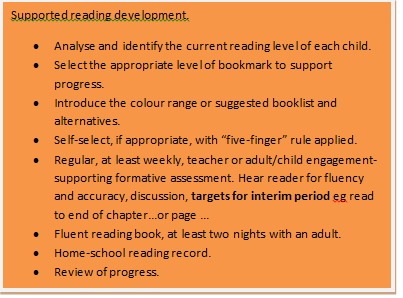
Guiding teachers, children and parents within these books was achieved through bookmarks which had been written with a specific level in mind. Based on a “can do” approach, the statements, such as talk about the setting or a specific character, were given to encourage conversation between reader and listener. Colour coded to link with the books being read, they had an appreciable impact.

Beyond and around the spine, other books were available. Children took home a non-fiction book each week within their library exchange period. “Free reader” was the ultimate accolade, when self-selection from the available books required different guidance and knowledge from the teacher of the available texts. Non-fiction texts were displayed within the topic corner, available for reading, but also for study skill lessons, using the books to enhance the literacy curriculum, through note taking and information gathering. The index and contents offered opportunities for alphabetical order and judgements about suitability of the text.
​
Author sets of books became a feature of each classroom, changed each term. This allowed consideration of author styles and approaches to writing across the class. In many case, the range of books written by the chosen authors allowed access across the whole class. One or more of the books would be chosen as teacher books to share with the children.

Free readers need the skills of choosing a book for themselves. To facilitate this, children were taught the “five-finger” rule; read the first page and fold one finger for each word that caused a problem. If five were counted, it’s probably too difficult. They also had to read the blurb to support their decision, made in discussion with the teacher. Children also had the (adult) right to say that they were not enjoying a book.

Children learned to read and enjoyed the process, in doing so becoming avid readers. Proof? For want of better, SAT English L4+ scores at age 11, usually 85% plus in classes with 20%+ SEN. Others will have greater evidence, from different approaches.

Picture
By now the reader will have noticed a theme developing.
  • A good range of reading material should be available, organised to support progress. Colour coded would be my preference, as it saves some teacher decision making.
  • Teacher awareness of available material and individual reading abilities and interests is essential.
  • The reading journey should be guided and supported as well as guided personal practice and a dynamic that encourages sharing books as widely as possible.
  • Adult engagement with different aspects is essential; diagnostic if necessary, such as miscue analysis and developmental feedback, written records of books read and qualitative statements of reading. Consider a home-school diary, especially for those who need close monitoring, and make sure that there is a positive dialogue, not just a parent notebook.
  • Reading between guided sessions is essential to fluency. This can be in the form of expectation to read to a certain point in a specific timescale. Just to say to read at home for homework is not a sufficient driver.
​
Picture
Developing a culture of reading in the class.
  • Create a book corner which actively encourages engagement.
  • “Author of the term”; a collection of books by one author, to be read and then followed up.
  • Postcards to an author; Fold A4 in half; Side one, a pictorial interpretation of the book, side two a postcard commentary, aimed at the author.
  • Letters to an author, alive or dead; offers opportunity for commentary instead of formal book review.
Display potential
  • Reading walls, considering an audience. Potential for home activity?
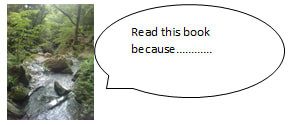
  • Photocopy book covers. Speech bubble commentary from children.
​
Picture
  
I LOVE books
·         Wordsmiths. Ten interesting words I have found in ……….(book title)
·         Settings, characters. Descriptions into art, art into words.
·         Settings in a box. 3D theatres allowing story telling, possibly animation.

In 1995, I wrote an article for Books for Keeps, based on 3D models. Can be read here:-
http://booksforkeeps.co.uk/issue/92/childrens-books/articles/other-articles/books-into-art

  • Storyboarding a book? Eg a book as a 5-picture cartoon.
 
Parents as partners
While parents are considered as partners within this process, there is no guarantee that they will all have a clear understanding of expectations, nor can it be assumed that every child goes home to a literate household.

Schools need to be aware of this dynamic, to avoid stress either to the child or the parents. Support and help may be needed and, where there is limited scope for support, this may need to be the focus for in-school intervention, such as additional TA time for reading.

Many schools have developed parent evenings specifically devoted to reading guidance, with modelling to parent of how to share books, not just talking about reading policies.

Where this was repeated over time and with an assurance that every parent participated, the impact on reading progress was often very impressive.

TEN SIGNS OF A SUCCESSFUL (ENGLISH) TEACHER

(Exeter University; Primary Improvement Project, funded by the Leverhulme Trust 1997)

This project looked at learning dynamics within reading classes and found the following:-
  • A high level of personal enthusiasm for literature, often supplementing the school’s resources with their own books.
  • Good professional knowledge of children’s authors and teaching strategies
  • Importance of literacy stressed within a rich literacy environment
  • Progress celebrated publicly and children’s confidence increased
  • Teaching individualised and matched to pupil’s ability and reading interests
  • Systematic monitoring and assessment
  • Regular and varied reading activities
  • Pupils encouraged to develop independence and autonomy, attacking unfamiliar words, or teachers backing pupils’ judgment as authors
  • A high quality of classroom management skill and personal relationships with pupils
  • High expectations, children striving to reach a high standard, whatever their circumstances
 
0 Comments

A Parrot on the Shoulder

28/9/2017

0 Comments

 
Picture

The past couple of weeks have seen me working with ITE trainees and Teaching Assistants (TAs). There are interesting parallels with both groups.

One is starting a process that will lead to QTS, under mentor/classteacher supervision, the other is working in a classroom under teacher direction.  

One begins to assume responsibility for the whole class, including planning for learning, after a period of induction and preliminary training, the other may have autonomy while working with a group, to address issues arising for learners.
A designated HLTA may assume some time-limited classroom responsibility, if directed by the head.

Both are acting, to some degree, as a teacher, with the classteacher/head taking overall responsibility. It has long been a head’s responsibility to decide who is a right and proper person to be in front of a class.

There is inevitably a responsibility upon the classteacher to quality assure the actions of either the trainee or the TA. In-lesson interaction is a vital ingredient.

In the case of the trainee teacher, I have advised mentors, who, by and large are the classteachers, to become what I have termed “the parrot on the shoulder” approach. This involves making timely decisions that result in a quiet word in the trainee’s ear to take some specific action. In other words, providing appropriate prompts that ensure the growing awareness of the trainee to the complexities of the classroom environment. I remember a conversation with Graham Newell, of Iris Connect, discussing the use of technology. I had envisaged the possibility of the trainee with an earpiece and the mentor with a microphone, really guiding with in-ear advice. A simple word in the ear may be all that is needed!

In the case of TAs, even if they are given responsibility for a group or an individual, these groupings should always operate under the teacher’s guidance. Classroom observations often show that when on task, teachers may rarely interact with the TA group or the TA during the lesson. If this becomes a norm, it can mean that the teacher has less and less contact with specific groups. Oversight and interaction are key, if children are to make the progress desired. Some kind of feedback loop should be integrated into the relationships.

The mentor role is an interesting one, in guiding and training both the ITE trainee and a TA. A second piece of advice that I gave the mentors was the “talk your thinking”, making actions clear, to both the children and the adults, making links overt, to avoid ambiguity. This does require the mentor/classteacher to have a very clear rationale for what they are doing, in order to explain this through the lesson.

The whole could of course be simplified to valuing adult interaction and professional talk within every lesson. By incorporating a trainee or a TA into a classroom, the team ethic needs to be secure, the team leadership and guidance falls to the senior professional, the class teacher, whose role is organiser, guide, mentor and quality assurance. Therefore every teacher is now becoming a manager in some form, responsible for the actions of others.

Having a TA or a trainee does not ensure an easy load, but a well-rehearsed team can work wonders, for everyone concerned.
​
The key is quality talk...
​
0 Comments

50 things to Do; Thinking Locality

20/9/2017

0 Comments

 
Picture

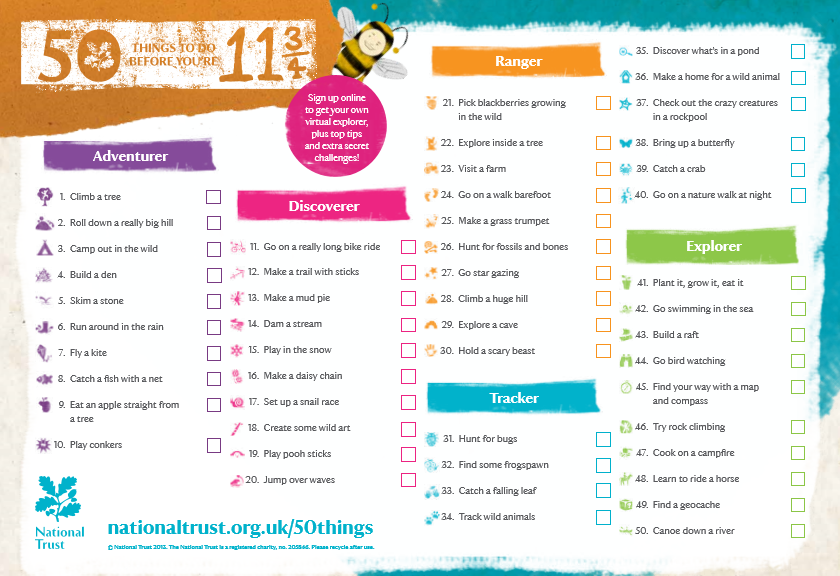
​During a session at Pedagoo Hampshire 2017, Pete Sanderson, aka @LessonToolbox, mentioned a National Trust initiative that he had seen in action in a local school; 50 things to do before you are 11 and ¾. I managed to find a very useful poster which is at the header of this post.

It could be seen as a sadness that there seems to be a need to promote what was, in effect, a normal part of my own childhood; eating an apple from the tree or picking blackberries sometimes sustained us during periods of play. However, the potential of relatively simple activities to generate discussion through shared participation should never be underrated. It is possible to speculate that families may not promote these activities, perhaps seeing them as undemanding or uninteresting, or just not “fun” things to do.

In many ways, looking at the list, it encompasses many things that could be offered, with good supervision or support, to younger children. Unless they are introduced to going out and looking around them, with the guidance of an interested adult, it may well be that the trappings of their external world become nothing more than wallpaper, through being ignored, or not deepened sufficiently to register long enough to make a record.

Going for a walk in the local area can offer the basis for sketch maps for orientation and familiarity that eventually builds to independent and safe use of the area. Highlighting and talking about landmarks is a key element of this orientation. Going out in different weathers creates opportunities to discuss appropriate clothing, to keep warm, dry, cool etc. Or maybe, going out in the dark, considering the best colours to wear to be seen.

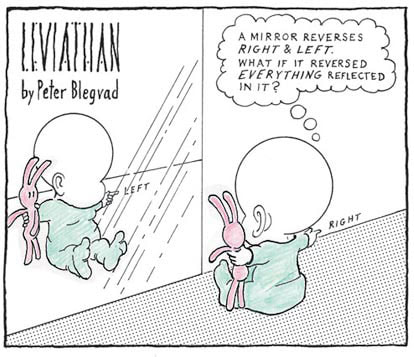
It’s all talk, before, during and after an experience. The talk can be descriptive, interrogative or speculative, but it forms an underpinning of future learning. Just knowing your left from right can be a useful bit of information. Everything is capable of being discussed, and, in many areas, to talk about mathematical ideas, shapes, money, mass, measures, as well as multiple opportunities for counting and using number in different ways. Comparative language, such as bigger, smaller, longer, shorter, heavier, lighter are all valuable conceptually and experientially.

Quality talk, pre-school, can be the difference between early success and an early feeling of failure, as children compare themselves to their peers.

If parents are concerned about taking their children out to discover, because they may feel that their own knowledge is lacking, joining local groups, through the libraries (if they still exist), or clubs through organisations like the NT, Wildlife Trusts and British Trust for Ornithology.

It may well be that parents need to let their hair down and rediscover their inner child. It’s autumn, so jump into, or kick around in a big pile of crunchy autumn leaves; collect conkers and have a (safe) battle; plant conkers, acorns and other tree seeds falling now in plastic bags of soil to germinate and pot them on in spring, develop a tree nursery; have a small bonfire/light the barbeque and cook outdoors together; bike ride together and picnic outdoors; make a den under a table with a sheet; cook together; paddle in a river or the sea or a pond; visit the local library or a museum.

And talk, talk, talk.

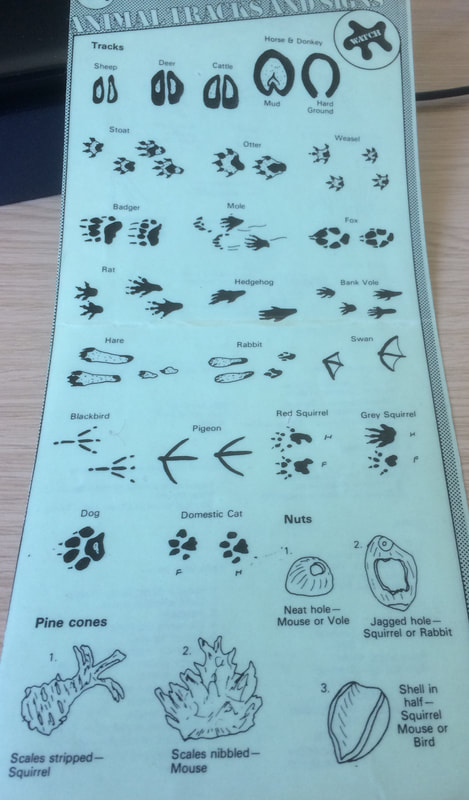
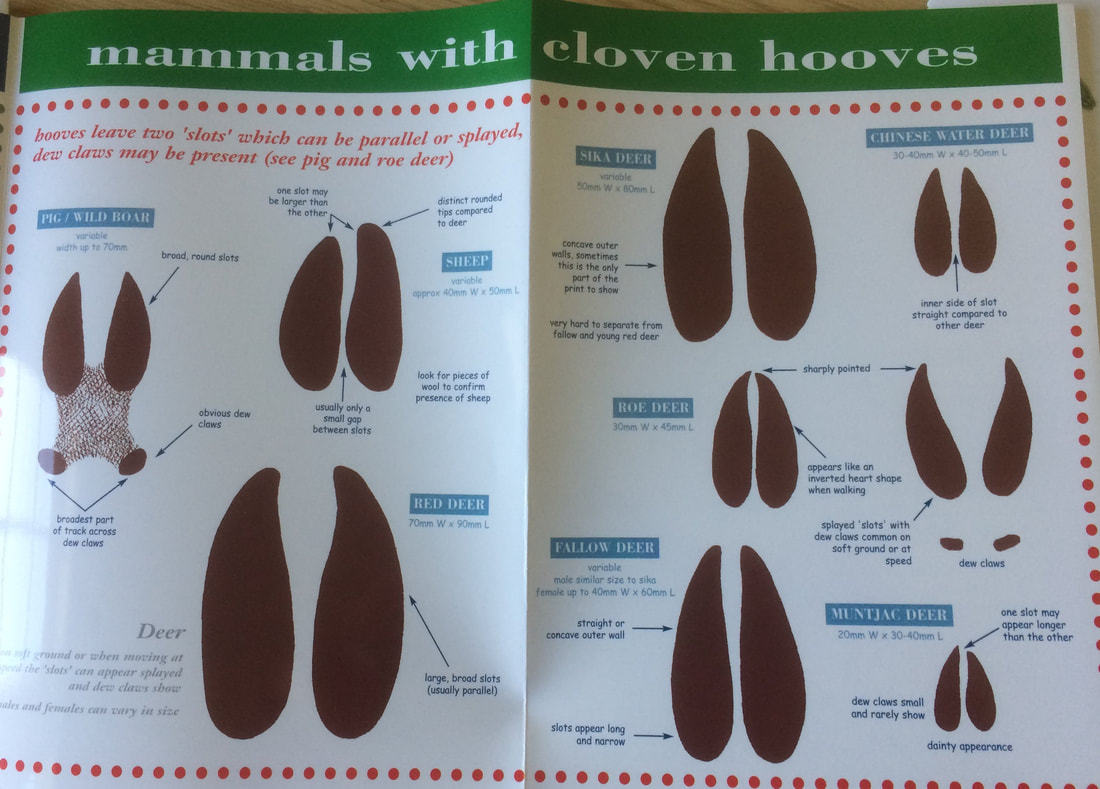
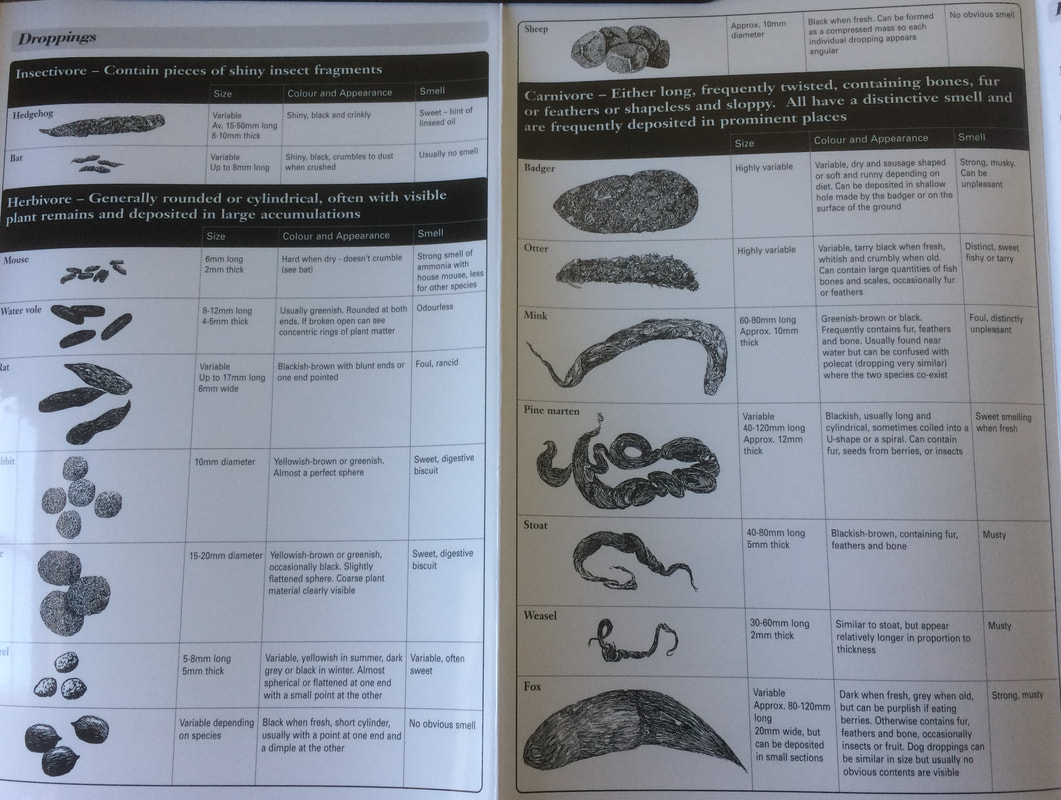
​If you're not sure about things while out walking, that's ok. Find an appropriate guide book, from a library, or maybe use something like the guides below.


0 Comments

Keeping Science on the Primary Agenda

19/9/2017

0 Comments

 
Why has science been somewhat sidelined in primary schools, when it offers so much in the way of stimulus for talk, reading and writing?

The TES today 19.09.2017, reported the outcomes of a report commissioned by the Wellcome Trust which argues that the subject is not being given enough priority or time by most of the nation's primaries. 

They found that on average, across all primary school year groups, more than half of classes (58%) did not get two hours of science a week. The figures are based on two surveys of teachers, including one of staff who led on the subject for their school.

Wellcome also identified a fear among teachers that children would ask a question they would not know the answer to, and a belief that science is messy, expensive, time-consuming. The study was published to mark the launch of Explorify, a new free digital resource for school science.

The downgrading of science could be tracked back to around 1997, when that incarnation of the curriculum coincided with the National Strategies for Literacy and Numeracy (not English and Maths) and the delivery of QCA packs of “foolproof” science recipe booklets. Science teaching by numbers… Teachers learned not to think as scientists, but to follow the instructions. In other words, they forgot to think for themselves.

I trained as a primary science teacher, extended through Environmental Science and spent a period seconded to the Assessment of Performance Unit looking at how primary children learn in science situations.

Like many practical areas of the curriculum, such as art, organising for a class of thirty is challenging, as it takes a significant resource base, space can be at a premium and time can be a limiting factor. Space, time and resources have been perennial issues and probably always will be.

In the beginning of my career, the integrated day, based on groups undertaking challenges, were the norm. This meant perhaps a group of up to 8 working on a challenge; one table devoted to science (or other topic area), another to art, perhaps one to writing, one to maths and one to reading. Yes, that is five groups of 8, the size of my classes from 1974-1979 and no TA…

When I became a head and LMS enabled the hiring of TAs to support learning, I was lucky enough to find someone with science and technology as interests, so we could create quality learning opportunities in both subjects, based on small groups supported by the expert TA. In between supported science, teachers would set up science challenges for small groups to undertake with some independence. It’s the practice in decision making, developing rational lines of investigation, that, to me, have always underpinned primary science.

Unless schools begin to address what might actually be a systemic issue, science and other foundation subjects will continue to suffer, yet they offer significant opportunities for use and application of knowledge and skills learned in maths and English.

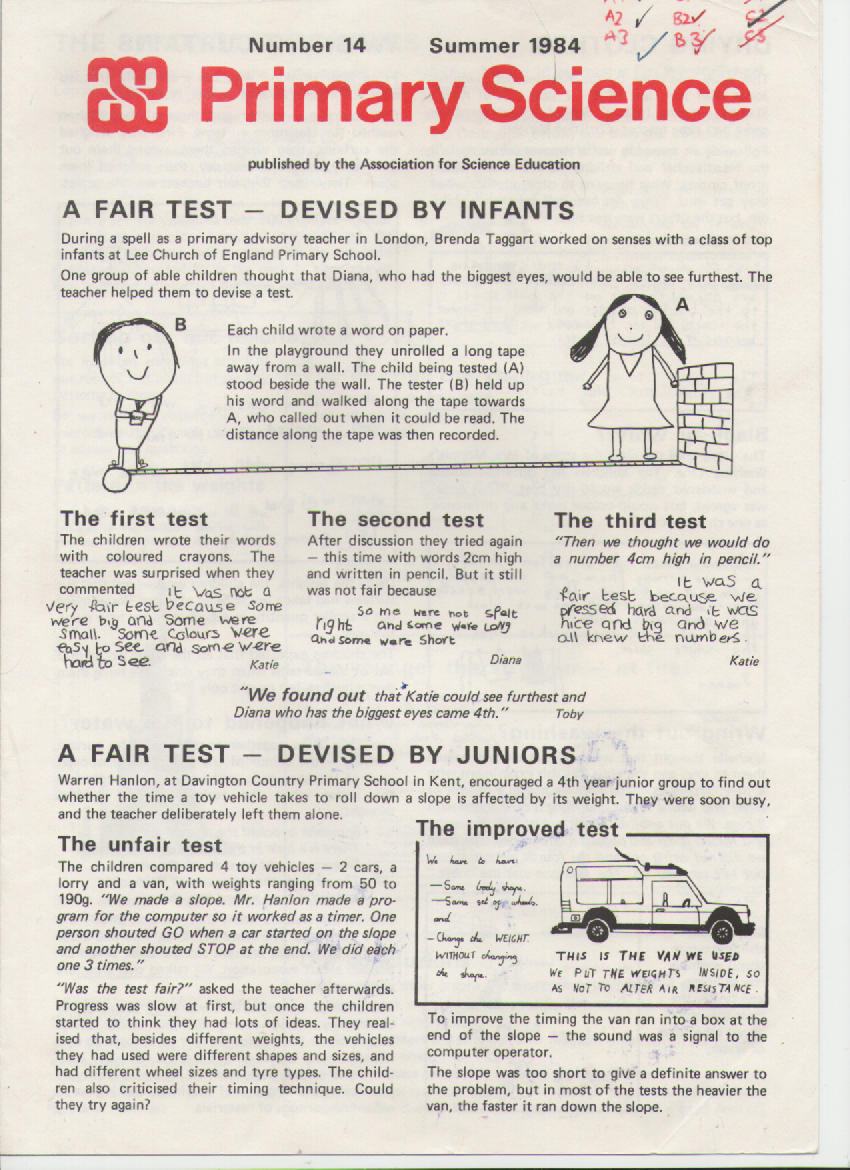
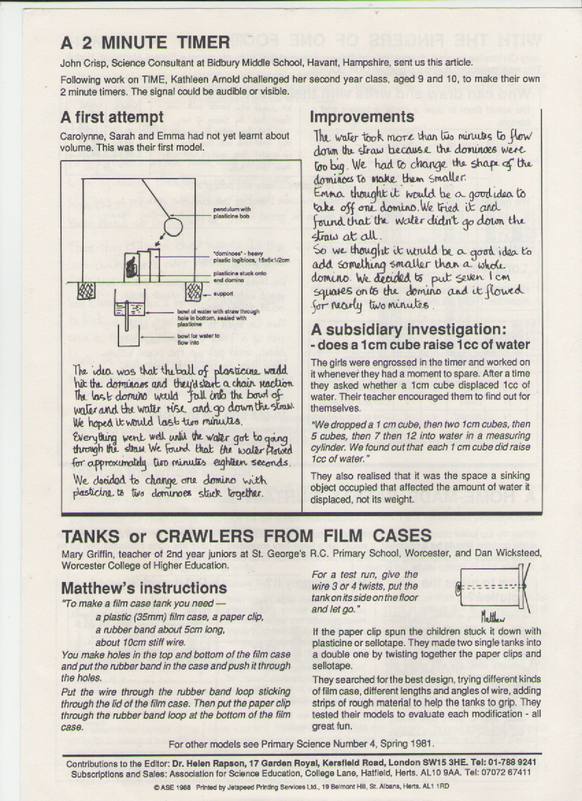
Some extracts from mid-1980s ASE publications.
Picture
Picture


And some other blogs that look at different aspects of primary science. It doesn’t have to be difficult!

​
Creating Primary Scientists ​
Primary Science is a practical subject
In search of the Triantiwontigongolope

Rafting
Messing About on the River
Exploring scientifically
​November is a rotten month
​Observation; get them to look
Creating Nature Detectives
The world is not wallpaper
Exploring Science From shiny Things
0 Comments

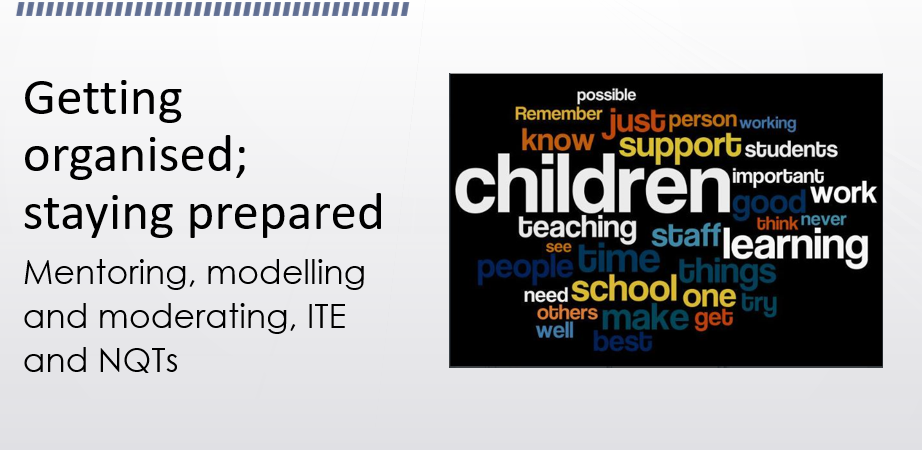
Mentors; Developing In-house Tutors?

17/9/2017

0 Comments

 
The past few years have seen a gradual increase in my work with mentors, through a variety of routes. There are common themes and some contextual nuances, but, at the centre is the significant importance of the mentor, whether for a trainee in initial teacher education, an NQT, RQT or perhaps coaching someone through a short term need.

​This area of interest, therefore, was one that I was happy to share during Pedagoo Hampshire 2017, albeit as a stand-in speaker as a favour to Martyn Reah.

​While there are some simple and straightforward expectations, the need to develop the professional thinking skills, as well as subject pedagogy, requires skills from the teacher that can eventually lead to significant self-development. 

Picture
Picture
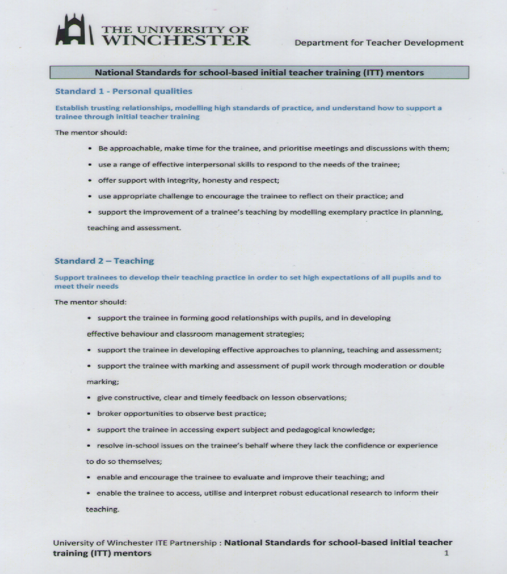
One year ago, September 2016, the government published a new document, in which it set out standards for mentors for Initial Teacher Training. many of these I would describe as "grandma sucking eggs", but, as experience has taught me, working with teachers, they come in all shapes sizes and experiences, from those who have actively volunteered for the role, purposefully to enhance their careers, to some who have suddenly found themselves as a mentor at the last minute.

​To some extent, the standards are self explanatory, so I have copied a version that we use at Winchester University, to set the scene for expectations. The quality of the professional relationship is key to a successful period in any class. How well the mentor can unpick aspects of practice, in order to share both the overview and the detail, without overloading the trainee, is an important element. 

​It is also worth mentioning that schools which choose to take on trainees of any description become de facto teaching schools, with every member of staff potentially being asked for help or advice at some stage. Therefore, the best prepared schools are those where everyone knows that a trainee is starting, and expectations of each staff member, as well as an understanding of the phases of development.

​The responsibilities for the trainee can be shared, with classroom mentors being supported by colleagues who may have recent study skills that might be useful to the trainee as they prepare written submissions for their PGCE or QTS status. Equally, using the available collective expertise can be useful in general discussion. Perhaps a colleague has completed a diploma, masters or some other qualification and can help with academic phrasing or referencing, perhaps offering to read the piece ahead of submission.  

Picture
Picture
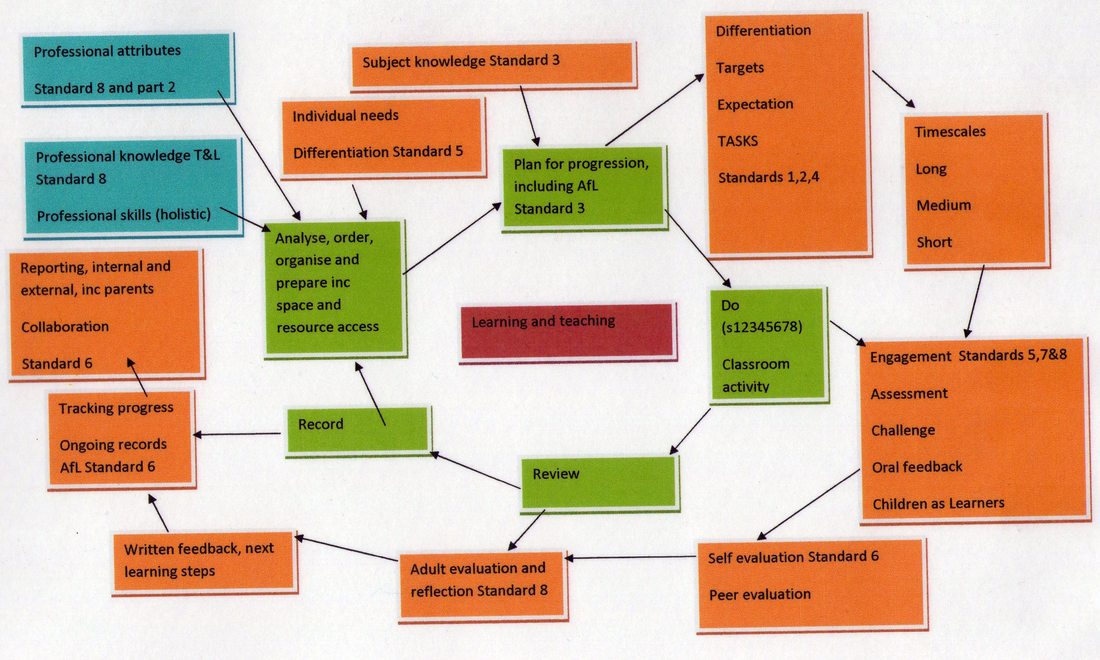
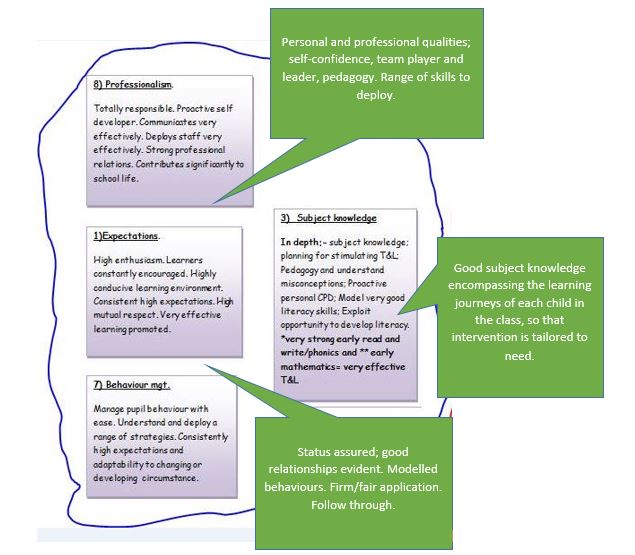
There are two distinct areas where there are likely to be different needs for support. The first is in the personal capacity of the trainee. The four standards, 8, 3, 7 and 1 are likely to be the essence of the starter; professionalism, subject knowledge, behaviour expectations and general expectations of how the classroom should be running.

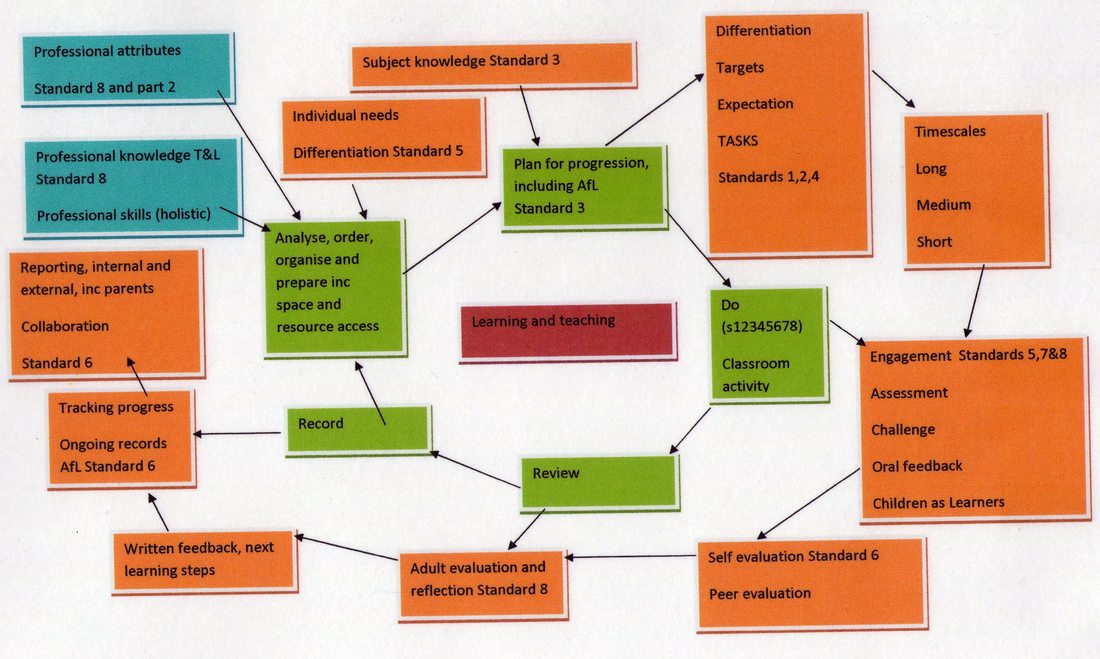
​Professional relationships, between the mentor and the trainee, trainee and teaching assistants, wider staff involvement, parents and children, will become self-evident, from the very outgoing to the excessively shy; I've met both extremes and every shade in between. The green boxes in the diagram below seek to summarise what might be seen in a potentially successful trainee. While they are self-explanatory, any suggestion of concern, in any of these areas, is likely to raise questions in a mentor's mind. These questions might, in themselves, become limiting factors. In this regard, the mentor has to unpick their own personal biases, in order to interact professionally. However, concerns are concerns and may eventually have to be addressed. We are talking basic teacher capabilities. 
Picture
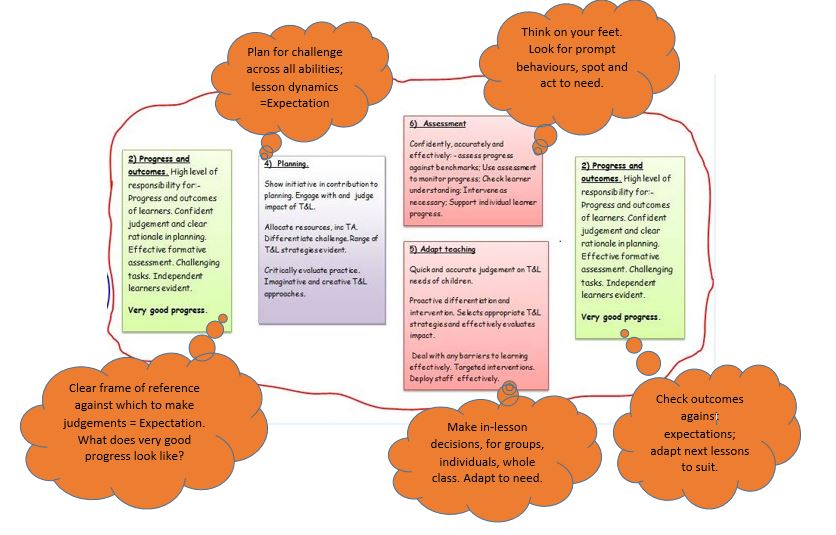
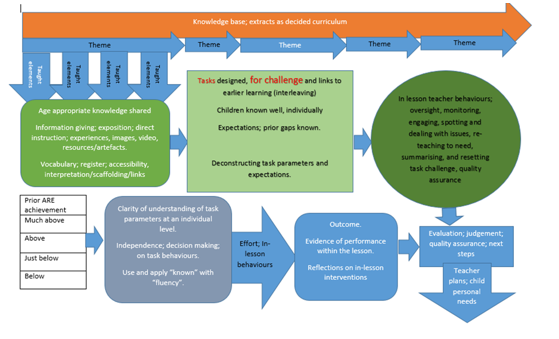
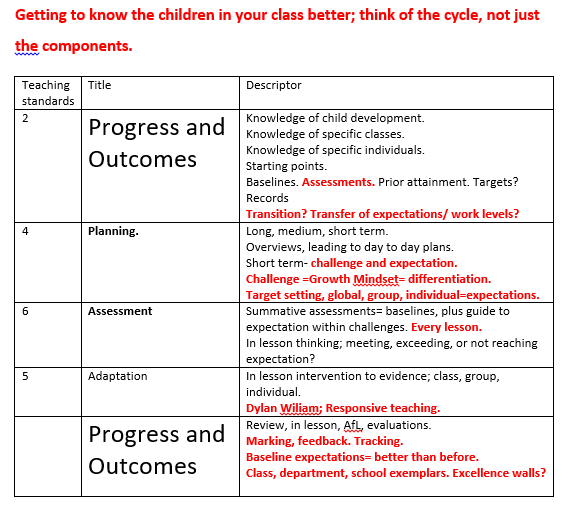
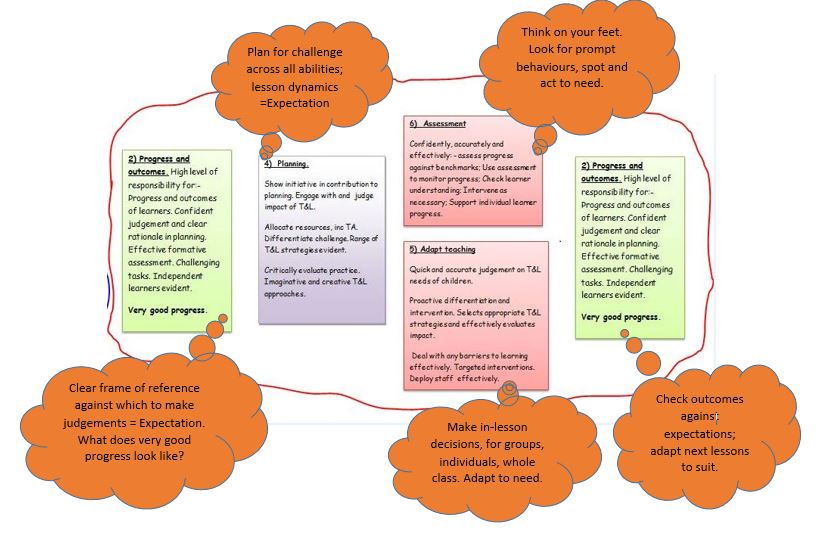
The second layer of teacher standards are likely to be more challenging, in that these are the practical aspects of teaching and learning; standards 2, 4, 6&5, leading back to 2. Progress and outcomes, leading to detail in planning of teaching and learning expectations, with in-lesson and post-lesson judgements (assessments) and adaptations to initial planning, leading to good outcomes that demonstrate progress across a period of time, eg week, fortnight, month.

​This is a significantly important area. A trainee will have had very little experience longitudinally. They may have had anything from a few weeks' experience to HLTA over time, but they may still need to get to grips with what "good outcomes" look like and the right decisions to make in order to promote further progress. Even an experienced teacher changing year groups or changing school settings may find this challenging. Moderation activity, aka talking about what the children are doing, between the trainee and the teacher is essential, to enable the mentor to guide decision making and develop baseline expectations. Visiting the year above and the year below is also a useful guide, to see where children have come from and what they are expected to be able to do the following year.

​The baselines will, in effect, guide in-lesson decisions. A clear idea of the journey of the lesson and the outcome expectations enable appropriate decisions to be made, including the use of sharing time, working alongside an individual or group to support their working approach.

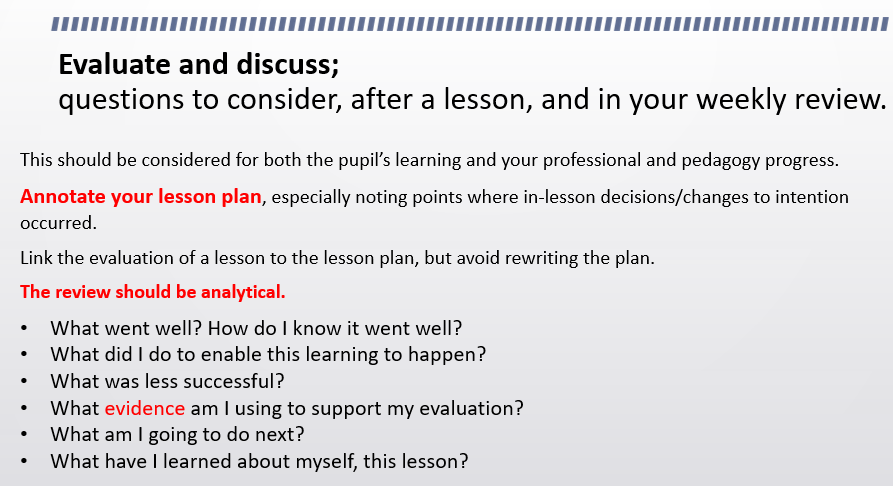
​reflection within and outside the lesson guides decisions about subsequent learning.
​
Picture
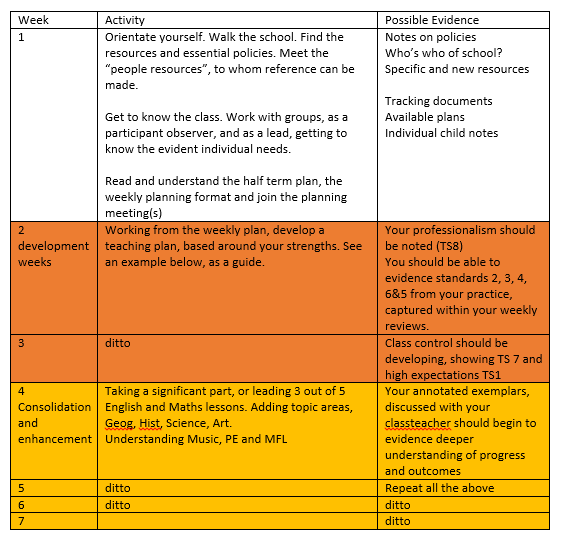
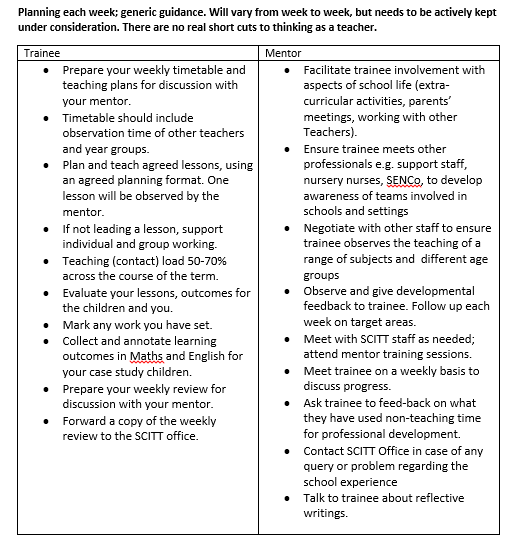
Planning for development over time is essential to avoid elements being missed. Trainees, on whatever route, have a mountain of paperwork to keep, to be able to show their development against the teacher standards. this can be aided by forward thinking and ensuring that structural elements of the programme are embedded in the timetable, so that they can be achieved, hopefully in timely fashion. In many ways the elements are articulated in the two slides.
Picture
Using this proforma as a checklist might ensure that each partner knows exactly what should be done each week, so nothing is left to chance and gets missed, leading to a backlog of activity later in the experience. Variation due to the vagaries of school life should be expected and addressed within a revised timetable.
Picture
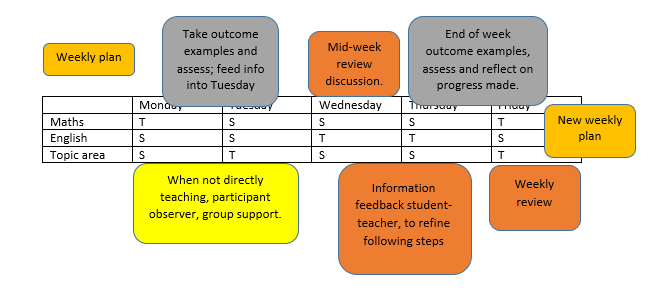
Trainees have to understand issues of learning over time. Working closely with medium term plans, over one or two weeks, it is possible to timetable periods where the trainee leads, is an observer or participant observer working with a group, feeding lesson outcome reflections to the teacher if passing on the next lesson or receiving such detail when taking over. This professional dialogue acts as prompts to dynamic thinking. Selecting work to annotate and investigate through the week allows more detailed discussion at the end of each week in preparation for the following week.

​Within lessons, it is fine of a mentor feels the need to act as a "parrot on the shoulder"; having a quiet word in the trainee's ear to prompt timely action. If the school has a system of microphone and earpiece, this could be an alternative means.

​Videoing the lesson can provide the basis for post-lesson analysis and discussion between mentor and trainee.
Picture
The "busyness" of a classroom, especially with younger children can sometimes prove daunting to early career trainees. The mentor has the role of unpicking what is going on within the complexity, so that the trainee can start to focus on specific areas, based on their mentor model and also from feedback on their own practice.

​Something as seemingly simple as in-lesson transitions can be the point where a trainee finds limitations in their practice. 

​The difficulty for an inexperienced trainee is that a good teacher can make teaching look easy. They may need guided observations to be able to tease out the key themes, then begin to delve into the nuances. A mentor "talking their thinking", making their actions overt, might seem an odd thing to propose, but it can be sufficient to guide the trainee within the dynamics of the classroom.
Picture
Knowing the children well is a key aspect of success. I would advise mentors to regularly ask their trainee to identify a couple of children and to give a short verbal summary of what they know, as if they were talking to a parent or perhaps writing a short report with a parent in mind. 
Picture
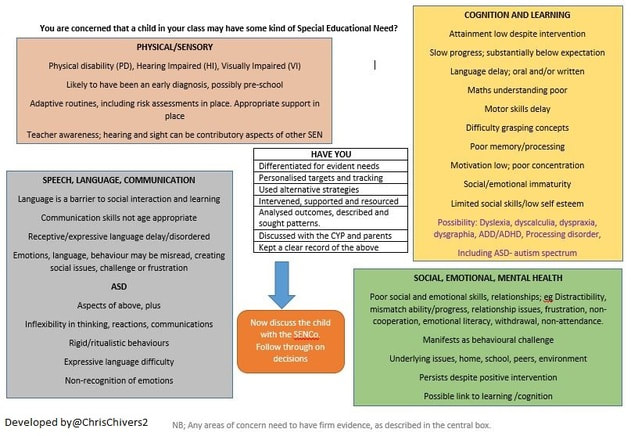
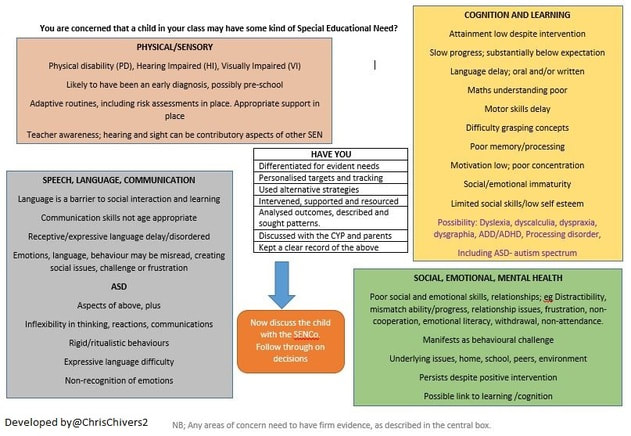
Knowing the individual needs of some children will be significant. Any child on the special needs register should be highlighted to the trainee, but they should also have the skill to spot developing needs in children who may not yet have been recognised as having a need. They need a framework, based on the 2014 SEN changes and I would offer the diagram below as a useful aide memoire, to be able to guide their thinking and provide the framework for a professional discussion with their mentor and the SENCo.
Picture
Reflection should become part and parcel of everything a trainee does, within the classroom and outside. Everything may be new, subject to internal chaos, needing sorting into internal "folders", to be used as appropriate when there is a need. 

​Reflection, supported by opportunities to discuss their thinking, will ensure that the trainee, over time, becomes a thinking professional colleague. Some have one year to achieve this. It is incumbent on the school, through the mentoring and colleague support, to ensure that they are led along this path. It should not be left to chance.

​At then end of the day, schools and mentors are creating the next generation of teachers, perhaps for themselves, but certainly on behalf of the education system. It is a responsibility, but it is also a privilege to see any trainee develop into an independent colleague.

​For this reason, I'd like to see some kind of accreditation available to mentors, to be able to transition to becoming in-house tutors, on a par with university colleagues, responsible for in-practice pedagogy.
Picture
0 Comments

Thinking Plenaries

12/9/2017

0 Comments

 
Picture
“The teacher’s job is not to transmit knowledge, nor to facilitate learning. It is to engineer effective learning environments for the students. The key features of effective learning environments are that they create student engagement and allow teachers, learners, and their peers to ensure that the learning is proceeding in the intended direction. The only way we can do this is through assessment. That is why assessment is, indeed, the bridge between teaching and learning.”
― Dylan Wiliam, Embedded Formative Assessment

The term plenary has crossed my path this week. It’s an interesting word, which seemed to derive from the three-part lesson that was seen as good practice when the National Strategies came about. It was the final part, the drawing together of what had occurred during the lesson and deriving significant learning points to take forward into subsequent lessons.

Or that was the supposed intention.  

For some, the plenary became a last activity to fill the final five minutes of a lesson, which may or may not, have a bearing on any learning during the lesson. It stood as a finale, in the same way as “starter” activities could also be separate activities, argued as a means to get children thinking in a particular subject at the transitional stage of a lesson.

This week, plenaries have been discussed as in-lesson interactions, where teachers spot a need and engage with a proportion of, or the whole class, to address a misconception. The problem with in-lesson “plenaries”, in the hands of an inexperienced practitioner, is that they can be done for the sake of being seen to be done.

Interventions, of any description, need to have a rational purpose.

“I’m stopping this child, group, class lesson, because I need to check x, in order to reassess, or reset where the learning is going.” It can even be articulated in that way to the children. It might be an occasion to use different resources or models, scaffolding ideas to ensure some additional information is embedded, to be incorporated into a task, allowing a greater degree of success in the outcome. It is the point where the teacher assumes the role of coach or mentor, unpicking the fine details of, sometimes individual need, fine tuning teaching and learning demands appropriately.

It is, to all intents and purposes, the point where teacher standards 6&5 impact on standard 2; spotting a need, addressing it and ensuring some positive achievements. In Dylan Wiliam’s terms, it is the point where the reflective teacher becomes reactive, based on the evidence of the child, group or class needs.

In other words, just good teaching.
​
“feedback should cause thinking. It should be focused; it should relate to the learning goals that have been shared with the students; and it should be more work for the recipient than the donor. Indeed, the whole purpose of feedback should be to increase the extent to which students are owners of their own learning,”
― Dylan Wiliam, Embedded Formative Assessment
​
Picture
0 Comments

Thinking back and Making a Start.

23/8/2017

0 Comments

 
Picture

No Battle Plan Survives Contact With the Enemy
Or as Burns puts it, “The best-laid schemes o’ mice an’ men gang aft agley”

​The children in the picture will now be in their 50s...

Expect the unexpected was a simple statement made to me by an experienced colleague. This has stayed with me throughout. The reactive behaviour of a teacher sets the tone for the classroom. A calm response to potential issues ensures calm in a classroom.

My advice to any ITE trainee or NQT starting this term would be to be extremely organised, especially in terms of their classroom, the layout and the accessibility of the wide variety of resources that might be called upon in any lesson. This means also looking at “walkways” to avoid congestion points. You didn’t know you were traffic police. It’s a piece of advice that has been drilled into me since I took over my first class, way back in 1974 and evidenced by my initial error of putting all the children’s trays in one place. It created congestion overload and resulted in two changes of plan; sharing out trays around the room and also moving one group purposefully at a time… We (should) learn from our mistakes…  

Being ordered and organised, to me, is the hallmark of a good teacher, in that the organisation allows for adaptation within each lesson, as children react to the initial exposition, stimulus or dialogue around a topic.

Knowing your stuff and knowing your children, or at least generic children of that age, allows for what I have called in other blogs, a calibration, or recalibration, depending on responses. It’s the adjustment up or down of expectations that allows the teacher to begin to hit the spot and refine delivery vocabulary, modelling and/or demonstration and use of concrete materials, so that a baseline of awareness is established, onto which new and more challenging material can be added.

It has always been thus.

However, as I have also written, these baselines don’t happen by chance. They are down to exposure to the real life of a classroom, with particular year groups.

Some teachers will be changing year group this year, or moving school, both situations are a change of context, requiring some kind of recalibration. The change, for a while, can be a little destabilising, but, given the opportunity to spend a couple of weeks getting to know the children, plans can be refined to the evidence of class and individual needs.

Where an ITE, SD, TF or NQT is involved, their experiences over one or even three years will necessarily be limited in year group terms, so they’ll need mentoring, hopefully with some kind of portfolio of school evidence, or even better, work or books from the previous year, to ensure that expectations in September are equivalent to the previous July. It provides the basis for simple comparison and qualitative judgements.

They’ll also need support in planning effectively for the specific needs of some children. They may not have taught the year group below or the one above, and their new context could be with higher or lower achieving cohorts, so getting their bearings, with guidance, is key to their early successes.

They should also accept that they are in a settling period, to be taken calmly, developing their professional demeanour in as unflustered a manner as possible In Primary after all, and it is “their class” for the year. They can afford a little settling time. In my own school, this was planned in with a closure on the second Friday, to allow time for reflection and detailed planning from knowledge of the children. It is an easy tweak to make.

Collegiate approaches will always help those new to the school, in whatever capacity. A school functions as a team; everyone needs to be able to play their part effectively, for the school to be effective.
​
It’s not just, as Roy Castle once sang, “dedication’s what you need”. In a school, communication is the centre of all development; keep talking.

0 Comments

Summer Daze?

14/8/2017

0 Comments

 
Picture


In education, student engagement refers to the degree of attention, curiosity, interest, optimism, and passion that students show when they are learning or being taught, which extends to the level of motivation they have to learn and progress in their education. Generally speaking, the concept of “student engagement” is predicated on the belief that learning improves when students are inquisitive, interested, or inspired, and that learning tends to suffer when students are bored, dispassionate, disaffected, or otherwise “disengaged.” Extract from http://edglossary.org/student-engagement/

To date, this has been the strangest holiday period for many years. The original intention of a month on France came to a serious halt when our car caught fire some 10km from our house. We decided to come home and sort ourselves out and, hopefully, find another car reasonably quickly and possibly resume where we had left off.

Perhaps I’m fussy, or perhaps live in the wrong area, but it’s taken an inordinate amount of time to locate cars to view. The spec wasn’t too onerous. Or so I thought. I’ve decided to stay with diesel, as we make significant journeys, with limited town driving. I wanted a fuel-efficient estate, not too many miles on the clock, preferably manual, as I like the experience of driving, and, if possible, a light interior; just because it brightens things a little.

There are several proprietary websites devoted to supporting car searches. By putting in the preferences and selecting a radius of 75 miles, I was able to see selected cars that were advertised through those sites. Interestingly, some were “promoted ads”, suggesting someone had paid extra to put them higher up the lists. Self-promotion via the internet? Now there’s an idea. I found cheaper cars, with seemingly higher specs, only to read the small print and discover “Cat C” or “Cat D” mentioned. Another layer of search identified these as repaired insurance write-offs.

Then I discovered a search model available through Google maps. This allowed me to identify every garage in a section of map, to click on their website and browse their forecourt adverts. A slightly laborious task, focused and slightly addictive, but eventually leading to a garage that had not appeared in the general searches, with a couple of possible cars and not too far away.

The main car in which I was interested was off-site in a compound, but, in it’s place, we saw a four-year old diesel VW Golf Estate, with 20k miles on the dial and a light interior. It demanded a test-drive and didn’t disappoint. I’m hoping to pick it up later today, so can plan an autumn return to France, to pick up the clothes and other bits that we had to leave behind.

The strangeness, though, is that, having not really paid any attention to VW Golf estates, we’ve started seeing them everywhere, often several in a day. It’s almost as if we have become attuned to a specific shape and style.

This phenomenon is not unusual. When I was leading conservation groups in the 1980s, pointing out different features, habitats or flora/fauna to children and their families, they would often report at subsequent meetings that they’d seen several of the same. They had become aware. They had “engaged” with an experience and rehearsed what they had experienced for themselves, using and applying what they “knew”. They had had their sensitivity raised and, by actively looking around, possibly sharing this with another.

I use the term engagement, because that’s appeared many times recently in Twitter conversations. It seems to be the latest “target word”, being endowed with magical powers associated with a particular view of teaching. Some participants what to ensure such specificity in meaning, that it begins to become meaningless, which is the fate of many words associated with education at the moment, which makes practical discussion, necessary to classroom practice, almost impossible.

And some wonder why the majority of teachers are not on Twitter! It’s no wonder that many become disengaged.
It would be akin to me specifying that the only true VW Golf estate is my new white one, or that I am the only true guru; all others are imitations…

We’re all, at heart, just trying to make sense of our existence, aware that there’s much that we don’t know; hopefully always retaining the sense of being a learner. In that, all teachers should be fully engaged.
​
0 Comments

BonnesVacances

19/7/2017

0 Comments

 
Picture

​The school holidays are upon us and a few weeks of R&R may be available to school staff. However, reality is that for many teachers and non-teaching staff, the real holiday won’t start immediately. Thinking, planning and sorting buildings will eat into the first few weeks of the break.

​If teachers are lucky, somewhere in weeks two and three there is the beginning of “holiday mood” as some aspects of the role recede sufficiently to allow space for consideration of personal and family needs. For some teachers this requires a complete break from all school related activities as early as possible, but with the need to pick up and start again a couple of weeks before the start of the next term.


Working in education can appear to be a 24/7/36 role. It’s clear that, even when seemingly distracted, that some aspects of the job interrupt thoughts. I can distinctly remember strimming some long grass in the middle of August and having to rush indoors to find some paper and writing implements to record a small bit of thinking which addressed an issue which had been bugging me before the holiday. The solution came when I wasn’t thinking about it.
​

Picture
Downtime can be mulling time, but it is essential for everyone to have some “me” time. People in education spend their lives giving and there’s never a shortage of takers. So, once the response to whatever the latest Government, school or Governor need is complete and detailed plans and aides-memoire for the autumn are recorded, make time for yourself.

Whether walking, cycling, cooking or any other pastime, enjoy yourself, enjoy the people around you and let the mind wander.


I’ll be doing a very bad Monet impression, at least as far as the straw hat is concerned, accompanied, occasionally by a passable glass of red wine. Paint will from time to time be placed on the canvas. It’s the thought that counts. The product can occasionally be pleasing, but the relaxation is the most important element. DIY will also happen, as long as the weather is helpful.

Walking, talking together, stopping to admire views, taking photographs, picnicking, spotting and watching the abundant wildlife, will all feature and a short trip into the Pyrenees is planned, to explore a new area of France. It's all a kind of discovery, or place and self.

Books will be read; the hammock will be used and hopefully will result in extra sleep, or mulling, which for me will be reflecting on this year of school visits for a range of providers and the many positive outcomes, which continue to suggest that personalisation of learning has a significant impact.
​

Salut. Bonnes vacances.

PS Coffee will also be drunk, with the view at the header, towards M. Bontemps farm, watching the sheep.
​
​
Picture
0 Comments

Reference Points

17/7/2017

0 Comments

 
Picture
It’s the end of term; hooray say all the tired teachers I meet and my grandchildren. The tiredness is not just from the past year, ending with the usual flurry of activity days; sports, parent evenings, discos, leaver’s assemblies, but also thoughts turning towards next year. Planning classroom or year group moves, possibly even moving schools and changing jobs altogether.

Changing class or year group can cause a few headaches, especially now, with a year-based curriculum. A move requires a complete learning of requirements of the year, in some significant detail. As for assessment systems; each school may have a variation on several themes, for the new member of staff to get to know.

Change is hard enough for experienced teachers, but will cause considerable concern for a newbie, fresh from their university experience, suddenly having to make all the decisions for themselves. Hopefully, they will be in a situation where they have an experienced mentor, with the time and professional space to really mentor and be working in a school where they have some background planning available for the newbie to consider against the specific needs of their class.

It would help transitional decisions if a piece of work from the recent few weeks was chosen by each child, as an example of their best current work that they’d like their new teacher to see, perhaps even to have in their new book as they write their first pieces in September, to be able to compare with the earlier benchmark. It tells the new teacher what “good” is for each child, to calibrate and refine their expectations for the near future.

As a HT, the last exercise book of a year transferred to the next year, together with personal targets, to provide simple continuity and progression information to the receiving colleague.

Adults need reference points against which to make decisions. Children can see from one piece of work to another whether it’s a better effort or not. We need to use the available evidence to ensure that transition (and transfer) doesn’t mean that progress stalls because the children reset the expectation through a blank page approach.
​
There is a need for some (few) to have a fresh start, but all start from a known point, or they can regress through their own (lack of) effort. Teachers need to remain in charge of the learning agenda.
0 Comments

You can't see me learning

11/7/2017

0 Comments

 
Picture
You can’t see me learning

If talk supports learning, so it follows that children need to learn to talk to a purpose, so that it enables learning. Pie Corbett’s Talk for Writing and Philosophy for Children encourage purposeful, deeper talk that goes beyond finishing and activity. However, there is a greater imperative to incorporate high quality talk purposes into every aspect of teaching and learning; the teacher is the model thinker and speaker in the classroom...
 
You may not “see” me learning, but have to rely on other things.
The term “proxy” appears often, but seems to be used as a negative.
Proxies can apparently include engagement, motivation and interest,
Which have been evident in classrooms forever.
Apparently they’re not learning.
Working might also be a proxy; busyness certainly doesn’t necessarily mean learning.
That’s been a constant throughout my career.
 
It’s easy to give children busy work, low level activities.
It always has been; just colour in this picture…
Before differentiation, we use the term match and challenge,
With challenge being the significant driver.
Task design was carefully considered to embed a clear outcome into a process.
Something to think about, to talk about, to decide, do act on, to review and revise,
To create or produce, so that both the outcome and the process could be evaluated.
 
We talk of a thought process, which is enhanced through talking ideas and getting feedback,
Which becomes an activity process,
Working to create a suitable solution to the problem that’s been set.
And when it’s finished we can look at the outcome,
reflect on what we’ve done,
edit and improve if the need is immediate,
or hold in mind those things that we need to work on further.
 
So, no, you can’t see my learning.
You can talk with me about what I am doing
and get a feeling for my thinking and where the journey is taking me.
You can give me advice and help me to refocus if necessary.
You can sit with me and talk through a problem as my guide.
You can critique the outcome of my thinking, a form of conversation.
 
To know my thinking, you need to listen, to observe, to engage in discussion, to guide, to help me evaluate and decide where to focus next; in other words, to be party to my thinking. Otherwise you might be guessing.

That way, what I produce can improve, with quality creating pride and a focus for effort.

Learning needs challenge, focused effort, constant editing or evaluation, occasionally support and refocusing.

It can’t be seen in and of itself, but you can perceive my growing capability and enable me to build myself as a learner.
A range of blogs that look at the place of talk in learning.

All talk? Every lesson is an English lesson.
Voice activated
Articulating thoughts
0 Comments

A day Out in the 17th Century

10/7/2017

0 Comments

 
Picture
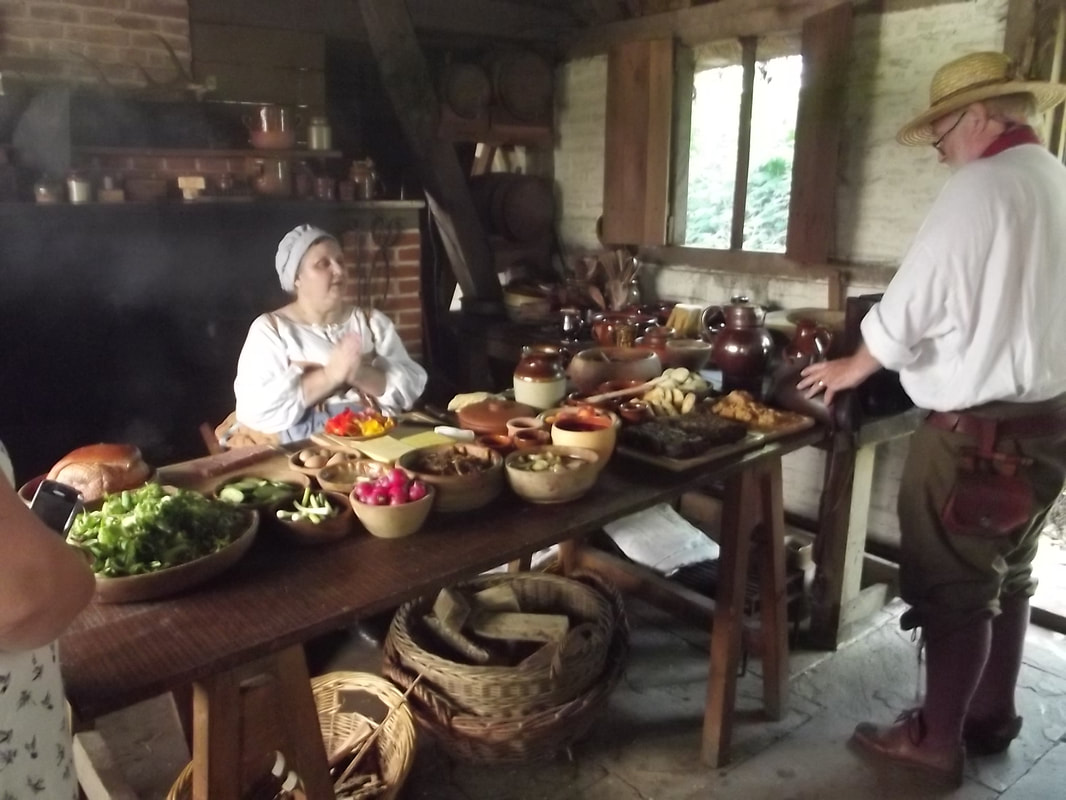
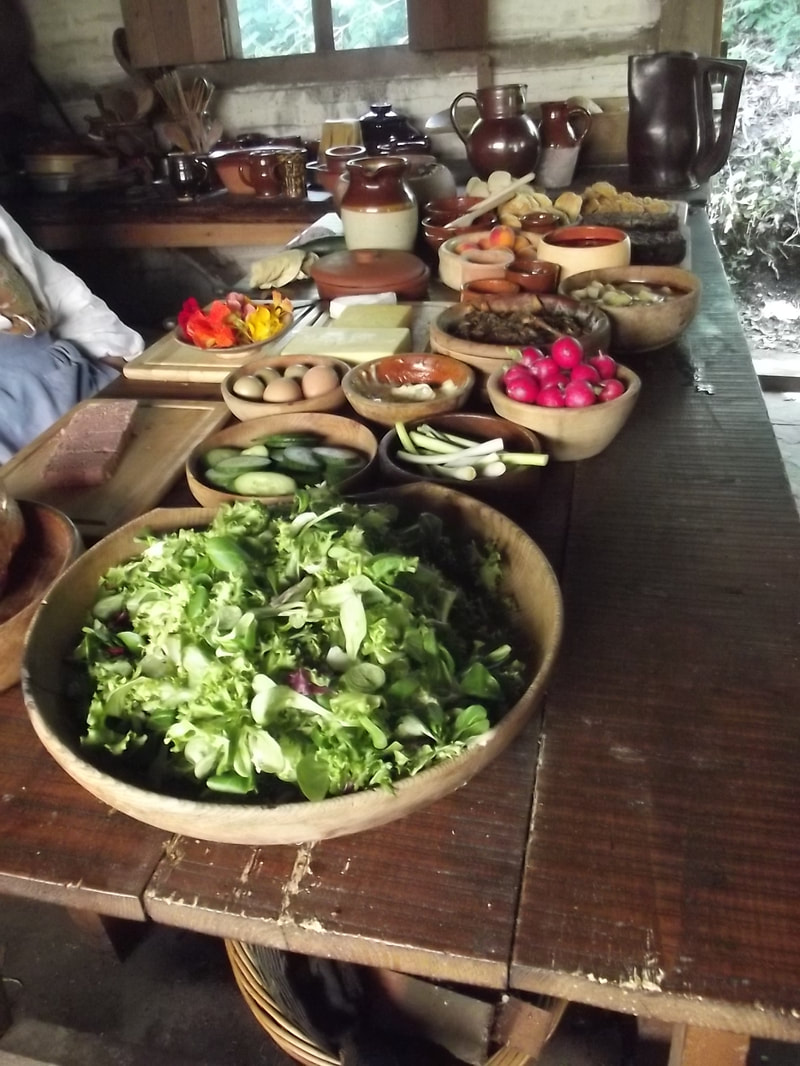
Originally started by the English Civil War Society in 1984, Little Woodham, a reconstruction of a small village from the 17th Century, was such a success that local volunteers created the Gosport Living History Society in order to keep the village developing as a local resource. Over time, from its early beginnings, more buildings have been built, showcasing a greater number of trades.

The village hosts school trips in the week, as well as families and individuals on selected weekends. It just happened that this past weekend it was open. I had visited several times previously, as a teacher and with family. Despite having lived in this area for well over twenty years, Melanie hadn’t, nor had local grandchildren, so, armed with 20th century camera, some small provisions and sufficient currency to effect an entry, we journeyed forth.

Getting there requires some local knowledge, or a sat-nav as the area around Little Woodham is in the process of being redeveloped, from very old naval quarters into a very modern estate. Surrounding Little Woodham on the other side is the newly designated Alver Valley nature reserve, reflecting how Gosport grew out of very small hamlets simply growing together, particularly with the growing naval and military connections.

Effectively, you have the hamlet with the temporary residents, each with their specific roles, in which they “hot seat” to ever changing groups of visitors. Some are more general in their roles, helping out where needed.

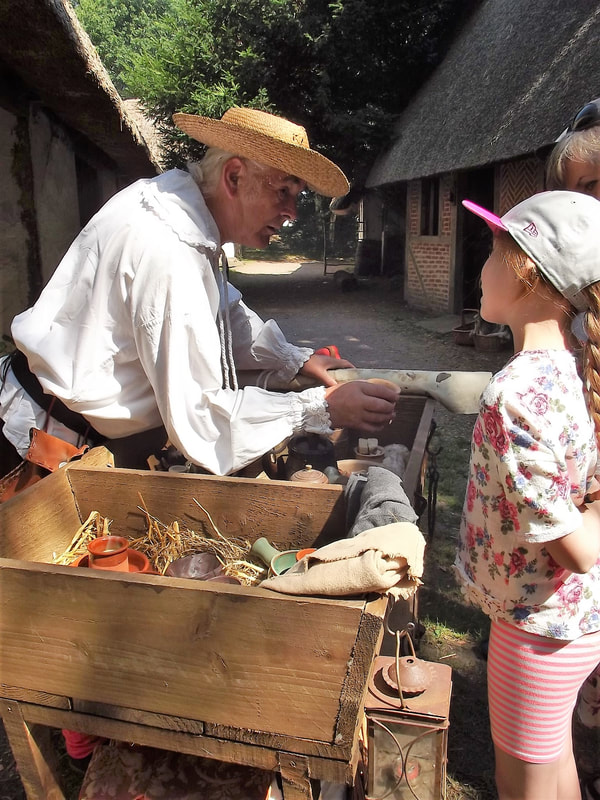
So we met the travelling salesman, with his barrow of goods, which he kindly showed in the hope of a “sale” to the passing public. In addition, he gave much insight into some of the products; crushed plantain mixed with olive oil and beeswax to make an ointment/skin balm or oak galls steeped in water, mixed with ferrous sulphate, or some other iron based liquid (eg leave nails to rust in water, use the water and gum arabic. He pointed us in the direction of the producers and users of his products.

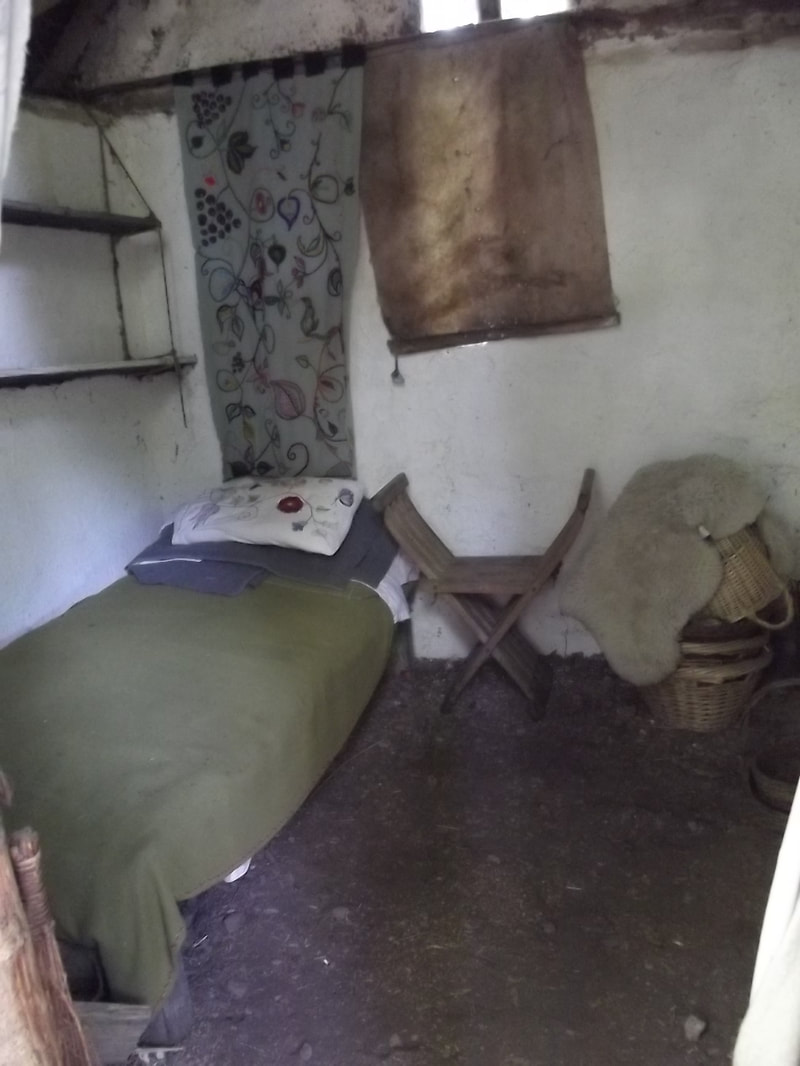
The Phoenix Tavern is a rebuilt version of an earlier building that burned down. The female proprietor was a mine of information about the food and drink available, as well as the formalities of hospitality; discovered a new word “palliasse”, a straw mattress. For children to understand something as simple as where and how people slept is significant.

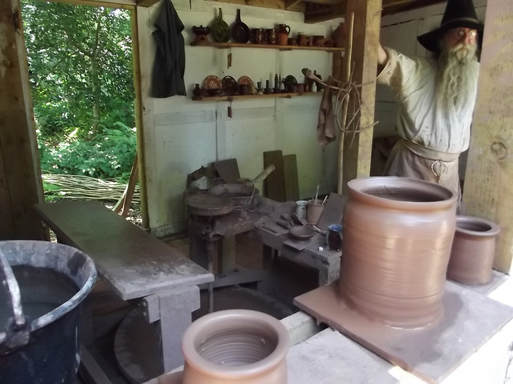
Spinning, dyeing and weaving were demonstrated, as was calligraphy, the apothecary’s shop, some eye-popping sleight of hand, simple knitting, woodcraft, pottery and bodging and the armourer encouraged some participation to feel the weight of swords and helmets.

The woodsman brought out his tinder box, made by the travelling tinker, to house the flint and iron to strike a spark that could be used to catch some dry tinder alight. A couple of cut fingers later, a spark was created. On an earlier visit to Little Woodham, the woodsman told the story of the “square peg in a round hole”, the means of holding timber joints securely. While the lower part of the peg was rounded to facilitate entry into the hole, the top was left square to bite into the wood and hold tight.

Social history, shared in this way, can be a means of children entering into a study of history, by linking how they live now with an understanding of how people lived in the past.

Very young children have a limited compass against which to judge “before”, but they themselves have a story as do their parents and grandparents, perhaps great grandparents. By linking generations, “histories” can be explored back, in extreme cases up to 100 years. Creating an interest in the past means leaps in imagination. To make some parts more real, through visits, artefacts and different forms of images allows greater insights, against which less obvious elements can be explored.

History is all around, if you know how to “read” buildings and road or landscape names, or visit the local graveyard. When I was a HT, the discovery of a WW1 role of honour board led to a visit to the graveyard opposite the school, finding some of the graves and tacking down the local families that still lived in the village. A parcel of photographs, a family’s genealogy and recalled stories added to the sum of available knowledge. Personal genealogies followed and many interesting stories emerged.

If you’re in, or near, southern Hampshire, check out the website. A day out for a family (of five) costs £16, which, after a four hour visit, felt like excellent value and it did what it said on the title; living history.

Schools need to book visits.
Picture
0 Comments

Messing About on the River

30/6/2017

0 Comments

 
Picture
With original words by Tony Hatch, Messing about on the River was a song on weekend children’s radio in the early 1960s.

As a child growing up in Brisbane, Qld, and Torbay, boats were a regular feature of life. Being in or on the water was a particular pleasure of growing up, with one darker incident, when a friend and I were the last people to see a boat loaded with six men and several sacks of cockles, with so little draught that while we were still out rowing, the police launch drew alongside and asked us if we’d seen them, as they hadn’t got back as planned. They had shipped water and all six had drowned when their boots, filled with water, had acted as anchors. It led to my first and only appearance in a Coroner’s court.

A tweet today talking of the oral tradition and nursery rhymes, reminded me of an earlier blog, but also made me think a little further about examples from my teaching.

As a teacher of a year 3 class around 1984, the topic choice was water, which provided the science, with exploration of floating and sinking, density exploration, evaporation and the water cycle, especially on showery days, siphons and pumps. Rafts enabled exploration of area and volume, linking science and maths. Rivers underpinned the geography, a visit to the Victory for some history and, for a short period, the song was the basis for dictionary and reference book research.

In the days before mass internet availability, the use of non-fiction books, using the contents and index to seek out information that could then become a general class resource, eg within displays was a common feature. Any parent who was associated with the navy, Royal or merchant, or a sailor or boater might be asked to visit to provide a personal talk.

Occasionally, this developed into an “alphabet of…” whatever was the current topic, creating a glossary of useful terms.

The song gave the focus, with specific words being identified as worthy of exploration. Ultimately, the activity also developed in-class thesaurus-style collections of associated words. By becoming the active explorers, children then often went home and found out more for themselves. The song became the vehicle for broader language development, but also, by being learned by heart for a performance in their assembly, helped with memory.

Oracy is a current buzz word. Like many others, it seems to mean different things to different people. To me, it means giving children something of quality to talk about, in small or larger groups, with the purpose of finding a solution to a problem, or working out how they will tackle a challenge. It’s rarely as formal as a debate, but might become such in specific circumstances. The confidence to interact with peers, to me, is more important than performance to a wider audience, as that’s how we live. Few of us have a soap box upon which to stand or a lectern to hide behind.

Learning to interact verbally is a life skill. A language rich environment encourages that.
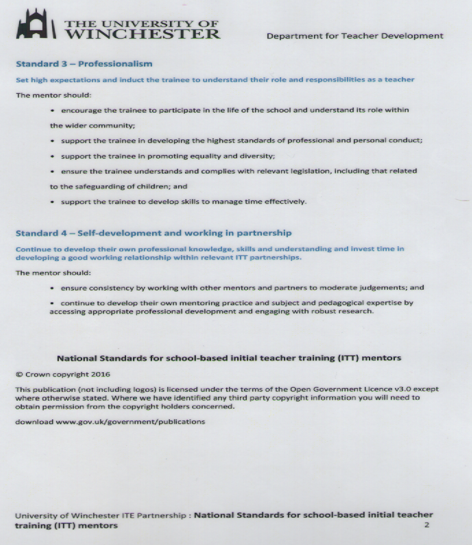
​
For those of you who don’t know the song, here’s a link. I'm hoping to resurrect my interest in the water and water activities when retirement beckons... who knows, I may even be tempted to accompany this with singing! 
When the weather is fine then you know it's a sign
For messing about on the river.
If you take my advice there's nothing so nice
As messing about on the river.
There are long boats and short boats and all kinds of craft,
And cruisers and keel boats and some with no draught.
So take off your coat and hop in a boat
Go messing about on the river.

There are boats made from kits that reach you in bits
For messing about on the river.
Or you might want to skull in a glass-fibred hull.
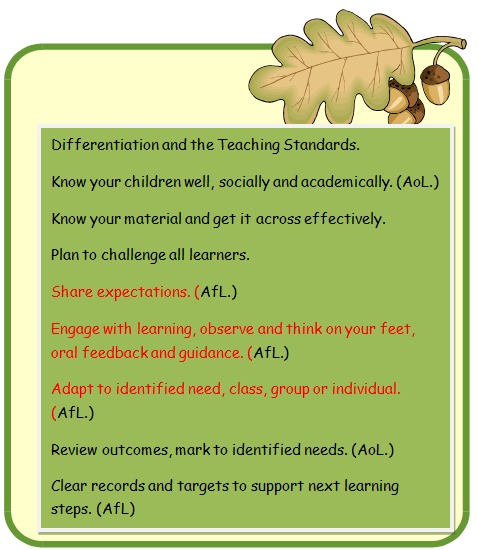
Just messing about on the river.
There are tillers and rudders and anchors and cleats,
And ropes that are sometimes referred to as sheets.
With the wind in your face there's no finer place,
Than messing about on the river.

There are skippers and mates and rowing club eights
Just messing about on the river.
There are pontoons and trots and all sorts of knots
For messing about on the river.
With inboards and outboards and dinghies you sail.
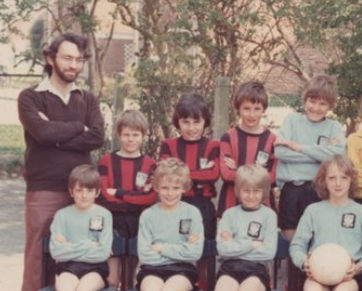
The first thing you learn is the right way to bail.

In a one-seat canoe you're the skipper and crew,
Just messing about on the river.

There are bridges and locks and moorings and docks
When messing about on the river.
There's a whirlpool and weir that you mustn't go near
When messing about on the river.
There are backwater places all hidden from view,
And quaint little islands just awaiting for you.
So I'll leave you right now to cast off your bow,
Go messing about on the river.

0 Comments

Quality, a Long and Winding Road...

28/6/2017

0 Comments

 
Picture
If you type the word quality into the search box on my blog site, you’ll come up with ten pages of blog references where the word has appeared. Quality is the hallmark of (high quality) education. It is, in my opinion, the essence of what teachers try to do each and every day; raising the quality of what children achieve.

This means, of course, that each and every day, teachers are making qualitative judgements about what their children achieve. With experience, teachers begin to calibrate their judgements more finely, as they have seen a greater number of outcomes. This fine judgement enables more refined responses to the individual concerned. In many ways, it is the qualitative judgement that informs formative assessment; aka thinking about what the children have achieved and deciding what that means for the next course of action.

Therefore, to me, improving the quality of teacher judgement has always seemed to be central to CPD, or PPD, as it often affects individuals.

We have a relatively young teacher force. Primary NQTs entering the profession in September, will have had between 100 and 150 days of direct in-school experience. This will have been across two key stages, with a gradual build-up of experience in each, in a school context supportive of trainees and with a direct mentor available. As a trainer, I always emphasise moderation activities, to promote professional dialogue about processes and the output.

Whether we like it or not, stratification of children happens; teachers and peers know who is the “best” reader, writer, mathematician, gymnast… They also probably know the opposite. The difficulties can occur when fine-tuned judgements are needed, especially where direct teacher intervention may be needed. And, in many ways this is what concerns me, especially where so much attention is placed on summative judgements and the ensuing data crunching.

There are simple questions that aid calibration of judgement; is this “good enough” for a year x child? Is it better than “good”? If it isn’t good enough, what needs to be addressed? What are the implications for the next teaching session, with a range of outcomes from this one?

Unless the activity devised by the teacher is a “copyist” one, where every child will produce an almost carbon copy of a teacher model, there will be a range of outcomes. Even if every child in a class is “above average”, as can occasionally occur, there will still be a range. Moderating discussion of outcomes is comparative, with embedded criteria being identified as evident or not.

Not that long ago there was a system of levels as a national judgement, used by every school to describe the stratification of outcomes. That these levels were used to give feedback on children’s developing work was inevitable, but over time, from the start in 1987, the move from using the descriptors to the numerical forms distorted their use and utility. We still have a form of descriptors within the year-based approach to the current National Curriculum, with a number of tracking systems ticking off coverage (at least what they’ve planned) and hoping that summative evidence will enable sufficient numbers of children to be described as “at (or above) standard”. In some case, you can’t be “above standard” until term three of the year, as you haven’t covered everything.
​
And then you end up with this: the set of descriptors that are used to stratify children at the end of the key stage. How helpful is this to further progress, or to identify what needs to be tackled next? It is no use to child, teacher or parent. Ten ways to say you’re not “at standard”. In other words, a waste of teacher (and system) time.
​
Picture
Tom’s tweet elicited a long conversation, during which most people expressed exasperation at the current system and a number questioned whether we would have been better off retaining levels. This led to James Pembroke posting a slide from one of his talks; James is a regular speaker at Beyond Levels conferences.
Picture

I look at this slide through the eyes of one who was a class-teacher in 1987 when levels were introduced as part of the National Curriculum. They were developed through the work of the Task Group on Assessment and Testing; TGAT, using the available expertise. (blogged about that here) In the context of broad, balanced and very relevant curriculum developments, they were only ever seen as guidance descriptors, to help with teacher judgement, highlighted through moderation activities, a novelty for some. They did move teacher expectations at the end of year 2 to 80% plus achieving a generalised level 2 or better and, in year 6 to level 4 or better. The descriptors described general capability. They enabled standards to rise over a relatively short period.

Today, we have yearness instead of levelness, and in the context of year-based outcomes, I would argue that the statements in James’ slide hold as much for the present as for the recent past, but with the added disadvantage that no-one knows what any of the statements really means. Outcomes are still largely best fit, and gaps can still occur and they certainly don’t tell us the detail that will help future teachers to build on prior learning in detail. If you set a pass mark at 75, with a range of outcomes, there’s not really much difference between 73 and 77, probably decided by qualitative teacher judgement, but is between 60, 75 and 90. It’s the same set of problems. We just think we’re cleverer in having a novel way of describing difference. Numbers don’t describe what a child can and cannot do.
​
This is one of the reasons why, with my school, we developed an approach to writing that allowed individualised progress and feeding forward of needs, so that they could not be forgotten by either the child or the teacher in the busyness of learning.


Picture

Many regular readers will recognise this approach and will have read the associated blogs, but, for those who may not, here are the links.


All writing in one exercise book?
Writing process; tweak your books
Exercise books as personal organisers?


If the development process is sufficiently high profile, then the outcomes improve over time, creating new baselines of expectation, resulting in greater challenge in contexts, associated vocabulary and child motivation, as teachers recognise and identify the progress being made; a self-fulfilling approach.
​

Process and Product can = quality
Quality; a work in progress

​For interest, you might like to see what TGAT originally said about the place of assessment (30 years ago) ...

Clear acceptance that the aim is to support and enhance the professional skills that teachers already deploy to promote learning.
Clear recognition that the focus of responsibility for operation of a new system lies with teachers within schools.
Stress on the formative aims and on giving clear guidance about progress to pupils and to their parents.
Widespread consultation and discussion before proposals are put into effect.
A realistic time-scale for phasing in a new system.
Adequate resources, including in-service provision.
Help with moderation procedures so that the system contributes to communication within schools, between schools, parents and governors, and to the community as a whole about the realisation and evaluation of the aims of schools.
Sensitive handling of any requirements for outside reporting, recognising that simplistic procedures could mislead parents, damage schools, and impair relations between teachers and their pupils.
0 Comments

Workload Thoughts

21/6/2017

0 Comments


Workload issues have been there throughout my working career in teaching, from 1971, and, from tales told at that time, was ever thus. My earlier thoughts were captured in this blog.

It has always struck me that workload becomes an issue when the status quo is shifted, by an initiative that can be presented by any layer of responsibility, but when it’s from Government, it is then interpreted by leaders at LA or Academy level, before dissemination and further adaptation within each school. At this point, teachers, who are “delivering” what has been required, are then expected to get their heads around the new approach, continue with the old before implementing the new, the implication being that up until then they had been doing something inefficiently.

Having been party to every incarnation of the National Curriculum, from 1987, the 2014 approach was, by far the most radical, requiring significant alteration to approaches, while also embedding changes in wider approaches, such as SEND legislation, GCSE and A level exam systems. It is not surprising that teachers are complaining about workload, especially if systems are in constant flux. Education requires a significant level of consistency, so that everyone knows what they are doing.

One area that will never be removed from a teacher workload is thinking about learning. In many ways, the key issue with teaching is that it can be very hard to switch off, and, with teachers being their own personal critics, sometimes the thinking needs to be identified by others, in order for the teacher to talk through their concerns. There will be variability of need from early career novices through to experienced colleagues taking on extended responsibilities. That experienced colleagues need to support, guide and mentor younger teachers is to the common good. If a novice quickly becomes effective, it reduces the team demand.

After one Ofsted, I sat with my staff and talked in detail about workload, in order to strip out unnecessary duplication and to refine the need to write things down, particularly in the short term, where reflective and responsive teaching was particularly needed. It took a little while to come to overall, effective decisions, but, in the end, it had an impact on every element of the teachers’ lives, and built in a form of PPA time well before it was a requirement.

I can’t help being someone who prefers order and organisation and overall planning. It has always seemed to me that good overview plans allow for appropriate or necessary diversions along the way, which are in response to evident needs. Running an effective school requires an organisation that is well known and a common thread for every teacher, but, I am a firm believer in seeking to release the talents of each individual teacher for the benefit of the whole team.

We drew up a holistic framework that sought to describe the detail of what the school was about in terms of organising for learning. This was an overview that could be easily understood by a wide range of people. As a Head, it was important, for me, to know that we had approaches that ensured that what we had to cover was actually planned to be covered, in the available time.

Two diagrams articulate the general thrust of thinking, at different points.
Picture
Picture

Every subject area had developed a range of support materials that we called topic specifications. Some people are today calling them knowledge organisers. They were designed as start points for thinking, especially to support non-specialists and to ensure that every child received a broad, balanced, relevant and engaging curriculum. Each articulated the available school resources and suggested challenges that were appropriate to the appropriate year groups. They were revisited every two years with County inspector support, so that they were up to date and each subject manager had personal CPD from their subject lead.

​
We organised what we called an annual plan, for each year group, to be worked on during a July closure day, in preparation for the coming September. This meant that 1) teachers knew what they were going to do in the first few weeks and 2) I knew what was intended across each year in July. It also saved teachers some valuable holiday time.
​
Picture
In addition, we also built in a two week, return to school, topic, completely down to teacher choice, in order to get to know their new children and to embed expectations. On the Friday of the second week back, we held a closure, where, in addition to early year needs, a proportion of the day was given to planning in detail the next few weeks of learning. Again, this allowed teachers to, perhaps, think about their plans during the holiday, but removed the need for them to write everything down in detail for me.

I asked for two layers of planning, the annual plan and the term overview. This was to support supply cover, should it be necessary.

Short term plans were seen as aides memoire for the teachers. We provided hard back, A4, note books, within which teachers would keep whatever notes that they needed, available to need if queries were raised about teaching, but the format was not prescribed, so that teachers could note whatever they didn’t want to forget!
​
However, we did create a format that could be used by student teachers within the school, which was available to any staff who wished to record their lessons formally, or, on one occasion, where significant questions were raised about capability.
Many teachers created a form of medium term, weekly or fortnightly planning, to emphasise the dynamics of learning.
​
Picture
Planning articulated the expectations of, say, writing forms, and the specifics that would be embedded in a good outcome, eg, a letter, where to put the address(es) and date, the start formalities and the appropriate endings. The contents would be the subject of discussion and modelling, with writing frames developed to support some needs and emphasise personal organisational challenges. The two page approach to writing development provided further support.
The specific needs of individual children, in writing, were articulated on flip sheets. These were available to children and any adults engaging with their learning support. So, if, for example, a child needed to select adjectives or adverbs more carefully, this would become a topic for discussion when engaging with the developing outcomes. The flip sheets also became de facto records of challenge and achievement across the year, summarised in reports/data. They certainly focused teachers' minds on their marking, which became much clearer.
Picture
Picture
By adopting a colour coded reading scheme, the embedded reading ages associated with the colours gave some indication of the movement in a child’s reading ability, with qualitative evidence from regular monitoring of reading, through either individual or group reading activity.
​
Picture


Recording evidence, as we did, also provided evidence for the specific needs of individual children, especially where they were greater than that of their peers. The following crib sheet was not in use, as it was developed in line with 2014 legislation, but the framework certainly was evident in practice, supported by a very active SENCo. 
​
Picture
Integrated systems ensured that the widest possible safety net was cast, to ensure teachers could teach and provide meaningful challenges to children’s learning. We were lucky to be able to appoint semi-specialist TAs who supported Science and DT, Art and PE, providing opportunities for smaller supported group activities, in addition to more generalist classroom support. Teachers were expected to take those groups with particular learning needs, with the TA overseeing other group needs. Outcomes provided evidence for discussion and modelling. Unpicking process improvements was as important as evaluating the outcomes, with reflection providing the impetus to subsequent challenges.

Engagement with parents had a number of elements. A September “meet the teacher” evening allowed teachers to share the year outline and talk about reading and other homework likely to appear. Teachers prepared a half year bullet-point report, that effectively became an agenda for a short discussion, with parents able to add an item if they wished. At the year end, the teachers wrote a personal report, appended to a child overview report of their year, with specific achievements and continuing needs. Teachers saw parents on request, after this report. Staff meetings were not planned for this period, to accommodate need.

My advice to any school wishing to tackle workload is to step back and look at every aspect of demand that can impact excessively on teacher time. Time spent on “busy work” is not necessarily productive and can impede the dynamics of learning or distract the teacher from thinking about their teaching in sufficient depth, so children’s progress in limited.

Where early career teachers are employed, there is a need for experienced colleagues to mentor and coach them into good habits, which is easier if the school has clearly articulated processes. There is also a need to provide personal development time, with a clear framework, so that wider reading and observation of, and talking with, colleagues adds to personal skills and knowledge.

Teachers work at multiple layers of need. A swirling mind, trying always to make sense of what is being asked eventually results in diminished outcomes. Creating time to think is an essential good; everyone benefits, especially the children and teachers can actually enjoy their teaching.
​
0 Comments

Assessment; Simply Rational Decision Making?

29/5/2017

0 Comments

 
Picture

​We spend our lives making assessments and then follow up with decisions that determine a course of action. Assessment, to some extent, is an evaluation of the available evidence that leads to action, either immediate or at some stage in the future. That the evidence may be the best available to us at the time, is often a determinant, especially if the need to decide is urgent. If time is available, then it is feasible to consider whether we have sufficient information, or if there are other sources of information that will broaden our considerations.

I’m soon heading on a road trip through France, then on into Spain, for the wedding of my step-daughter to her Spanish boyfriend. I am effectively the luggage van, taking wedding dresses and large suitcases, as well as baby paraphernalia for second step-daughter. DIY stuff will also be included for a working stop en route, in France.

 That is an overall plan, which I have considered in terms of the direction of travel, highlighting specific towns to head for, but also knowing that I will use the Sat Nav as my co-pilot, to prompt awareness of decisions that will need to be made in a near future. Even the best laid travel plans can be subject to alteration. There may be an occasional detour, with localised roadworks, or perhaps an earlier accident leading to a hold-up. To take account of these possibilities, I’ll add some time to what will ultimately be a ten hour drive, to allow for stopping, sleeping, refreshments and eating. I’m planning to arrive in Valencia to meet my wife, who’s flying in at lunchtime. If the weather is hot, my journey timings will change, to use the cool of evening and morning, perhaps choosing to stop to sleep, as I did on a previous trip, beside the Mediterranean. Not a bad way to enjoy a morning coffee!


Picture

Teaching’s like that, in that we have a journey on which to take a cohort of children. They will be known, to some extent, ahead of time, although the receiving teacher might have to recalibrate their prior expectations to tailor their responses to the new group. This applies to every teacher taking on a new class each September. It is especially important for a NQT, whose experience may yet be limited. However, in both cases, there are collegiate co-pilots, those who had the class before, whose insights are invaluable, but can also be subject to their own biases towards specific children, often on personality grounds.

The children come with a learning and achievement past. Records are shared, but, in the absence of descriptive information, data can mask both achievement and personal needs to cover “missing” bits from prior learning. I have to say that this has always been an issue. Specific personal needs have rarely been shared as effectively as they could, especially at transfer and transition, leaving receiving teachers to spend time reordering their thinking. Taking previous books into the new year, or at least copying a latter piece of good achievement, can provide an essential baseline for both the teacher and the child. To also have specific, personal needs highlighted as prompts for teacher and child focus ensures that “gaps” are at least identified and then capable of being addressed.

Learning is a continuous process. Why do we allow time breaks to become potential points for learning loss, which can be magnified in a change of school? There are many years of evidence of loss at years three and seven.

Where we had a system of levelness from 1987-2014, we now have the notion of yearness, described in terms of age related expectation, or ARE. Although some regularly argue that new assessment systems should not recreate levels systems, in many ways it could be an inevitability. Teachers are required to make judgements; there’s even a new kid on the block calling itself comparative judgement, which implies a level of judgement that allows comparison of two bits of work, taking me back to teaching before 1987.

Ordering classes according to whether they are coping with specific aspects of work, or who’s seemingly achieved and who needs additional help, has been a standard part of practice throughout my career. It’s how teachers think, at an organisational level. Dylan Wiliam now wishes that he’d called Assessment for Learning (AfL) reflective, responsive teaching. I just see it as essential teacher decision-making, as per this diagram.
​
Picture

It’s when we get to the level of personal needs that teachers cannot be expected to remember every child’s needs.
To address this, in my Primary school, we developed exercise books as personal organisers, with flip sheets that allowed teachers to create prompts for themselves and the children to ensure focus on specific potential gaps. The interaction of the teacher with the journeys of each child, is the key to progress for each. Keeping an eye on specifics within interesting contexts allows for regular use and application, allowing children to maintain themselves within the class, with personal targets within the context targets.


Picture

Engagement and feedback are essential.

The teacher acts as sub-editor on written outcomes, giving feedback on technicalities, but when faced with a finished piece of work becomes a reader, offering a critique to the writer, in an effort to improve structural quality. As a teacher, they also make quality assurance decisions that then impact on their subsequent actions. Teachers will always interact with children at the level of “experts”, whatever their level of subject expertise. Their feedback, whether verbal in-lesson or written, post-lesson is a part of the child and class learning process; a form of guided reflection.
How much self-evaluative thinking are children really involved in?  

An earlier blog looked at process and product evaluation as an essential aspect of progress. I’ve extracted a short piece.

We talk in terms of a thought process, not a thought product, but there can be a product of thought. So the act of thinking is a process, not an end in itself. The challenge to think around a problem, to analyse and make a judgement about how to proceed, to order and organise a coherent plan of action, to carry out the action with record keeping embedded, then to review and evaluate the process and the outcome, suggesting areas for re-assessment, are higher order thinking skills leading to potentially different outcomes . To give a group of children a “recipe” to be followed is a lower order set of skills, following instructions, leading to thirty exact copies. The former approach leads to questions such as “How do I….?” rather than “I can’t…..” These two responses suggest, in the first example, the need for a skill as identified by the independent learner, while the second can suggest a block and dependence.

Within these areas, are teachers and supporting adults the barriers to learning? It is very arguable that they may become so, often inadvertently, by designing inappropriate tasks that cover all the children, in so doing potentially limiting a number of learners and over-challenging others. The implications for classroom practice can be great, particularly in resource terms, cost, access and use. The first can be limited by the use of recycled materials, or no cost collections, such as newspapers, boxes and so on. Storage and access need to be overcome. Thirty children all needing the same materials at the same time will cause chaos, unless there is clear organisation for use and return. Resources across the curriculum need to be in the classroom, easily accessible and available to be selected by children in their need to solve a problem.

Support staff, often concerned that the children for whom they are responsible have to fulfil the task as set by the teacher can become actively involved, in the more extreme cases actually taking over from the child to finish the activity. This can be the case in an art activity, especially activities such as cards for a special occasion. Why can’t Teaching Assistants be deployed with groups to allow independent tasks to be undertaken with an overseer as observer?


I think issues arise with teacher tracking of children’s outcomes. I’d argue that the system above for Primary writing is, in itself a form of personalised tracking, of need, outcomes and feedback. Reading records, at Primary, are often based on an adult making contemporary notes from hearing readers, but can also be as simple as a personal bookmark, with books read being recorded (by children). Maths books could benefit from flip sheets of reminder prompts.

Extrapolating the tracking of essential information into data points, is the area that has caused the greatest concern, as multiple pieces of information are expected to be collated into a simplified decision, formerly something like level 4b, now it’s +/- ARE. That’s also where the issues are then often hidden, especially at year end transition, with receiving teachers making assumptions based on the available evidence.

As a teacher and as a driver, you cannot take your eye off the road, keeping a check on those around you, to avoid accidents. Occasionally a stop is needed, to take stock, relook at the map, possibly rejig the route, especially for some, or to refuel and replenish supplies.

Journeys are rarely as simple as A to B. Actually, a detour can provide unexpected highlights that add colour to the journey.

Motorway driving can be very boring; I’m taking what used to be called Route Nationale (RN), but which now is renamed Route Departmentale (RD). As long as my journey of forward, I’ll get there eventually, making decisions as I go.
0 Comments

Assessment; Unpicking the Past

22/5/2017

0 Comments

 
Picture
(as discussed on Twitter)
During a long day in London, yesterday, where I was enjoying some sightseeing before meeting my daughter to see my grandson take part in a Chance to Dance, the Royal Opera House charity opportunity for children in some London boroughs to receive some high quality dance tuition and experience.

As it was hot, I took advantage of occasional shade and, inevitably, wandered into Twitter. A regular feature is assessment. It has been so for several years, and, surprise, no-one’s cracked the definitive approach.

I think everyone agrees that it has something to do with interacting with learners and their different parts of their learning journey, although that is sometimes differently expressed, occasionally with polarised views; you could occasionally sell the ice…

SATs and testing generally, are seen by some as an essential good, while others see them as blunt instruments of child torture that make an overall judgement based on narrow areas and, if Twitter is to be believed, subject to significant moderator error across a major subject component, writing.

In discussing assessment, the demise of previous use of levels is welcomed by many (on Twitter), with possibly equal numbers (not on Twitter) wishing they were still available, at least as a form of descriptor guidelines. It is certainly frustrating that, in the thirty years since levels appeared in the 1987 National Curriculum, that the descriptive aspects became lost in the data scramble that characterised the latter 1990s.

Levels, to some, are almost described anti-knowledge. As a practitioner when they were introduced, they were a useful addition to the knowledge areas, to describe the child’s ability to use and apply their knowledge in more challenging tasks, with a degree of independence.

Yesterday’s conversation was with Clare Sealy @ClareSealy, Tim Roach @MrTRoach, Kate Aspin @etaknipsa and Juliet Green @s0f0nisba, with occasional interjections from others, including Daisy Christodoulou @daisychristo. It would be impossible and impractical to utilise all the tweets. Suffice to say that there was a level of disagreement and an occasional meeting of minds; probably as there would be if we were face to face.

Some of the discussion also reflects the different roles and sectors of the participants, which inevitably adds a particular slant to points raised. Current classroom teachers spend a great deal of time interacting with learners and their outcomes, as has always been the case. There will be variation between Primary and Secondary due to frequency of contact and closeness of relationships; it’s easier to get to know 30 children with 25 hours a week contact than 200+ only seen a few times a week. Kate Aspin and I are both involved in ITE, so see the need of developing teachers, whose training involves at least two school placements, where each school may have radically different systems to guide interaction with learning.

Anyone reading my blog over the past few years, will know of my view that assessment is essentially what drives all teacher thinking, helping them with analysing the needs of the children in their class, planning effectively, delivering high quality lessons, with informed interactions, reflecting during and after the lesson, recording any necessary details to support their thinking. Assessment can be summarised as how well you know your children, from ongoing and summative activities.
​
A long conversation was generated by my tweet that proposed locality dialogue to agree standards, through guided moderation activity, which I think should be seen as staff development activity.
Picture
At some stage during this aspect of the conversation, Daisy joined and offered the following, which made me think back 30 years. There’s not a huge cohort of people who were actively teaching at that point in time, so the collective knowledge has been lost.
Picture
My thoughts, tweets, on what teaching was like in 1986/7 is bullet pointed.

·         1987 reminisces. 85-87 National Writing Project improved process and outcomes. NC provided descriptors that enhanced collective dialogue.
·         1986 NC gave a language of notional progression that enhanced colleague dialogue. Previously was much less specific.
·         The National Writing Project instituted the idea of dialogue between children and teachers, to establish quality and tentative next steps.
·         Expectations rose, with greater clarity, so transition with l4 more than "good 3". Government exemplars also helped understanding.
·         Local Advisors and inspectors worked to common agenda, so widespread sharing in local networks. Sharing outcomes included process discussion
·         Strategies and APP distracted and distorted dialogue to minimalist progression; assuming learners would draw elements together. Skill loss.
·         Holistic processes, well modelled, together with informed interaction and intervention is needed, then you have quality outcomes to judge
·         Loss of common language reduces understanding and confidence in decisions; TS 2 drives 6&5, fine tuning to evident need.
·         So teachers revert to activities, rather than developing learning journeys. APP style tracking makes this worse.
 
There were a number of organisational differences in 1987.

Class sizes were bigger, TAs didn’t exist and technology was very simple. Timetables, apart from PE and music (timetabled in the hall), were very much in the teacher’s hands, which meant that flexibility could be built into challenges, with writing tasks taking whole mornings, practical science investigations being developed over a week, or in the case of a need for an extra ten minutes to complete a task, children “bridging” playtimes and carrying on for a while, with transition to the next lesson delayed. “Quality First” meant quality outcomes ahead of time-limited activities, which can be more of a feature in a rigidly timetabled system. Activities are then designed to fit the available time; what can you really expect in the 20-30 minutes available?

Staff talking together and moderating outcomes began to use the common language, which enhanced their expectations and so outcome quality rose. Process enhancement from planning, through drafting, to evaluation of outcomes, led to further raising achievement.

Creating real audiences for outcomes, through open area displays and class books, created motivation and pride in presentation. So it became a case of create quality, share quality, unpick quality (enhance qualities of the writing), publish quality, so that children wanted to do more.

With the current situation with assessment being somewhat fluid, it can be very difficult for trainees and providers to give a clear overall picture of what they might encounter in schools. This year, School Direct trainees have encountered a different system in each of their placement schools, which adds to their performance concerns.
 
·         Consider the need of developing teachers. Insecurity can lead to added workload, checking and double-checking. Mentoring essential.

·         In a group of nine mentors, had seven different systems. New school experience, new system...

·         Think the need to spend a bit of quality time talking together in locality could be seen as de facto CPD. Guided self-help groups?
​
Picture

I would like to see exemplar portfolios, locality and national, discussed with expert guidance, to share the thinking of an experienced colleague as they unpick the positive elements and learning needs being shown. This was a part of the original National Curriculum. Exemplar booklets, drawn from a wider area than our locality, showed what was being achieved elsewhere. This knowledge added to our local challenges.

Mentors need the confidence to be able to demonstrate what an acceptable standard of outcome is and what would be an aspirational outcome, so that the trainee had insights that supported learner journeys. In some ways, despite the availability of easy linking, through the internet, many schools are, like in 1987, little islands, which would be fine if they achieve highly, but could be disastrous for the children and their teachers if they do not have an idea of how high they could aspire; consider the needs of geographically disadvantaged schools.

The journey;
·         the thinking processes in response to challenges; the development of a toolkit of ideas and words, within a knowledge rich environment; the ability and time to draft and alter ideas, forever seeking self-improvement through guidance and coaching dialogue; making the learner at least part-owner of their journey,
·         takes time, reflection, high quality interaction and guidance, occasional detours for enhancement, but is always under the watchful eye of the teacher, who acts as overseer, quality control, guide and counsellor,
·         building up progressive baselines of quality against which the next outcome can be compared.  
In the “old days”, it was common practice, before levels, just to flick back in a child’s book to compare their current work with a previous piece. This was a simple mechanism to show them their own progress or that their output had declined.

From 1987, level descriptors and the National Writing Project approaches came together in a simple use of an exercise book, as many of you will have seen, but which might be of interest to new readers (see links below). It also gave rise to the use of one book for all writing, in whatever subject, to maintain a focus on the writing, for example, writing a science report, a trip account, how to play a sport, how a piece of art/DT was created, were all seen as report writing, so became the main focus for that week. Storyboarding and scaffolding aided first drafts, with interaction between drafts. Writing went across all subjects. Flip out sheets became prompts for in-lesson dialogue and evaluation. they were also a focus for detailed marking.

It wasn’t at all a bad approach. The outcomes in the last SATs of my headship gave us 90% level 4 and above writing scores. In a class of thirty, one child (3.3%) had come from Zimbabwe with limited English in year 6, but got a level 3a, with the other two achieving the same.

For children at that time, 2005, transition to Secondary was positive, as they enjoyed their learning and had some credit for their achievement, so did not have the stigma that can be attached to the current nomenclature “not at Age Related Expectation”. Implied failure, at any age, will be demotivating. On a long journey, you need encouragement to keep going, not a message to say that you’re not doing well enough.  

Children need a language that allows them to clearly understand where they are in their journey, what they need to do next, and, more importantly, how they can achieve this; a stepped explanation and exemplification that is easy to access and use.

Teaching today can sometimes appear too full of jargon, to the detriment of learner progress. We need assessment language in child terms. If there’s a need to interpret this to data speak, that is a teacher level role.
​
After all, it’s all based on assessment; refined/agreed judgements, leading to quality challenge in tasks, not small scale busy work...

Remember 24652=refinement.
Picture
Selection of English blogs
Draft-check-improve/redraft
National writing project; revival time?
All writing in one exercise book?
Writing process; tweak your books
Exercise books as personal organisers?
Selection of assessment blogs
Assessment WITH CHILDREN IN MIND
​Assessment with Trainees and NQTs in mind
Assessing capability
Frames of Reference=FORmative assessment
Assessment=value Judgements
0 Comments
<<Previous
Forward>>

    Chris Chivers

    Long career in education, classroom and leadership; always a learner.
    University tutor and education consultant; Teaching and Learning, Inclusion and parent partnership.
    Francophile, gardener, sometime bodhran player.

    Archives

    March 2021
    January 2021
    July 2020
    June 2020
    May 2020
    April 2020
    March 2020
    September 2019
    June 2019
    May 2019
    April 2019
    March 2019
    February 2019
    January 2019
    December 2018
    November 2018
    October 2018
    September 2018
    August 2018
    July 2018
    June 2018
    May 2018
    April 2018
    March 2018
    February 2018
    January 2018
    December 2017
    November 2017
    October 2017
    September 2017
    August 2017
    July 2017
    June 2017
    May 2017
    April 2017
    March 2017
    February 2017
    January 2017
    December 2016
    November 2016
    October 2016
    September 2016
    August 2016
    July 2016
    June 2016
    May 2016
    April 2016
    March 2016
    February 2016
    January 2016
    December 2015
    November 2015
    October 2015
    September 2015
    August 2015
    July 2015
    June 2015
    May 2015
    April 2015
    March 2015
    February 2015
    January 2015
    December 2014
    November 2014
    October 2014

    Categories

    All
    Assessment
    Behaviour
    Differentiation
    English
    Experience
    History
    Home Learning
    Inclusive Thinking
    Maths
    Parents
    Science
    SEND
    Sing And Strum
    Teaching And Learning

    RSS Feed

    Picture
    Click to set custom HTM L
Powered by Create your own unique website with customizable templates.