“Keep right on to the end of the road…”
“It’s a long way to Tipperary…”
Teaching is like walking along together, sometimes ahead, sometimes beside and sometimes behind, all the while encouraging strugglers. A good teacher/leader does this, having a chat with each, according to need.
The mantra should be “no-one left behind”, while seeking to ensure that the quicker ones get a good run out and don’t get frustrated and switch off or stop trying.
I am grateful to @oldandrewuk for prompting me to spend the morning reflecting on the idea of goal setting. There was a discussion about the nature of goal setting that suggested that goals have absolute qualities, therefore could be set as a standard.
As in much of life, the idea of goals is a slightly slippery beast, perhaps except in a game like football, where getting the ball in the net is counted as a goal. Of course, the build up to the goal could be simple or complex. It might be the aim of the game, but many games end up as equal, 0-0, 1-1 etc, where each team cancels the other, in a game of strategy. So the same applies to other games like chess, where some games end as stalemate.
I might aim for something, but life, in all its delights can just get in the way and mean that original plans have to be adjusted. That’s happened a number of times throughout my life, often quit dramatically, meaning that longer term plans had to be adjusted to the new reality.
I’m currently reading a book, given to me for my birthday, “The Hairy Hikers”, by a chap called David Le Vay, who tells the story of his trip along the Grande Randonee (GR10) from Hendaye, along the Pyrenees to Banyuls sur Mer. It’s a diary in reality, with each day presented as a single chapter. The two friends, in middle age, decide to set themselves a significant challenge, as a means of taking stock and time out. So they had a goal. In case you are wondering how significant the goal is, the GR10 statistics are (thanks to Trildino)
- Length of trail 866 km, 538 miles
- Length in days 58 days
- Start of trail Hendaye
- End of trail Banyuls-sur-Mer
- Traildino grading SW, Strenuous walk, mountain trail
- Hut tour grading T2, Mountain walk
Education can be seen as a series of goals. There is the overview aspirational goal, within which there will be set realistic personal goals. Some learners will need step by step guidance and support, whereas others quite quickly develop the skills of running ahead. The latter group may need some staging agreements; do this and then this if you finish, while I catch up with you and reset the goals.
While walking allows reference to landmarks, eg walk as far as the rock and wait, stop at the post box, the language of educational milestones can appear at times to be obscure, but they need to be known and mutually understood in order to prompt progress.
Goal setting allows the teacher to assess where each learner is in relation to the goal and to reset the goals realistically so that the learner can perceive the need and seek to address it.
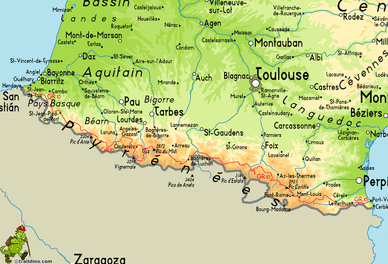
Like having a clear map, or sets of maps to undertake the different stages along a trail, educational progression needs a set of marker posts, which can be used to judge how far and how fast the learners are progressing. These for 26 years were called levels, alongside the National Curriculum (NC). The current NC has no levels, with schools having to devise a system to suit.
For many this will be based on the Programme of Study for each year group, so will be described in yearness stages. A child will be emerging into the stage, achieving as expected, or exceeding expectation. It is not yet clear to me how these will be graded, up to 30%=emerging, 31-79%=expected, 80%+=exceeding? Except that unless a child gets 100% can the ever be exceeding the requirements of the year?
Unlike the walkers along the GR10, children may not have the opportunity to go a little faster, especially if the teacher is slightly risk averse and keeps the group together “just to be safe”.
Whatever we end up with “beyond levels” will inevitably describe the step by step progress being made by learners. Whether these are presented as ladders, or maps, they will essentially mark the staging posts which can be used to challenge the learners and to judge whether they have achieved.
What’s the real risk in a classroom? Children can’t fall off an exercise book. They can, however, fall out of love with learning, if it is slow, tedious and frankly boring. A little like David and Rob on the GR10, when the walking got tough.
We don’t want learners to give up on learning.
It is their walk, after all, and they need to learn to do that independently.
For many this will be based on the Programme of Study for each year group, so will be described in yearness stages. A child will be emerging into the stage, achieving as expected, or exceeding expectation. It is not yet clear to me how these will be graded, up to 30%=emerging, 31-79%=expected, 80%+=exceeding? Except that unless a child gets 100% can the ever be exceeding the requirements of the year?
Unlike the walkers along the GR10, children may not have the opportunity to go a little faster, especially if the teacher is slightly risk averse and keeps the group together “just to be safe”.
Whatever we end up with “beyond levels” will inevitably describe the step by step progress being made by learners. Whether these are presented as ladders, or maps, they will essentially mark the staging posts which can be used to challenge the learners and to judge whether they have achieved.
What’s the real risk in a classroom? Children can’t fall off an exercise book. They can, however, fall out of love with learning, if it is slow, tedious and frankly boring. A little like David and Rob on the GR10, when the walking got tough.
We don’t want learners to give up on learning.
It is their walk, after all, and they need to learn to do that independently.
 RSS Feed